

Gestão
WhatsApp groups: where your company's strategy is born (and where it gets lost)
Discover how to transform the chaotic flow of messages and informal decisions in WhatsApp groups into strategic intelligence and structured data.
Zapper Team
·
·
12 min of reading

A critical decision about pricing is made at 10 PM on a Tuesday. A scope adjustment in a million-dollar project is defined with a simple "ok" in a quick conversation. A new approval process is communicated informally, and those who haven't seen the message are left behind. If these scenarios sound familiar, you know exactly where your company's true strategy is being discussed: in WhatsApp groups.
Agile, direct, and omnipresent, these groups have become the central nervous system of countless organizations. It is here that operations pulse, problems emerge, and solutions are improvised. However, this agility can come at a very high and silent cost. All this intelligence, all this history of decisions, and all organizational learning are born and die in the endless flow of messages.
What happens when this crucial information is not captured, structured, or governed? It gets lost. Important decisions become rumors, accountability dilutes, and the company becomes a hostage to a fragile collective memory that fades with each new member who joins or leaves the group.
This article is not about demonizing WhatsApp. It’s about recognizing its power and understanding that, to achieve true digital maturity, it is necessary to go beyond conversation. It’s time to transform this chaotic flow of unstructured data into actionable intelligence. It’s time to implement corporate WhatsApp governance that protects and enhances your business.
The Groups That Really Move the Company
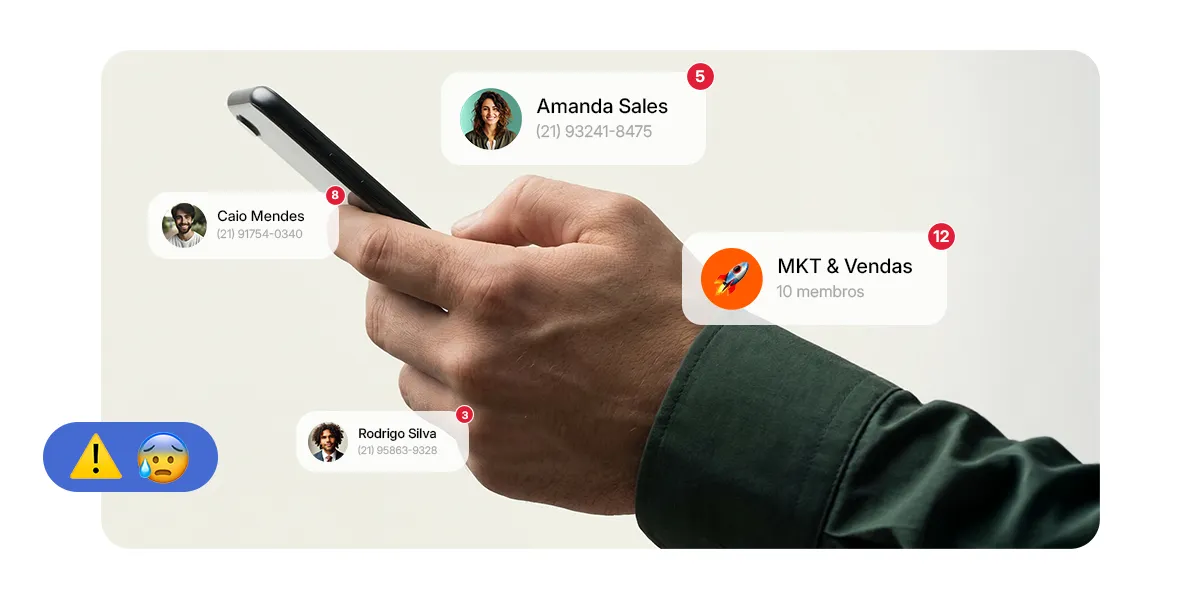
Forget for a moment the meeting minutes and formal emails. Where do things really happen? In the "Leadership Alignment" group, in the "Project Phoenix Squad", in the "Sales - Sales Team" or in the "Crisis - Launch Product X". Each of these corporate WhatsApp groups is a microcosm of the organization, reflecting its culture, its priorities, and, above all, its real processes.
Communication in these channels is instantaneous. A seller's question about a new discount policy is answered within seconds by a manager. A critical bug identified by the support team is escalated to the developers in real-time. This speed is addictive and undeniably efficient for solving specific problems. The groups function as informal decision-making centers, accelerating the pace of business in a way that no other tool has managed.
However, this informality is a double-edged sword. Although quick, informal corporate decisions lack traceability. Who exactly approved the change? What was the full context of that discussion? If a new member joins the team, how can they understand the history of decisions that shaped the current project? The answer is simple: they cannot. They rely on what others say, and the information degrades with each transmission.
The result is an operation that functions on the basis of trust and short-term memory. Internal communication management becomes reactive, and critical knowledge is stored on individuals’ cell phones, not in the company’s systems. When a key employee leaves the organization, they take with them months or even years of context, negotiations, and strategic decisions. The company suffers from a partial "amnesia", forced to rediscover solutions and repeat the same mistakes again.

The Problem Is Not WhatsApp. It’s the Absence of Governance
It’s tempting to blame the tool. Many leaders, frustrated with the disorganization, consider banning the use of WhatsApp for corporate purposes. This is a losing battle. The app is already deeply embedded in the global work culture because it is simple, effective, and universal. Trying to remove it is like trying to ban conversations in the hallway. The real issue is not the platform, but the lack of a structure surrounding it.
WhatsApp is merely a communication infrastructure. The real risk lies in structural informality, in the absence of a system that brings order to chaos. Without corporate WhatsApp governance, the company operates in the dark, exposed to a series of dangers:
Compliance Risks: Decisions affecting contracts, clients, or sensitive data (LGPD) are made without an auditable record. In the event of a legal dispute or audit, how can one prove what was agreed upon? The lack of compliance in digital channels can lead to severe fines and reputational damage.
Loss of Traceability: A misguided decision can lead to significant losses. Without decision traceability, it is nearly impossible to identify the root cause of a problem, learn from the error, and correct the process for the future.
Operational Inefficiency: The search for an old piece of information or approval becomes an archaeological treasure hunt, with hours of scrolling through endless conversations. This lost time multiplies throughout the team, undermining productivity.
Informal Decision-Making Culture: The absence of formal records encourages a culture where decisions are made impulsively or conveniently, without proper data analysis or strategic alignment.
Organizing WhatsApp groups in the company is not just about creating etiquette rules. It is about implementing a layer of control and visibility that transforms the channel from a risk liability into an intelligence asset.
Organizational Intelligence Hidden in the Flow of Messages
Amid the flow of memes, stickers, and everyday conversations, lies a goldmine of organizational intelligence. WhatsApp groups are the company’s seismographs, detecting operational and cultural tremors long before they show up in formal reports. Intelligence gleaned from corporate conversations is raw, honest, and immediate.
Simply observe carefully to notice the patterns:
Bottlenecks appear first there: The phrase "Guys, I’m stuck waiting for approval from finance" posted in a project group is the first sign of a bottleneck in the process. In a formal system, this alert might take days to be formalized. On WhatsApp, it’s instant. Monitoring corporate conversations allows you to identify these friction points in real-time.
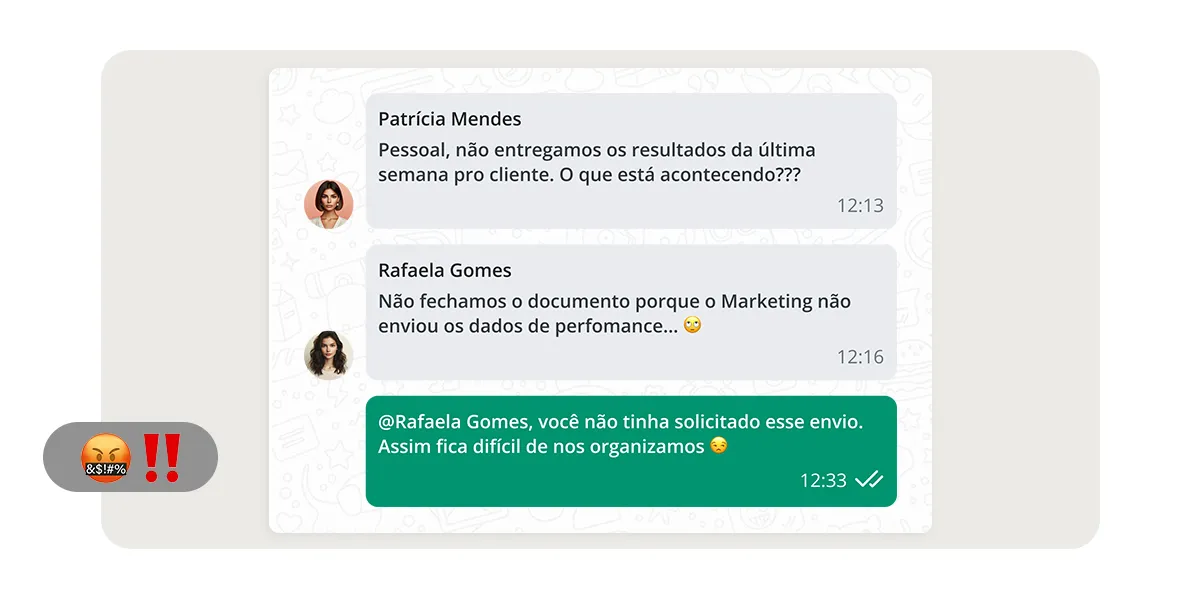
Tensions between areas become evident: The tone of messages, delays in responses between certain teams, or the exchange of veiled accusations in an interdepartmental group are clear indicators of misalignment or conflict. This analysis of corporate interactions reveals the health of internal relationships in a way that no climate survey can capture.
Real priorities are revealed: Notice which topics generate immediate engagement and which are ignored. A request from the CEO may be responded to in seconds, while a request regarding an internal compliance process may go unanswered for hours. This shows what the team practically considers urgent and important, regardless of what is written in the strategic planning.
Improvised processes are exposed: Questions like "What’s the link to open a ticket?" or "Does anyone have the client presentation template?" reveal gaps in documentation and training. Each one of these questions is a piece of data pointing to an opportunity for process improvement, a chance for structuring information that gets lost in the flow of conversation.
All this intelligence is there. The challenge is that it exists in the form of unstructured data, trapped in a format that does not allow for analysis, aggregation, or systematic action.
Unstructured Conversation Does Not Turn into Learning
All this wealth of information, all these vital signs of the operation, are lost because conversation, by its nature, is ephemeral and disorganized. The company generates a colossal volume of conversational data every day, but this raw material is never refined to become knowledge. The consequence is a vicious cycle of inefficiency.
The reason is simple: unstructured conversation...
Does not turn into metrics: How do you measure the "Average Resolution Time of a Problem" if the problem and the solution are scattered over 50 messages exchanged over three days? It’s impossible. Without metrics, there’s no way to manage or improve.
Does not become a standard: An analyst on a team discovers a brilliant way to solve a recurring problem and shares it in the group. The solution works, everyone celebrates, and the conversation continues. Six months later, a new analyst faces the same problem. The original solution is buried in thousands of messages and no one remembers it. Knowledge was not standardized and the wheel is reinvented.
Does not generate actionable insight: Several sellers in different groups mention that clients are complaining about the same product defect. Each mention is an isolated event. Without a system to aggregate this data, the company never sees the pattern and misses the chance to identify a critical product issue before it becomes a crisis.
Does not create a structured history: Finding a specific decision about a project budget approved a year ago is a Herculean task. There’s no way to search for "decision", "budget", or "approved" effectively. The searchable message history is a distant dream, and auditing becomes a nightmare.
This reality can be summed up in a harsh but true phrase: The company talks a lot, but learns little. Constant dialogue creates the illusion of alignment and progress, but without the structuring of conversational data, the organization remains trapped in a state of chronic amnesia, unable to evolve based on its own experiences.
What Digital Maturity Means in This Context
Many associate digital maturity with adopting cutting-edge software or automating tasks. Although this is part of the equation, true corporate digital maturity is deeper. It is the ability of an organization to transform data – all types of data – into intelligence to make better and faster decisions.
In the context of internal communication, digital maturity manifests when the company stops being a victim of informational chaos and becomes the master of it. This means going beyond simply using messaging tools and starting to govern them strategically. Achieving this level involves five fundamental pillars:
Structuring conversational data: This is the technical capability to extract relevant information from a free text flow and transform it into organized fields. For example, a message like "Budget of R$5,000 approved for the marketing campaign. @Carlos is responsible, final deadline Friday" is converted into data: {Decision: Approved}, {Topic: Budget}, {Value: 5000}, {Project: Marketing Campaign}, {Responsible: Carlos}, {Deadline: Date}.
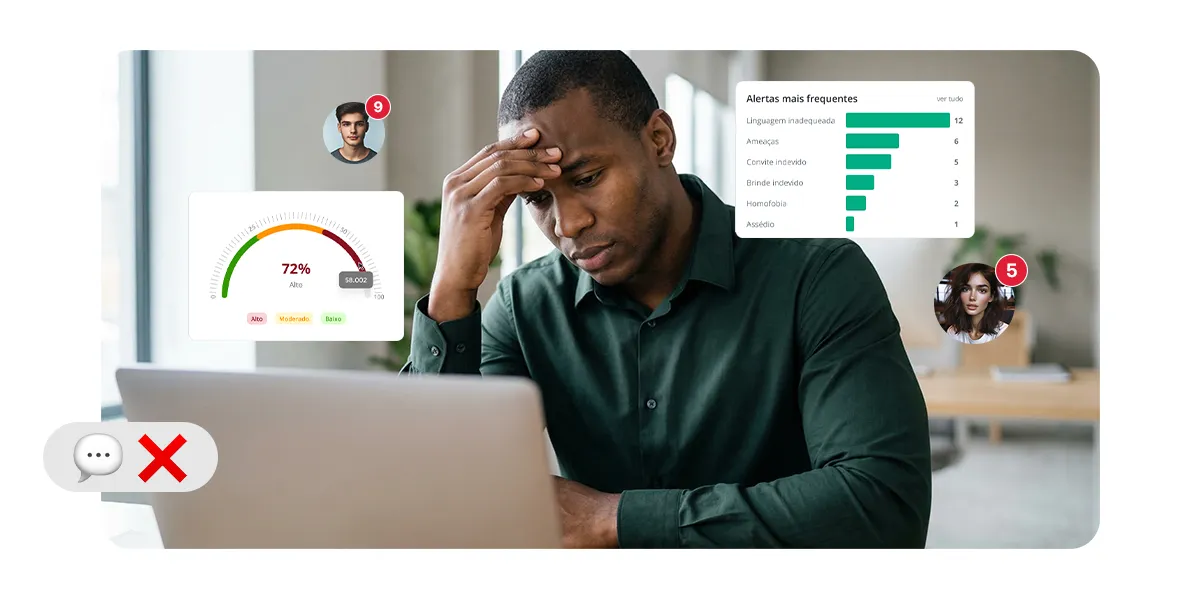
Monitoring interactions: This is not about spying on employees, but about having operational visibility. It involves setting up alerts for keywords ("critical problem", "unsatisfied client"), analyzing the sentiment of conversations, and understanding the main themes discussed, all in an aggregated and anonymous way to identify trends.
Traceability: Every decision, task, or important information must have a clear and immutable audit trail. It should be possible, with just a few clicks, to trace any information back to its originating message, knowing who said it, when, and in what context.
Conversation-based reporting: The transformation of conversation into data allows for the creation of dashboards and reports that were once unthinkable. How many times was the word "delay" mentioned this month? Which team discusses "bugs" the most? What is the average time between the mention of a problem and the assignment of responsibility?
Transforming text into structured data: This is the technological engine that drives the other four pillars. It uses natural language processing (NLP) and artificial intelligence to read, understand, and categorize the content of messages, creating a structured message history that can be analyzed.
A digitally mature company does not shy away from informal conversations. On the contrary, it embraces them and installs a layer of intelligence over them to ensure no valuable information is lost.
While the Group Is Conversation, Zapper Is Intelligence
Recognizing the problem is the first step. The second is adopting a solution that brings governance without destroying the agility that makes WhatsApp such a powerful tool. This is exactly where Zapper comes in, not as a replacement, but as a strategic layer that operates over your existing corporate groups.
Zapper does not ask your team to change applications or behavior. It integrates with the environment that everyone is already using and enriches it with control, structure, and visibility. While the WhatsApp group remains the space for fluid and quick conversation, Zapper works behind the scenes to transform that conversation into organizational intelligence.
With Zapper, your company gains:
Structured dashboard with corporate conversations: A centralized and real-time view of the most discussed topics, emerging problems, and decisions made in all monitored groups. Operational visibility ceases to be a challenge.
Messages converted into organized data: Our technology analyzes the content of messages and automatically classifies them, extracting tasks, decisions, responsible parties, and deadlines. Unstructured data becomes a valuable asset.
Detection of relevant problems in the flow: Set up alerts for keywords, mentions of important customers, or spikes in negative sentiment. Act proactively before small problems become big crises.
Reports generated from the conversations: Create customized reports to measure communication efficiency, identify bottlenecks, and substantiate strategic decisions with data extracted directly from operations.
Searchable and structured history: Find any information, decision, or file in seconds, using advanced filters by date, user, type of information, or keyword. The nightmare of infinite scrolling ends.
Policies and control criteria over the channel: Implement robust digital governance, ensuring compliance in messaging and establishing digital channel control that protects the company without stifling communication.
Where Decisions Truly Begin
Formal meetings and well-crafted emails often serve only to ratify what has already been agreed upon in WhatsApp. Strategic decisions do not come ready in a conference room; they germinate in message exchanges, in quick debates, and in informal alignments.
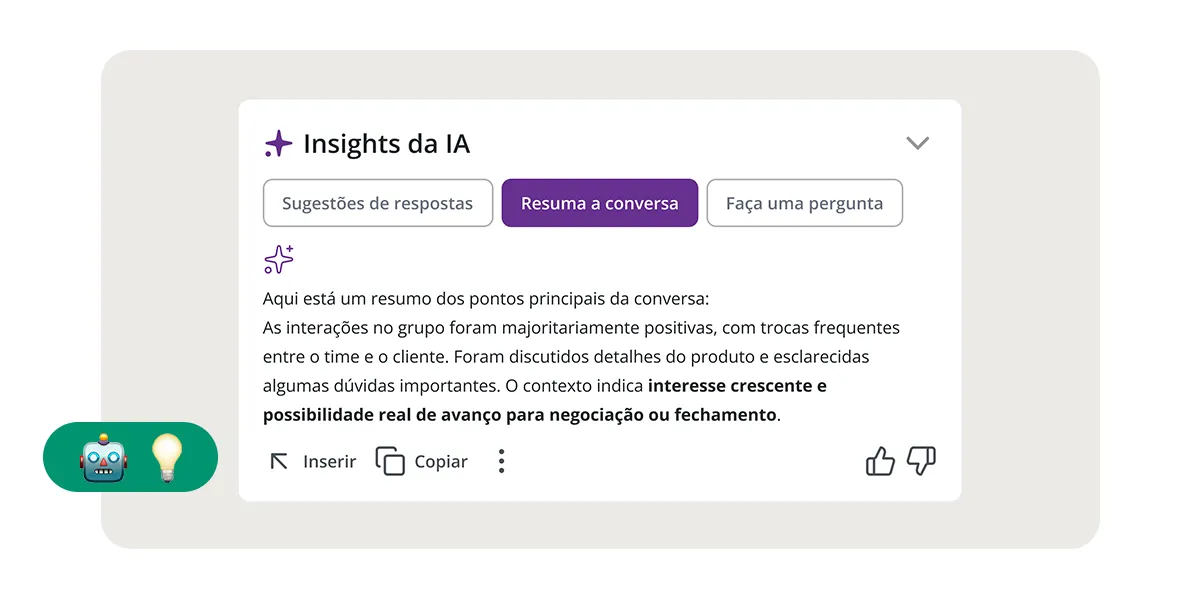
Zapper gives managers the ability to see the start of this process. It allows capturing the genesis of ideas and decisions, understanding the context, participants, and logic behind each choice. It is the tool that finally connects the informal world of instant communication with the formal world of strategic management, bringing the culture of informal decision-making into a controlled and auditable environment.
Conversations Converted Into Organized Data
Imagine being able to transform the chaotic and incessant flow of WhatsApp messages into a clean, organized database ready for analysis. It’s like turning the noise of a crowd into a symphony orchestra, where each instrument (information) can be heard and understood clearly.
This is the essence of the transformation that Zapper provides. Each conversation becomes a data point. Each decision, a record. Each problem, a documented learning opportunity. Knowledge ceases to be the property of individuals and becomes an asset of the company, perpetually accessible and analyzable.
Implementing corporate WhatsApp governance is no longer an option but a competitive necessity. In a world where the speed of information defines winners and losers, allowing your most valuable intelligence to evaporate in informal conversations is a luxury that no company can afford. It’s time to structure your conversations and turn dialogue into a strategic differential.

A critical decision about pricing is made at 10 PM on a Tuesday. A scope adjustment in a million-dollar project is defined with a simple "ok" in a quick conversation. A new approval process is communicated informally, and those who haven't seen the message are left behind. If these scenarios sound familiar, you know exactly where your company's true strategy is being discussed: in WhatsApp groups.
Agile, direct, and omnipresent, these groups have become the central nervous system of countless organizations. It is here that operations pulse, problems emerge, and solutions are improvised. However, this agility can come at a very high and silent cost. All this intelligence, all this history of decisions, and all organizational learning are born and die in the endless flow of messages.
What happens when this crucial information is not captured, structured, or governed? It gets lost. Important decisions become rumors, accountability dilutes, and the company becomes a hostage to a fragile collective memory that fades with each new member who joins or leaves the group.
This article is not about demonizing WhatsApp. It’s about recognizing its power and understanding that, to achieve true digital maturity, it is necessary to go beyond conversation. It’s time to transform this chaotic flow of unstructured data into actionable intelligence. It’s time to implement corporate WhatsApp governance that protects and enhances your business.
The Groups That Really Move the Company
Forget for a moment the meeting minutes and formal emails. Where do things really happen? In the "Leadership Alignment" group, in the "Project Phoenix Squad", in the "Sales - Sales Team" or in the "Crisis - Launch Product X". Each of these corporate WhatsApp groups is a microcosm of the organization, reflecting its culture, its priorities, and, above all, its real processes.
Communication in these channels is instantaneous. A seller's question about a new discount policy is answered within seconds by a manager. A critical bug identified by the support team is escalated to the developers in real-time. This speed is addictive and undeniably efficient for solving specific problems. The groups function as informal decision-making centers, accelerating the pace of business in a way that no other tool has managed.
However, this informality is a double-edged sword. Although quick, informal corporate decisions lack traceability. Who exactly approved the change? What was the full context of that discussion? If a new member joins the team, how can they understand the history of decisions that shaped the current project? The answer is simple: they cannot. They rely on what others say, and the information degrades with each transmission.
The result is an operation that functions on the basis of trust and short-term memory. Internal communication management becomes reactive, and critical knowledge is stored on individuals’ cell phones, not in the company’s systems. When a key employee leaves the organization, they take with them months or even years of context, negotiations, and strategic decisions. The company suffers from a partial "amnesia", forced to rediscover solutions and repeat the same mistakes again.
The Problem Is Not WhatsApp. It’s the Absence of Governance
It’s tempting to blame the tool. Many leaders, frustrated with the disorganization, consider banning the use of WhatsApp for corporate purposes. This is a losing battle. The app is already deeply embedded in the global work culture because it is simple, effective, and universal. Trying to remove it is like trying to ban conversations in the hallway. The real issue is not the platform, but the lack of a structure surrounding it.
WhatsApp is merely a communication infrastructure. The real risk lies in structural informality, in the absence of a system that brings order to chaos. Without corporate WhatsApp governance, the company operates in the dark, exposed to a series of dangers:
Compliance Risks: Decisions affecting contracts, clients, or sensitive data (LGPD) are made without an auditable record. In the event of a legal dispute or audit, how can one prove what was agreed upon? The lack of compliance in digital channels can lead to severe fines and reputational damage.
Loss of Traceability: A misguided decision can lead to significant losses. Without decision traceability, it is nearly impossible to identify the root cause of a problem, learn from the error, and correct the process for the future.
Operational Inefficiency: The search for an old piece of information or approval becomes an archaeological treasure hunt, with hours of scrolling through endless conversations. This lost time multiplies throughout the team, undermining productivity.
Informal Decision-Making Culture: The absence of formal records encourages a culture where decisions are made impulsively or conveniently, without proper data analysis or strategic alignment.
Organizing WhatsApp groups in the company is not just about creating etiquette rules. It is about implementing a layer of control and visibility that transforms the channel from a risk liability into an intelligence asset.
Organizational Intelligence Hidden in the Flow of Messages
Amid the flow of memes, stickers, and everyday conversations, lies a goldmine of organizational intelligence. WhatsApp groups are the company’s seismographs, detecting operational and cultural tremors long before they show up in formal reports. Intelligence gleaned from corporate conversations is raw, honest, and immediate.
Simply observe carefully to notice the patterns:
Bottlenecks appear first there: The phrase "Guys, I’m stuck waiting for approval from finance" posted in a project group is the first sign of a bottleneck in the process. In a formal system, this alert might take days to be formalized. On WhatsApp, it’s instant. Monitoring corporate conversations allows you to identify these friction points in real-time.
Tensions between areas become evident: The tone of messages, delays in responses between certain teams, or the exchange of veiled accusations in an interdepartmental group are clear indicators of misalignment or conflict. This analysis of corporate interactions reveals the health of internal relationships in a way that no climate survey can capture.
Real priorities are revealed: Notice which topics generate immediate engagement and which are ignored. A request from the CEO may be responded to in seconds, while a request regarding an internal compliance process may go unanswered for hours. This shows what the team practically considers urgent and important, regardless of what is written in the strategic planning.
Improvised processes are exposed: Questions like "What’s the link to open a ticket?" or "Does anyone have the client presentation template?" reveal gaps in documentation and training. Each one of these questions is a piece of data pointing to an opportunity for process improvement, a chance for structuring information that gets lost in the flow of conversation.
All this intelligence is there. The challenge is that it exists in the form of unstructured data, trapped in a format that does not allow for analysis, aggregation, or systematic action.
Unstructured Conversation Does Not Turn into Learning
All this wealth of information, all these vital signs of the operation, are lost because conversation, by its nature, is ephemeral and disorganized. The company generates a colossal volume of conversational data every day, but this raw material is never refined to become knowledge. The consequence is a vicious cycle of inefficiency.
The reason is simple: unstructured conversation...
Does not turn into metrics: How do you measure the "Average Resolution Time of a Problem" if the problem and the solution are scattered over 50 messages exchanged over three days? It’s impossible. Without metrics, there’s no way to manage or improve.
Does not become a standard: An analyst on a team discovers a brilliant way to solve a recurring problem and shares it in the group. The solution works, everyone celebrates, and the conversation continues. Six months later, a new analyst faces the same problem. The original solution is buried in thousands of messages and no one remembers it. Knowledge was not standardized and the wheel is reinvented.
Does not generate actionable insight: Several sellers in different groups mention that clients are complaining about the same product defect. Each mention is an isolated event. Without a system to aggregate this data, the company never sees the pattern and misses the chance to identify a critical product issue before it becomes a crisis.
Does not create a structured history: Finding a specific decision about a project budget approved a year ago is a Herculean task. There’s no way to search for "decision", "budget", or "approved" effectively. The searchable message history is a distant dream, and auditing becomes a nightmare.
This reality can be summed up in a harsh but true phrase: The company talks a lot, but learns little. Constant dialogue creates the illusion of alignment and progress, but without the structuring of conversational data, the organization remains trapped in a state of chronic amnesia, unable to evolve based on its own experiences.
What Digital Maturity Means in This Context
Many associate digital maturity with adopting cutting-edge software or automating tasks. Although this is part of the equation, true corporate digital maturity is deeper. It is the ability of an organization to transform data – all types of data – into intelligence to make better and faster decisions.
In the context of internal communication, digital maturity manifests when the company stops being a victim of informational chaos and becomes the master of it. This means going beyond simply using messaging tools and starting to govern them strategically. Achieving this level involves five fundamental pillars:
Structuring conversational data: This is the technical capability to extract relevant information from a free text flow and transform it into organized fields. For example, a message like "Budget of R$5,000 approved for the marketing campaign. @Carlos is responsible, final deadline Friday" is converted into data: {Decision: Approved}, {Topic: Budget}, {Value: 5000}, {Project: Marketing Campaign}, {Responsible: Carlos}, {Deadline: Date}.
Monitoring interactions: This is not about spying on employees, but about having operational visibility. It involves setting up alerts for keywords ("critical problem", "unsatisfied client"), analyzing the sentiment of conversations, and understanding the main themes discussed, all in an aggregated and anonymous way to identify trends.
Traceability: Every decision, task, or important information must have a clear and immutable audit trail. It should be possible, with just a few clicks, to trace any information back to its originating message, knowing who said it, when, and in what context.
Conversation-based reporting: The transformation of conversation into data allows for the creation of dashboards and reports that were once unthinkable. How many times was the word "delay" mentioned this month? Which team discusses "bugs" the most? What is the average time between the mention of a problem and the assignment of responsibility?
Transforming text into structured data: This is the technological engine that drives the other four pillars. It uses natural language processing (NLP) and artificial intelligence to read, understand, and categorize the content of messages, creating a structured message history that can be analyzed.
A digitally mature company does not shy away from informal conversations. On the contrary, it embraces them and installs a layer of intelligence over them to ensure no valuable information is lost.
While the Group Is Conversation, Zapper Is Intelligence
Recognizing the problem is the first step. The second is adopting a solution that brings governance without destroying the agility that makes WhatsApp such a powerful tool. This is exactly where Zapper comes in, not as a replacement, but as a strategic layer that operates over your existing corporate groups.
Zapper does not ask your team to change applications or behavior. It integrates with the environment that everyone is already using and enriches it with control, structure, and visibility. While the WhatsApp group remains the space for fluid and quick conversation, Zapper works behind the scenes to transform that conversation into organizational intelligence.
With Zapper, your company gains:
Structured dashboard with corporate conversations: A centralized and real-time view of the most discussed topics, emerging problems, and decisions made in all monitored groups. Operational visibility ceases to be a challenge.
Messages converted into organized data: Our technology analyzes the content of messages and automatically classifies them, extracting tasks, decisions, responsible parties, and deadlines. Unstructured data becomes a valuable asset.
Detection of relevant problems in the flow: Set up alerts for keywords, mentions of important customers, or spikes in negative sentiment. Act proactively before small problems become big crises.
Reports generated from the conversations: Create customized reports to measure communication efficiency, identify bottlenecks, and substantiate strategic decisions with data extracted directly from operations.
Searchable and structured history: Find any information, decision, or file in seconds, using advanced filters by date, user, type of information, or keyword. The nightmare of infinite scrolling ends.
Policies and control criteria over the channel: Implement robust digital governance, ensuring compliance in messaging and establishing digital channel control that protects the company without stifling communication.
Where Decisions Truly Begin
Formal meetings and well-crafted emails often serve only to ratify what has already been agreed upon in WhatsApp. Strategic decisions do not come ready in a conference room; they germinate in message exchanges, in quick debates, and in informal alignments.
Zapper gives managers the ability to see the start of this process. It allows capturing the genesis of ideas and decisions, understanding the context, participants, and logic behind each choice. It is the tool that finally connects the informal world of instant communication with the formal world of strategic management, bringing the culture of informal decision-making into a controlled and auditable environment.
Conversations Converted Into Organized Data
Imagine being able to transform the chaotic and incessant flow of WhatsApp messages into a clean, organized database ready for analysis. It’s like turning the noise of a crowd into a symphony orchestra, where each instrument (information) can be heard and understood clearly.
This is the essence of the transformation that Zapper provides. Each conversation becomes a data point. Each decision, a record. Each problem, a documented learning opportunity. Knowledge ceases to be the property of individuals and becomes an asset of the company, perpetually accessible and analyzable.
Implementing corporate WhatsApp governance is no longer an option but a competitive necessity. In a world where the speed of information defines winners and losers, allowing your most valuable intelligence to evaporate in informal conversations is a luxury that no company can afford. It’s time to structure your conversations and turn dialogue into a strategic differential.