

Intelligence
The most expensive blind spot in your operation: the negotiations that happen on WhatsApp
Your company invests in CRM, BI and marketing dashboards. But it operates blind on the channel where revenue actually closes.
Zapper Team
·
·
14 min of reading

There is a curious paradox in the daily life of companies that invest seriously in their sales operation. The technology stack grows, dashboards get more sophisticated, the CRM gets more integrations, the RevOps team gains more autonomy. And even so, a considerable share of negotiations happens on a channel no one monitors, no system captures and leadership rarely manages to audit.
That channel is WhatsApp.
It's no news to anyone that WhatsApp has become the main means of communication between companies and customers in Brazil. What's surprising is the proportion: 91% of small Brazilian businesses use WhatsApp as their main customer service channel.¹ Every day, 175 million people around the world start a conversation with a business on the app.² In Brazil, the number of active users reaches 148 million, the second-largest market globally, behind only India.³ The penetration rate among internet users approaches 99%.⁴
What do these numbers say, in practice? That WhatsApp isn't a support channel. It is the core sales relationship infrastructure of a good part of Brazilian companies. It's where the proposal arrives, where the discount is negotiated, where the sale happens, where the customer complains before canceling.
And it's where the operation runs without data.
What your CRM doesn't see
When a company deploys a CRM, the central argument is visibility. Knowing what stage each opportunity is in, the average cycle time, where the funnel loses the most leads, who on the team is underperforming. That reasoning is sound. The problem is that the CRM captures what was recorded. And recording a negotiation that happened on WhatsApp requires the salesperson to remember to do it, to have the time, and to understand why it matters.
In practice, this rarely happens systematically.
The conversation happens on WhatsApp, the sale happens on WhatsApp, the customer voices an objection on WhatsApp, the salesperson offers an unauthorized discount on WhatsApp, and none of it enters the CRM with the necessary depth. It enters, at best, as a generic note or a status updated manually hours later.
The result is a CRM that reflects an edited version of commercial reality, not reality itself.
BI dashboards depend on the quality of the data that feeds them. If the raw data of a negotiation was never captured faithfully, the dashboard can show a seemingly reliable forecast while the real pipeline is silently collapsing. Not because the team is lying. But because the system doesn't reach where the conversation actually happens.
The anatomy of a sale the system doesn't see
Consider a common scenario in mid-sized B2B companies. A lead comes in through the website form, is qualified by the SDR, receives a proposal by email and enters the CRM as an active opportunity. So far, everything is on the radar.
But then the real decision process begins.
The customer's contact sends the salesperson a WhatsApp message: "Can you give a 15% discount?" The salesperson replies. Negotiates. Sends a new proposal over WhatsApp because "it's faster." The customer asks to add one more service to the package. The salesperson agrees verbally. They close. The sale is recorded in the CRM as "won", at the proposal's original value.
The discount granted never entered the system. The additional service informally promised isn't documented. The objection that almost sank the sale wasn't recorded. And this customer's behavior pattern, which will be useful at renewal time, stayed buried in a WhatsApp thread no one will reread.
Multiply this scenario by dozens of salespeople and hundreds of negotiations a month. What leadership sees in the CRM isn't the real operation. It's a caricature of it.
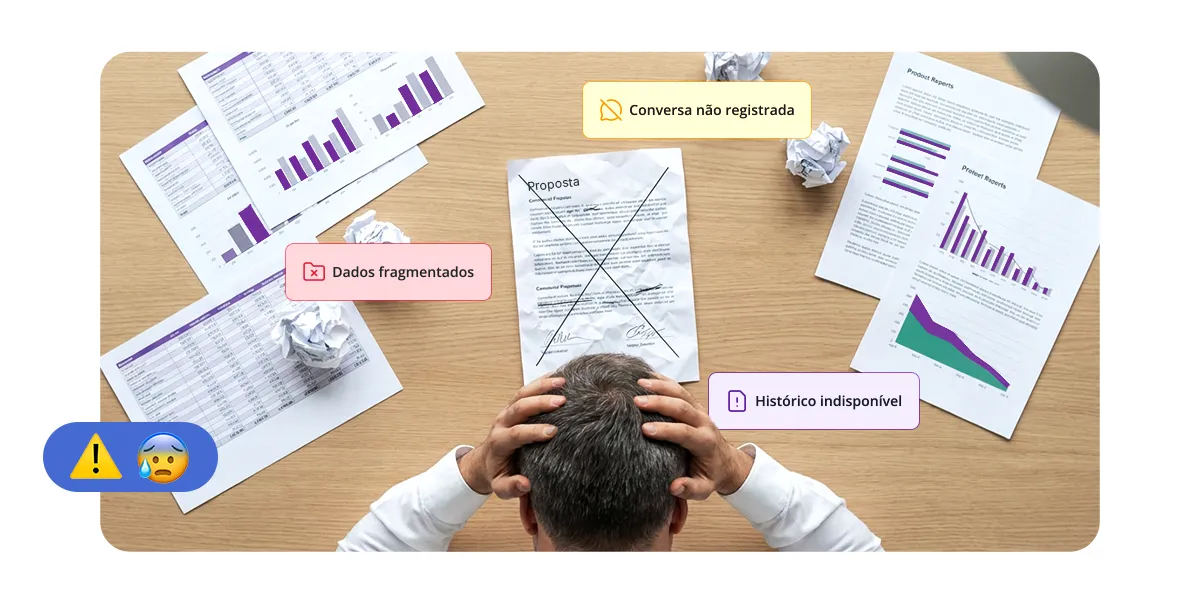
Where churn begins, and why the company doesn't notice in time
Silent churn is different from cancellation. The customer who cancels makes noise. Sends an email, calls, asks for a meeting. The customer who silently walks away disengages gradually: opens less, replies more slowly, stops asking questions. Until one day they simply don't renew.
According to OpenText's analysis of customer experience trends in 2026, the silence before churn is one of the hardest behaviors to capture with traditional metrics.⁵ And WhatsApp is where that silence becomes visible first.
Before formally canceling, a customer who is considering leaving usually changes their communication pattern on WhatsApp. Replies that used to take hours start taking days. Questions that used to arrive frequently disappear. The conversation that was two-way becomes a series of unanswered messages. These are signs of silent churn that don't appear in any NPS dashboard, any engagement report, any CRM alert. They appear in the conversations. But no one is monitoring the conversations.
The cost of this is twofold. First, the company loses the customer who could have been retained with a simple intervention at the right moment. Second, and perhaps more serious, the company doesn't learn from this pattern. If the churn signal wasn't captured, it doesn't feed any predictive model, doesn't enter any retention playbook, doesn't generate any process improvement.
The same reasoning applies to upsell. When a customer mentions, in the middle of a support conversation on WhatsApp, that they're thinking of expanding the contract or have a new need, that information rarely reaches the sales team in a structured way. It stays in the agent's head, or at most in an informal note. The opportunity passes.
The size of what's off the radar
To grasp the scale of the problem, it's worth looking at the size of the phenomenon. Brazil generates more web traffic to WhatsApp than any other country in the world, about 19% of the global total according to March 2026 data.⁶ Brazilian companies account for the highest lifetime revenue generated by WhatsApp Business among all countries.⁷ Conversational commerce via WhatsApp is expected to move approximately US$ 45 billion globally in 2026, and Brazil is one of the main drivers of that volume.⁸
In a context where 98% of internet users in the country have WhatsApp installed and check the app dozens of times a day,⁴ the channel isn't complementary. It is the channel.
But the governance and visibility infrastructure still treats WhatsApp as if it were a private phone. No records. No traceability. No analysis capability.
In a scenario where RevOps managers dedicate significant budgets to improving revenue predictability, the absence of structured data on the channel where revenue actually happens is a first-order operational contradiction.
What traditional dashboards can't capture
There is a fundamental difference between transactional data and conversational data. BI captures the first type well. The second, where revenue is actually decided, is left out.
Transactional data | Conversational data | |
|---|---|---|
Where it lives | CRM, ERP, payment platforms | WhatsApp, message history |
Format | Structured, with fields and timestamps | Free-form, contextual, unstructured |
What it captures | Recorded sale, signed contract, processed payment | Intent, sentiment, urgency, resistance, negotiation context |
Visibility for the manager | High — goes straight into BI | None — depends on the salesperson reporting it |
Examples of what's left out | — | The tone in which the customer said "I'll think about it." The discount granted without authorization. The proposal that never got a reply. |
Impact on forecast | Direct and traceable | Invisible — but decisive |
When mature companies talk about revenue intelligence, they're talking about exactly this layer that conventional BI doesn't reach. WhatsApp messages have an open rate between 95% and 98%, versus 20% to 25% for email.⁹ The customer is reading. The problem is that the company isn't monitoring the channel where they reply.
WhatsApp is the largest repository of sales conversations at Brazilian companies. And it sits completely outside the revenue intelligence architecture of most of them.
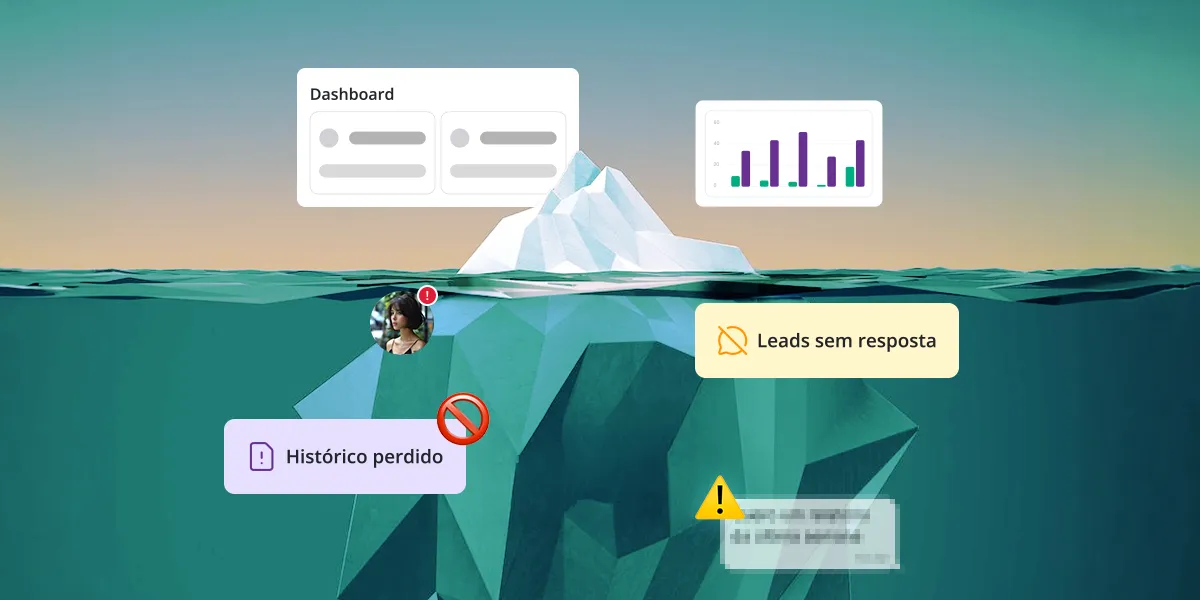
The data that doesn't fit in any CRM field
There is an undeclared premise in most RevOps operations: if it's in the system, it exists. If it isn't, it didn't happen.
That premise worked well while the sales process ran through structured channels: email, recorded phone calls, meetings with minutes. It worked until WhatsApp became the central channel. Because WhatsApp has no fields. No structure. No automatic export to any CRM on the market.
What exists on WhatsApp is context. And context is exactly what most forecasts lack.
Think about what an experienced salesperson knows about each customer in their portfolio that they've never typed anywhere: the tone of the replies when the conversation is going well, the sign that the person on the other side is under pressure from their boss, the moment when the price objection appears for the second time and indicates that it's real. That knowledge exists. It's distributed among the heads of the sales team. And when someone leaves, it goes with them.
Revenue intelligence isn't about recording more. It's about capturing what is already happening on the channel where real conversations take place. The difference between a company that can predict revenue accurately and one that keeps adjusting its forecast in the last week of the month often comes down to this: one has data about its sales conversations, the other works with memory and intuition.
What the pipeline isn't telling you
A wrong revenue forecast is a symptom. The cause usually lies further back.
When the RevOps team analyzes why the quarter's forecast came in below actuals, the investigation usually finds some mix of inconsistent data in the CRM, deal stages that don't reflect the real state of negotiations, or opportunities that had been "in negotiation" for weeks with no traceable movement. The diagnosis stops at the CRM because that's where the data is. But the problem started earlier, in the conversation that happened on WhatsApp and was never captured faithfully.
This gap has a cost that goes beyond an incorrect forecast. It affects headcount planning, budget allocation, product decisions. Any analysis built on incomplete data produces conclusions that look solid but are founded on a partial picture of the operation. According to Lane Four's analysis of the state of RevOps in 2025 and 2026, silent risks that propagate through the pipeline are one of the main factors undermining confidence in the forecast and complicating handoff work between teams.¹⁰
The irony is that the missing data exists. It's in the conversations. It's in the interaction history with each customer. It's in the response patterns that indicate closing temperature, in the moments when the negotiation stalled, in the questions that were never answered. The point is that no CRM field can absorb this automatically while the process runs on WhatsApp without capture infrastructure.
Companies advancing in RevOps maturity have begun treating this problem as a priority. Not because they discovered some new practice, but because it has become too hard to keep optimizing the analysis end when the capture end still has a hole this size.
What changes when the operation gains visibility into its conversations
The first change is in the questions the manager can ask.
With visibility into sales conversations, it's no longer necessary to ask "how did the negotiation go?" and wait for a summary filtered through the salesperson's perception. You can check directly where the conversation stalled, which objection came up, whether the customer was engaged or just replying out of courtesy. This changes the quality of the management conversation and, more than that, changes the ability to step in before the opportunity cools.
The second change is in the operation's institutional memory. Patterns that today stay in the heads of the most experienced salespeople start to become company assets. Which arguments work with a given customer profile. At which stage of the process the cycle tends to stall. What the average time is between the first sign of interest and closing, by segment. This kind of intelligence exists in every mature sales operation, but has rarely been captured in a way that allows analysis or knowledge transfer.
The third change, probably the most underestimated, is in retention capability. Missed upsell and silent churn are phenomena that show up in conversations before they appear in any metric. When the capture infrastructure exists, they stop being surprises and become actionable indicators. Data from WhatsApp customer service platforms indicates that companies that centralize conversation management report up to a 60% reduction in customer response time¹¹ — which, in the context of retention, can be the difference between catching an exit signal in time or receiving the cancellation notice too late.
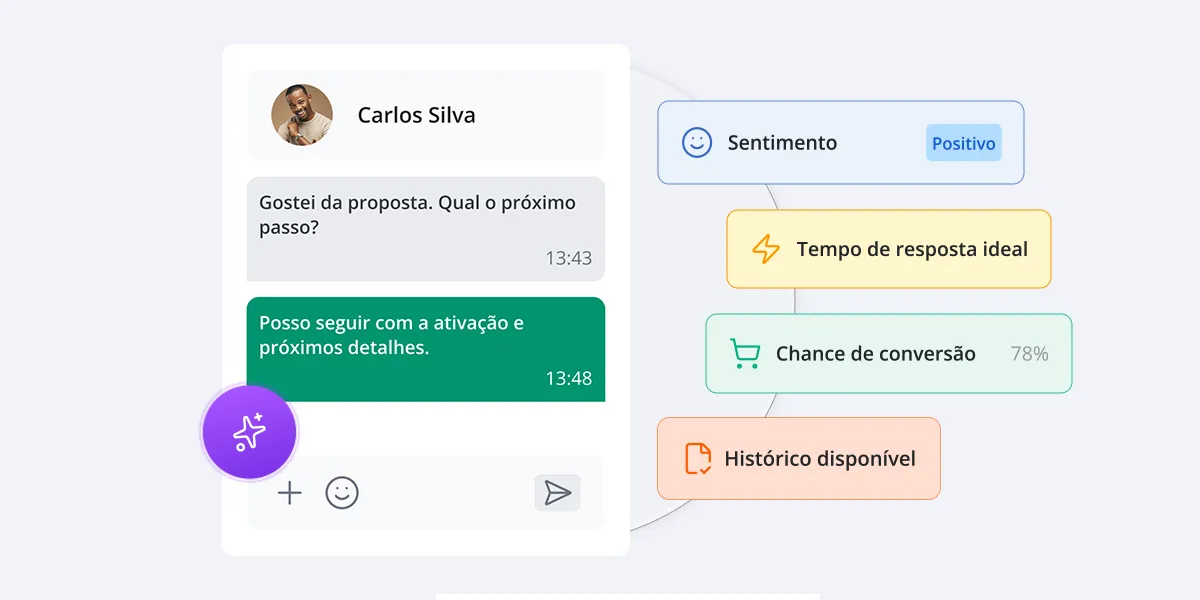
The gap between intention and infrastructure
There is a significant distance between recognizing the problem and having the infrastructure to solve it.
Most companies that reach this point of awareness realize their WhatsApp operation is fragmented. Personal numbers mixed with corporate numbers. Conversation histories that vanish when a salesperson leaves the company. Service that depends on the good memory of whoever is on the line. No centralization, no auditing, no integration with the rest of the stack.
Solving this takes more than installing a tool. It requires rethinking WhatsApp as operational infrastructure, not as an informal channel. That means centralizing customer service numbers on platforms that allow visibility and traceability, integrating conversations into the CRM in a structured way, creating usage protocols that reflect the strategic role of the channel, and defining which conversation metrics are relevant to the revenue operation.
It isn't a simple change. But it is one that companies that take RevOps seriously are already making. According to industry projections, 75% of fast-growing companies are expected to operate under some structured RevOps model by the end of 2026.¹² Treating WhatsApp as a blind spot in that model is not a neutral position. It is a choice with calculable consequences.
What the operation needs to understand now
Revenue managers who work with OKRs, NRR, pipeline velocity and churn rate generally have well-built dashboards to track these metrics. What those dashboards don't show is what is happening in the conversations that feed each of them.
A declining NRR has an explanation. That explanation usually lies in the communication patterns of the 60 days before renewal. A stagnant pipeline has a cause. It almost always runs through some WhatsApp conversation that went unanswered, some objection that wasn't addressed, some signal the team didn't catch because no one was looking.
The question that remains isn't whether WhatsApp should be part of the data architecture of a modern sales operation. It already is the channel. The question is for how much longer it makes sense to run the main revenue channel without the visibility that every other point of the operation has as standard.
This article is part of the series on operational visibility produced by Zapper for operations, revenue and RevOps leaders.

References
¹ Aurora Inbox — Adoption of WhatsApp Business in Latin America. Available at: https://aurorareach.com/blog/whatsapp-business-latin-america
² WizMessage — WhatsApp Business Statistics 2026: 50+ Key Data Points. Available at: https://wizmessage.com/blog/whatsapp-business-statistics
³ DemandSage — Latest WhatsApp Statistics 2026 (Active Users Data). Available at: https://www.demandsage.com/whatsapp-statistics/
⁴ Quantumrun — WhatsApp Statistics And User Trends 2026. Available at: https://www.quantumrun.com/consulting/whatsapp-statistics/
⁵ OpenText Blog — Customer Experience Trends Defining 2026. Available at: https://blogs.opentext.com/customer-experience-trends-2026/
⁶ DemandSage — Latest WhatsApp Statistics 2026 (Active Users Data). Available at: https://www.demandsage.com/whatsapp-statistics/
⁷ Invent — The $45B WhatsApp Business Economy: How to Capture Your Share (2026 Guide). Available at: https://www.useinvent.com/blog/the-usd45b-whatsapp-business-economy-how-to-capture-your-share-2026-guide
⁸ Invent — The $45B WhatsApp Business Economy: How to Capture Your Share (2026 Guide). Available at: https://www.useinvent.com/blog/the-usd45b-whatsapp-business-economy-how-to-capture-your-share-2026-guide
⁹ WizMessage — WhatsApp Business Statistics 2026: 50+ Key Data Points. Available at: https://wizmessage.com/blog/whatsapp-business-statistics
¹⁰ Lane Four — The Salesforce and RevOps Stories of 2025 and What They Mean for 2026. Available at: https://lanefour.com/news/the-salesforce-and-revops-stories-of-2025-and-what-they-mean-for-2026/
¹¹ Trengo — 45 WhatsApp Business Statistics You Need To Know In 2026. Available at: https://trengo.com/blog/whatsapp-business-statistics
¹² ORM Technologies — The Future of RevOps: Strategic Planning & Trends for 2026. Available at: https://orm-tech.com/revops-strategic-planning-trends-for-2026/
There is a curious paradox in the daily life of companies that invest seriously in their sales operation. The technology stack grows, dashboards get more sophisticated, the CRM gets more integrations, the RevOps team gains more autonomy. And even so, a considerable share of negotiations happens on a channel no one monitors, no system captures and leadership rarely manages to audit.
That channel is WhatsApp.
It's no news to anyone that WhatsApp has become the main means of communication between companies and customers in Brazil. What's surprising is the proportion: 91% of small Brazilian businesses use WhatsApp as their main customer service channel.¹ Every day, 175 million people around the world start a conversation with a business on the app.² In Brazil, the number of active users reaches 148 million, the second-largest market globally, behind only India.³ The penetration rate among internet users approaches 99%.⁴
What do these numbers say, in practice? That WhatsApp isn't a support channel. It is the core sales relationship infrastructure of a good part of Brazilian companies. It's where the proposal arrives, where the discount is negotiated, where the sale happens, where the customer complains before canceling.
And it's where the operation runs without data.
What your CRM doesn't see
When a company deploys a CRM, the central argument is visibility. Knowing what stage each opportunity is in, the average cycle time, where the funnel loses the most leads, who on the team is underperforming. That reasoning is sound. The problem is that the CRM captures what was recorded. And recording a negotiation that happened on WhatsApp requires the salesperson to remember to do it, to have the time, and to understand why it matters.
In practice, this rarely happens systematically.
The conversation happens on WhatsApp, the sale happens on WhatsApp, the customer voices an objection on WhatsApp, the salesperson offers an unauthorized discount on WhatsApp, and none of it enters the CRM with the necessary depth. It enters, at best, as a generic note or a status updated manually hours later.
The result is a CRM that reflects an edited version of commercial reality, not reality itself.
BI dashboards depend on the quality of the data that feeds them. If the raw data of a negotiation was never captured faithfully, the dashboard can show a seemingly reliable forecast while the real pipeline is silently collapsing. Not because the team is lying. But because the system doesn't reach where the conversation actually happens.
The anatomy of a sale the system doesn't see
Consider a common scenario in mid-sized B2B companies. A lead comes in through the website form, is qualified by the SDR, receives a proposal by email and enters the CRM as an active opportunity. So far, everything is on the radar.
But then the real decision process begins.
The customer's contact sends the salesperson a WhatsApp message: "Can you give a 15% discount?" The salesperson replies. Negotiates. Sends a new proposal over WhatsApp because "it's faster." The customer asks to add one more service to the package. The salesperson agrees verbally. They close. The sale is recorded in the CRM as "won", at the proposal's original value.
The discount granted never entered the system. The additional service informally promised isn't documented. The objection that almost sank the sale wasn't recorded. And this customer's behavior pattern, which will be useful at renewal time, stayed buried in a WhatsApp thread no one will reread.
Multiply this scenario by dozens of salespeople and hundreds of negotiations a month. What leadership sees in the CRM isn't the real operation. It's a caricature of it.
Where churn begins, and why the company doesn't notice in time
Silent churn is different from cancellation. The customer who cancels makes noise. Sends an email, calls, asks for a meeting. The customer who silently walks away disengages gradually: opens less, replies more slowly, stops asking questions. Until one day they simply don't renew.
According to OpenText's analysis of customer experience trends in 2026, the silence before churn is one of the hardest behaviors to capture with traditional metrics.⁵ And WhatsApp is where that silence becomes visible first.
Before formally canceling, a customer who is considering leaving usually changes their communication pattern on WhatsApp. Replies that used to take hours start taking days. Questions that used to arrive frequently disappear. The conversation that was two-way becomes a series of unanswered messages. These are signs of silent churn that don't appear in any NPS dashboard, any engagement report, any CRM alert. They appear in the conversations. But no one is monitoring the conversations.
The cost of this is twofold. First, the company loses the customer who could have been retained with a simple intervention at the right moment. Second, and perhaps more serious, the company doesn't learn from this pattern. If the churn signal wasn't captured, it doesn't feed any predictive model, doesn't enter any retention playbook, doesn't generate any process improvement.
The same reasoning applies to upsell. When a customer mentions, in the middle of a support conversation on WhatsApp, that they're thinking of expanding the contract or have a new need, that information rarely reaches the sales team in a structured way. It stays in the agent's head, or at most in an informal note. The opportunity passes.
The size of what's off the radar
To grasp the scale of the problem, it's worth looking at the size of the phenomenon. Brazil generates more web traffic to WhatsApp than any other country in the world, about 19% of the global total according to March 2026 data.⁶ Brazilian companies account for the highest lifetime revenue generated by WhatsApp Business among all countries.⁷ Conversational commerce via WhatsApp is expected to move approximately US$ 45 billion globally in 2026, and Brazil is one of the main drivers of that volume.⁸
In a context where 98% of internet users in the country have WhatsApp installed and check the app dozens of times a day,⁴ the channel isn't complementary. It is the channel.
But the governance and visibility infrastructure still treats WhatsApp as if it were a private phone. No records. No traceability. No analysis capability.
In a scenario where RevOps managers dedicate significant budgets to improving revenue predictability, the absence of structured data on the channel where revenue actually happens is a first-order operational contradiction.
What traditional dashboards can't capture
There is a fundamental difference between transactional data and conversational data. BI captures the first type well. The second, where revenue is actually decided, is left out.
Transactional data | Conversational data | |
|---|---|---|
Where it lives | CRM, ERP, payment platforms | WhatsApp, message history |
Format | Structured, with fields and timestamps | Free-form, contextual, unstructured |
What it captures | Recorded sale, signed contract, processed payment | Intent, sentiment, urgency, resistance, negotiation context |
Visibility for the manager | High — goes straight into BI | None — depends on the salesperson reporting it |
Examples of what's left out | — | The tone in which the customer said "I'll think about it." The discount granted without authorization. The proposal that never got a reply. |
Impact on forecast | Direct and traceable | Invisible — but decisive |
When mature companies talk about revenue intelligence, they're talking about exactly this layer that conventional BI doesn't reach. WhatsApp messages have an open rate between 95% and 98%, versus 20% to 25% for email.⁹ The customer is reading. The problem is that the company isn't monitoring the channel where they reply.
WhatsApp is the largest repository of sales conversations at Brazilian companies. And it sits completely outside the revenue intelligence architecture of most of them.
The data that doesn't fit in any CRM field
There is an undeclared premise in most RevOps operations: if it's in the system, it exists. If it isn't, it didn't happen.
That premise worked well while the sales process ran through structured channels: email, recorded phone calls, meetings with minutes. It worked until WhatsApp became the central channel. Because WhatsApp has no fields. No structure. No automatic export to any CRM on the market.
What exists on WhatsApp is context. And context is exactly what most forecasts lack.
Think about what an experienced salesperson knows about each customer in their portfolio that they've never typed anywhere: the tone of the replies when the conversation is going well, the sign that the person on the other side is under pressure from their boss, the moment when the price objection appears for the second time and indicates that it's real. That knowledge exists. It's distributed among the heads of the sales team. And when someone leaves, it goes with them.
Revenue intelligence isn't about recording more. It's about capturing what is already happening on the channel where real conversations take place. The difference between a company that can predict revenue accurately and one that keeps adjusting its forecast in the last week of the month often comes down to this: one has data about its sales conversations, the other works with memory and intuition.
What the pipeline isn't telling you
A wrong revenue forecast is a symptom. The cause usually lies further back.
When the RevOps team analyzes why the quarter's forecast came in below actuals, the investigation usually finds some mix of inconsistent data in the CRM, deal stages that don't reflect the real state of negotiations, or opportunities that had been "in negotiation" for weeks with no traceable movement. The diagnosis stops at the CRM because that's where the data is. But the problem started earlier, in the conversation that happened on WhatsApp and was never captured faithfully.
This gap has a cost that goes beyond an incorrect forecast. It affects headcount planning, budget allocation, product decisions. Any analysis built on incomplete data produces conclusions that look solid but are founded on a partial picture of the operation. According to Lane Four's analysis of the state of RevOps in 2025 and 2026, silent risks that propagate through the pipeline are one of the main factors undermining confidence in the forecast and complicating handoff work between teams.¹⁰
The irony is that the missing data exists. It's in the conversations. It's in the interaction history with each customer. It's in the response patterns that indicate closing temperature, in the moments when the negotiation stalled, in the questions that were never answered. The point is that no CRM field can absorb this automatically while the process runs on WhatsApp without capture infrastructure.
Companies advancing in RevOps maturity have begun treating this problem as a priority. Not because they discovered some new practice, but because it has become too hard to keep optimizing the analysis end when the capture end still has a hole this size.
What changes when the operation gains visibility into its conversations
The first change is in the questions the manager can ask.
With visibility into sales conversations, it's no longer necessary to ask "how did the negotiation go?" and wait for a summary filtered through the salesperson's perception. You can check directly where the conversation stalled, which objection came up, whether the customer was engaged or just replying out of courtesy. This changes the quality of the management conversation and, more than that, changes the ability to step in before the opportunity cools.
The second change is in the operation's institutional memory. Patterns that today stay in the heads of the most experienced salespeople start to become company assets. Which arguments work with a given customer profile. At which stage of the process the cycle tends to stall. What the average time is between the first sign of interest and closing, by segment. This kind of intelligence exists in every mature sales operation, but has rarely been captured in a way that allows analysis or knowledge transfer.
The third change, probably the most underestimated, is in retention capability. Missed upsell and silent churn are phenomena that show up in conversations before they appear in any metric. When the capture infrastructure exists, they stop being surprises and become actionable indicators. Data from WhatsApp customer service platforms indicates that companies that centralize conversation management report up to a 60% reduction in customer response time¹¹ — which, in the context of retention, can be the difference between catching an exit signal in time or receiving the cancellation notice too late.
The gap between intention and infrastructure
There is a significant distance between recognizing the problem and having the infrastructure to solve it.
Most companies that reach this point of awareness realize their WhatsApp operation is fragmented. Personal numbers mixed with corporate numbers. Conversation histories that vanish when a salesperson leaves the company. Service that depends on the good memory of whoever is on the line. No centralization, no auditing, no integration with the rest of the stack.
Solving this takes more than installing a tool. It requires rethinking WhatsApp as operational infrastructure, not as an informal channel. That means centralizing customer service numbers on platforms that allow visibility and traceability, integrating conversations into the CRM in a structured way, creating usage protocols that reflect the strategic role of the channel, and defining which conversation metrics are relevant to the revenue operation.
It isn't a simple change. But it is one that companies that take RevOps seriously are already making. According to industry projections, 75% of fast-growing companies are expected to operate under some structured RevOps model by the end of 2026.¹² Treating WhatsApp as a blind spot in that model is not a neutral position. It is a choice with calculable consequences.
What the operation needs to understand now
Revenue managers who work with OKRs, NRR, pipeline velocity and churn rate generally have well-built dashboards to track these metrics. What those dashboards don't show is what is happening in the conversations that feed each of them.
A declining NRR has an explanation. That explanation usually lies in the communication patterns of the 60 days before renewal. A stagnant pipeline has a cause. It almost always runs through some WhatsApp conversation that went unanswered, some objection that wasn't addressed, some signal the team didn't catch because no one was looking.
The question that remains isn't whether WhatsApp should be part of the data architecture of a modern sales operation. It already is the channel. The question is for how much longer it makes sense to run the main revenue channel without the visibility that every other point of the operation has as standard.
This article is part of the series on operational visibility produced by Zapper for operations, revenue and RevOps leaders.
References
¹ Aurora Inbox — Adoption of WhatsApp Business in Latin America. Available at: https://aurorareach.com/blog/whatsapp-business-latin-america
² WizMessage — WhatsApp Business Statistics 2026: 50+ Key Data Points. Available at: https://wizmessage.com/blog/whatsapp-business-statistics
³ DemandSage — Latest WhatsApp Statistics 2026 (Active Users Data). Available at: https://www.demandsage.com/whatsapp-statistics/
⁴ Quantumrun — WhatsApp Statistics And User Trends 2026. Available at: https://www.quantumrun.com/consulting/whatsapp-statistics/
⁵ OpenText Blog — Customer Experience Trends Defining 2026. Available at: https://blogs.opentext.com/customer-experience-trends-2026/
⁶ DemandSage — Latest WhatsApp Statistics 2026 (Active Users Data). Available at: https://www.demandsage.com/whatsapp-statistics/
⁷ Invent — The $45B WhatsApp Business Economy: How to Capture Your Share (2026 Guide). Available at: https://www.useinvent.com/blog/the-usd45b-whatsapp-business-economy-how-to-capture-your-share-2026-guide
⁸ Invent — The $45B WhatsApp Business Economy: How to Capture Your Share (2026 Guide). Available at: https://www.useinvent.com/blog/the-usd45b-whatsapp-business-economy-how-to-capture-your-share-2026-guide
⁹ WizMessage — WhatsApp Business Statistics 2026: 50+ Key Data Points. Available at: https://wizmessage.com/blog/whatsapp-business-statistics
¹⁰ Lane Four — The Salesforce and RevOps Stories of 2025 and What They Mean for 2026. Available at: https://lanefour.com/news/the-salesforce-and-revops-stories-of-2025-and-what-they-mean-for-2026/
¹¹ Trengo — 45 WhatsApp Business Statistics You Need To Know In 2026. Available at: https://trengo.com/blog/whatsapp-business-statistics
¹² ORM Technologies — The Future of RevOps: Strategic Planning & Trends for 2026. Available at: https://orm-tech.com/revops-strategic-planning-trends-for-2026/

