

Segurança
Banning numbers on WhatsApp: the phenomenon that has been halting business operations in Brazil
Understand what is happening on WhatsApp and how to prevent the deletion of your work numbers and the freezing of your team's business operations.
Zapper Team
·
·
6 min of reading

What may seem like a nightmare can become a reality for countless companies in Brazil. In recent weeks, a wave of banning numbers on WhatsApp has caused true confusion for regular users and also professionals of the tool, generating financial losses and a communication crisis. What was once an agile and efficient point of contact has turned into a source of uncertainty and risk.
Reports of bans are multiplying in forums, social networks, and recent press articles. According to publications from Times Brasil and ICL Notícias, there are users being banned even shortly after sending the first message¹ to a contact that was not saved in their contacts.
Imagine the scenario: your sales and support team, which depends on WhatsApp to communicate with clients and close deals, wakes up on a Monday and finds that all the company's numbers have been banned. The SDR cannot send messages, leads remain unanswered, and the company's main source of revenue has suddenly been frozen.
If your operation depends on WhatsApp, this is not a problem you can ignore. Understanding what is happening is the first step to protect your business and ensure the continuity of your sales and customer service.
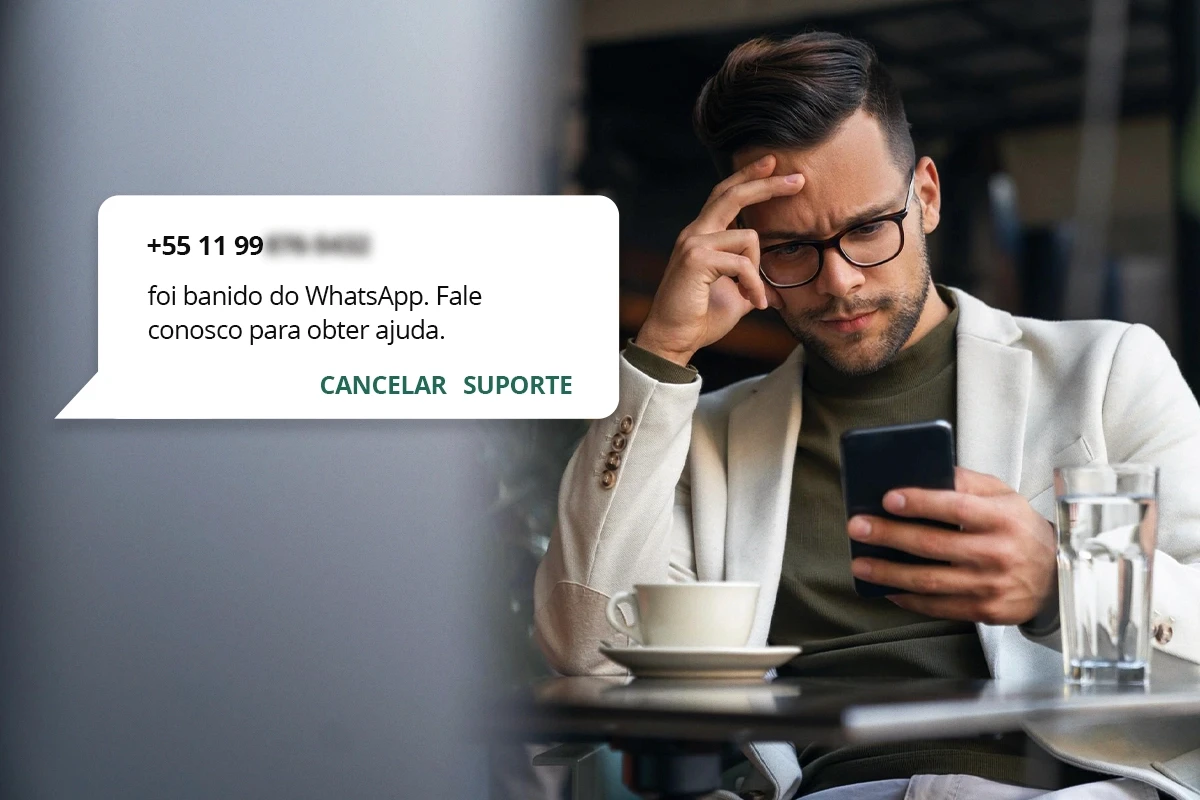
Learn what is behind the wave of bans on WhatsApp and how to prevent your company from being caught off guard
The main reason behind this wave of bans is an intensification of WhatsApp's policies (and its parent company, Meta) to combat practices that violate its Terms of Service². The goal is clear: to clean the platform of spam, fake news, and, mainly, the use of unofficial tools that automate the sending of mass messages.
For a long time, companies used unapproved third-party software to send promotions and announcements to contact lists. This practice, in addition to being invasive to the user, goes against WhatsApp's usage rules. Meta is now using increasingly sophisticated algorithms to identify and punish this behavior.
The impact of a WhatsApp ban on a business operation is devastating and immediate:
Halting sales: the sales team loses access to negotiation funnels and cannot contact new leads or follow up with potential clients;
Disruption of support: clients with questions or problems are left without a communication channel, causing frustration and damaging the brand's reputation;
Loss of history: all conversations, files, and contacts associated with the banned number can be permanently lost;
Financial loss: the interruption of sales and the need to restructure communication generate direct costs and loss of revenue.
The ban can be temporary or permanent. Temporarily banned numbers can be recovered after a period but serve as a serious warning. Permanent banning means the definitive loss of the number on the platform. Understanding the reasons leading to this punishment is crucial to prevent your company from becoming the next victim.
4 main reasons for mass banning of numbers on WhatsApp
Account suspension does not happen by chance. It is a result of activities that WhatsApp's systems identify as suspicious or violative of its policies. Knowing these triggers is the best way to protect yourself.
Here are the main reasons that lead to banning numbers on WhatsApp:
Sending mass messages (spam): sending the same message to a large number of contacts at once, especially to people who did not request this contact (without opt-in), is a classic spam behavior. This leads to reports and bans;
Sudden spikes in activity: if a new number or one with low activity suddenly starts sending hundreds of messages a day, the system identifies it as suspicious. Gradually warming up the number is essential to build a positive reputation;
High rates of blocking and reporting: if many users block or report your number in a short period, WhatsApp understands that your content is unwanted or offensive. The platform prioritizes the experience of the end user, and a high volume of reports is a red flag;
Violation of Content Terms: Sending illegal, misleading, defamatory content, that promotes hate speech or violates the rights of others is a direct cause for banning.
How to avoid banning and protect your operation
Fortunately, there are solutions for WhatsApp banning, and the main one involves professionalizing the use of the tool. Prevention is the best strategy.
Respect Opt-In: the golden rule of digital communication. Only send messages to users who have explicitly consented to receive them. This not only avoids reports but is also in compliance with the General Data Protection Law (LGPD).
Offer valuable content: instead of focusing only on promotions, create communication strategies that deliver value to your client. Personalized and relevant messages have a much higher engagement rate and drastically reduce the risk of bans.
Facilitate Opt-Out: all your communications should include a clear and easy way for the user to unsubscribe (for example, "Reply STOP to stop receiving messages"). This shows respect for the user and is a best practice recommended by WhatsApp.
Monitor suspicious behaviors: triggers such as excessive sending, sensitive terms, or unusual hours can alert you before a ban.
If you have already had a banned number, the process of how to recover WhatsApp number can be lengthy and without guarantees. The way is to contact WhatsApp's official support and explain the situation, but the best approach is undoubtedly prevention.
The wave of bans is a clear message from Meta: the era of amateur and unregulated use of WhatsApp for commercial purposes is over. Companies that wish to continue using this vital channel must adapt, adopting tools and best practices to ensure security, compliance, and, above all, the continuity of their operations.
Main triggers that lead to the banning of a number on WhatsApp
Even if sent without negative intent.
1. Prohibited content or classified as a potential risk
With each user who blocks your account, your "score" worsens.
2. High rates of blocking or reporting
Sending 200 messages at once from a newly activated number, for example.
3. Abnormal spikes in sending
One of the biggest triggers for reporting and banning.
4. Mass sending without consent (without opt-in)
Even if it is a seller "doing manual prospecting".
5. Sending messages to unknown numbers
How to protect your company from banning on WhatsApp with Zapper
Today, relying only on "good manual practices" is no longer enough. It is necessary visibility, governance, and monitoring intelligence. For companies that depend on WhatsApp, operating "in the dark" is no longer acceptable. Zapper adds real layers of security, including:
Continuous message monitoring
Detects risk behaviors before WhatsApp penalizes.
Alerts for sensitive or suspicious terms
Protects against unintended violations of Meta's policies.
Configurable policies for sellers and agents
Ensures governance and standardization of interactions.
Secure backup
Conversations, files, and evidence stored securely.
Total visibility of interactions
Knows who sent what and to whom, avoiding accidental risks.
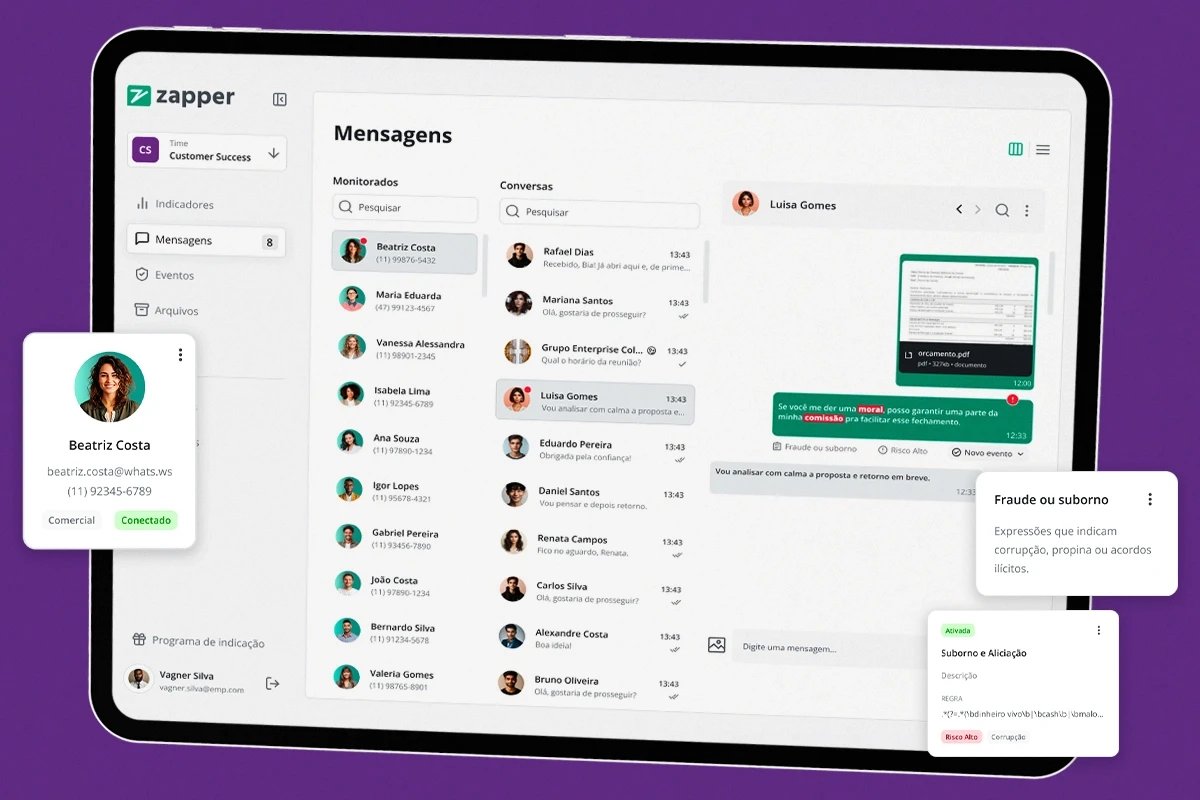
Conclusion: conversational intelligence is the new requirement for operating on WhatsApp
Meta has made it clear: the era of WhatsApp used amateurishly is over. Companies that continue to operate without visibility, without governance, and without monitoring will be just a click away from total paralysis.
Operational security on WhatsApp today depends on:
visibility;
monitoring;
intelligence;
compliance.
And that is exactly what Zapper helps deliver.
Sources:
What may seem like a nightmare can become a reality for countless companies in Brazil. In recent weeks, a wave of banning numbers on WhatsApp has caused true confusion for regular users and also professionals of the tool, generating financial losses and a communication crisis. What was once an agile and efficient point of contact has turned into a source of uncertainty and risk.
Reports of bans are multiplying in forums, social networks, and recent press articles. According to publications from Times Brasil and ICL Notícias, there are users being banned even shortly after sending the first message¹ to a contact that was not saved in their contacts.
Imagine the scenario: your sales and support team, which depends on WhatsApp to communicate with clients and close deals, wakes up on a Monday and finds that all the company's numbers have been banned. The SDR cannot send messages, leads remain unanswered, and the company's main source of revenue has suddenly been frozen.
If your operation depends on WhatsApp, this is not a problem you can ignore. Understanding what is happening is the first step to protect your business and ensure the continuity of your sales and customer service.
Learn what is behind the wave of bans on WhatsApp and how to prevent your company from being caught off guard
The main reason behind this wave of bans is an intensification of WhatsApp's policies (and its parent company, Meta) to combat practices that violate its Terms of Service². The goal is clear: to clean the platform of spam, fake news, and, mainly, the use of unofficial tools that automate the sending of mass messages.
For a long time, companies used unapproved third-party software to send promotions and announcements to contact lists. This practice, in addition to being invasive to the user, goes against WhatsApp's usage rules. Meta is now using increasingly sophisticated algorithms to identify and punish this behavior.
The impact of a WhatsApp ban on a business operation is devastating and immediate:
Halting sales: the sales team loses access to negotiation funnels and cannot contact new leads or follow up with potential clients;
Disruption of support: clients with questions or problems are left without a communication channel, causing frustration and damaging the brand's reputation;
Loss of history: all conversations, files, and contacts associated with the banned number can be permanently lost;
Financial loss: the interruption of sales and the need to restructure communication generate direct costs and loss of revenue.
The ban can be temporary or permanent. Temporarily banned numbers can be recovered after a period but serve as a serious warning. Permanent banning means the definitive loss of the number on the platform. Understanding the reasons leading to this punishment is crucial to prevent your company from becoming the next victim.
4 main reasons for mass banning of numbers on WhatsApp
Account suspension does not happen by chance. It is a result of activities that WhatsApp's systems identify as suspicious or violative of its policies. Knowing these triggers is the best way to protect yourself.
Here are the main reasons that lead to banning numbers on WhatsApp:
Sending mass messages (spam): sending the same message to a large number of contacts at once, especially to people who did not request this contact (without opt-in), is a classic spam behavior. This leads to reports and bans;
Sudden spikes in activity: if a new number or one with low activity suddenly starts sending hundreds of messages a day, the system identifies it as suspicious. Gradually warming up the number is essential to build a positive reputation;
High rates of blocking and reporting: if many users block or report your number in a short period, WhatsApp understands that your content is unwanted or offensive. The platform prioritizes the experience of the end user, and a high volume of reports is a red flag;
Violation of Content Terms: Sending illegal, misleading, defamatory content, that promotes hate speech or violates the rights of others is a direct cause for banning.
How to avoid banning and protect your operation
Fortunately, there are solutions for WhatsApp banning, and the main one involves professionalizing the use of the tool. Prevention is the best strategy.
Respect Opt-In: the golden rule of digital communication. Only send messages to users who have explicitly consented to receive them. This not only avoids reports but is also in compliance with the General Data Protection Law (LGPD).
Offer valuable content: instead of focusing only on promotions, create communication strategies that deliver value to your client. Personalized and relevant messages have a much higher engagement rate and drastically reduce the risk of bans.
Facilitate Opt-Out: all your communications should include a clear and easy way for the user to unsubscribe (for example, "Reply STOP to stop receiving messages"). This shows respect for the user and is a best practice recommended by WhatsApp.
Monitor suspicious behaviors: triggers such as excessive sending, sensitive terms, or unusual hours can alert you before a ban.
If you have already had a banned number, the process of how to recover WhatsApp number can be lengthy and without guarantees. The way is to contact WhatsApp's official support and explain the situation, but the best approach is undoubtedly prevention.
The wave of bans is a clear message from Meta: the era of amateur and unregulated use of WhatsApp for commercial purposes is over. Companies that wish to continue using this vital channel must adapt, adopting tools and best practices to ensure security, compliance, and, above all, the continuity of their operations.
Main triggers that lead to the banning of a number on WhatsApp
Even if sent without negative intent.
1. Prohibited content or classified as a potential risk
With each user who blocks your account, your "score" worsens.
2. High rates of blocking or reporting
Sending 200 messages at once from a newly activated number, for example.
3. Abnormal spikes in sending
One of the biggest triggers for reporting and banning.
4. Mass sending without consent (without opt-in)
Even if it is a seller "doing manual prospecting".
5. Sending messages to unknown numbers
How to protect your company from banning on WhatsApp with Zapper
Today, relying only on "good manual practices" is no longer enough. It is necessary visibility, governance, and monitoring intelligence. For companies that depend on WhatsApp, operating "in the dark" is no longer acceptable. Zapper adds real layers of security, including:
Continuous message monitoring
Detects risk behaviors before WhatsApp penalizes.
Alerts for sensitive or suspicious terms
Protects against unintended violations of Meta's policies.
Configurable policies for sellers and agents
Ensures governance and standardization of interactions.
Secure backup
Conversations, files, and evidence stored securely.
Total visibility of interactions
Knows who sent what and to whom, avoiding accidental risks.
Conclusion: conversational intelligence is the new requirement for operating on WhatsApp
Meta has made it clear: the era of WhatsApp used amateurishly is over. Companies that continue to operate without visibility, without governance, and without monitoring will be just a click away from total paralysis.
Operational security on WhatsApp today depends on:
visibility;
monitoring;
intelligence;
compliance.
And that is exactly what Zapper helps deliver.