Sales
Events: how to make the most of networking on professional WhatsApp
How to use the data captured at events, and the impact of Latin America's most widely used communication channel on your conversion strategy.
Zapper Team
·
·
17 min of reading
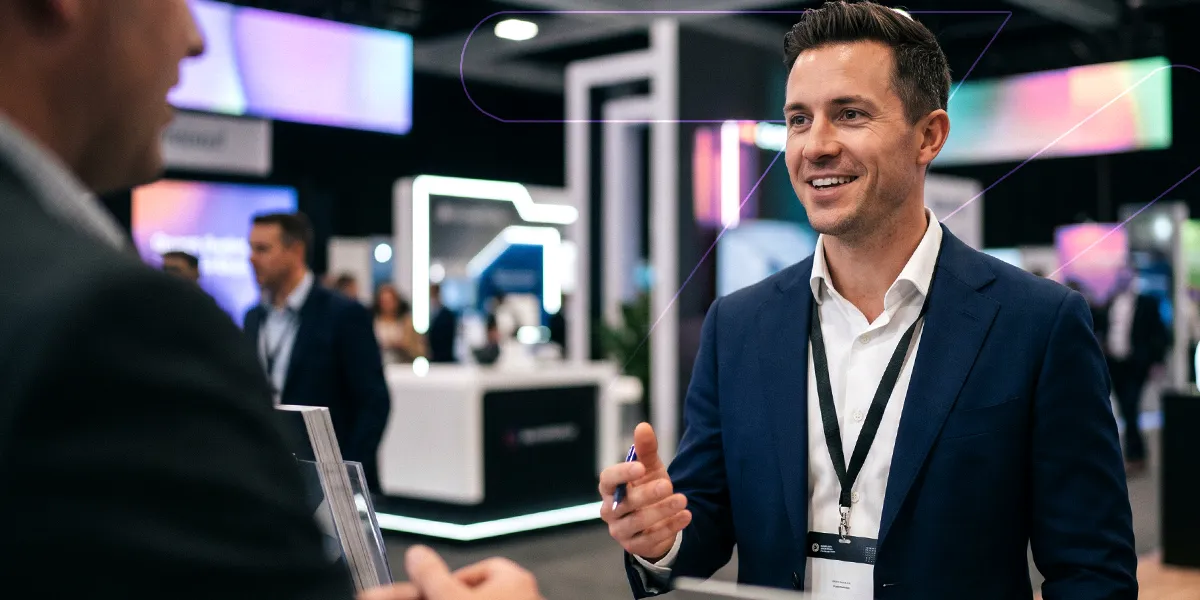
Trade shows, conferences, business roundtables, industry expos. Anyone who works in B2B sales knows these events have a value that goes beyond coffee and badge pickup. It's where business cards become lists, where conversations become opportunities, where the pipeline starts to take shape.
The problem is what comes after.
Most companies collect contacts at events with some efficiency. But when it's time to activate those leads, things start to unravel. Either the company sends messages indiscriminately and ends up blocked, or it leaves the list sitting for fear of getting it wrong. In both cases, the money invested in the event goes down the drain.
And the LGPD added fuel to the fire. Not because it banned commercial communication — it didn't. But because it set rules that, if ignored, turn into lawsuits, fines and a damaged reputation.
This article was written for those who want to understand how to use these contacts correctly: what the law allows, what Meta tolerates, and how to structure WhatsApp campaigns that actually generate results.
Why events remain one of the biggest sources of leads
There is a market logic that doesn't change: people who show up at industry events have already passed through a filter. They have at least some interest in the topic, they have a budget to be there, and they usually hold a decision-making or influencing role.
That's rare in ordinary digital traffic.
When you buy a lead via Google Ads or a website form, you know almost nothing about who filled it in. When you swap business cards in the aisle of an industry trade show, you already have context: the company, the role, the subject being discussed at that moment. That context is worth a lot to whoever is doing the follow-up.
Data from the events sector in Brazil points to consistent growth in the number of corporate trade shows and conferences since 2022, with a strong post-pandemic recovery. Sectors such as healthcare, agribusiness, technology, construction and education run annual calendars with dozens of medium and large events.
The event lead also tends to convert better. The reason is simple: the context of trust has already been established. The person met you, attended a talk, visited your booth. They have a real reference. That shortens the sales cycle.
But all of this only works if the follow-up is done well. And WhatsApp, given its reach and the level at which messages get opened (read rates that reach 90% in B2B), is the channel that makes the most sense for that first approach.
The strategic value of mailing lists captured at events
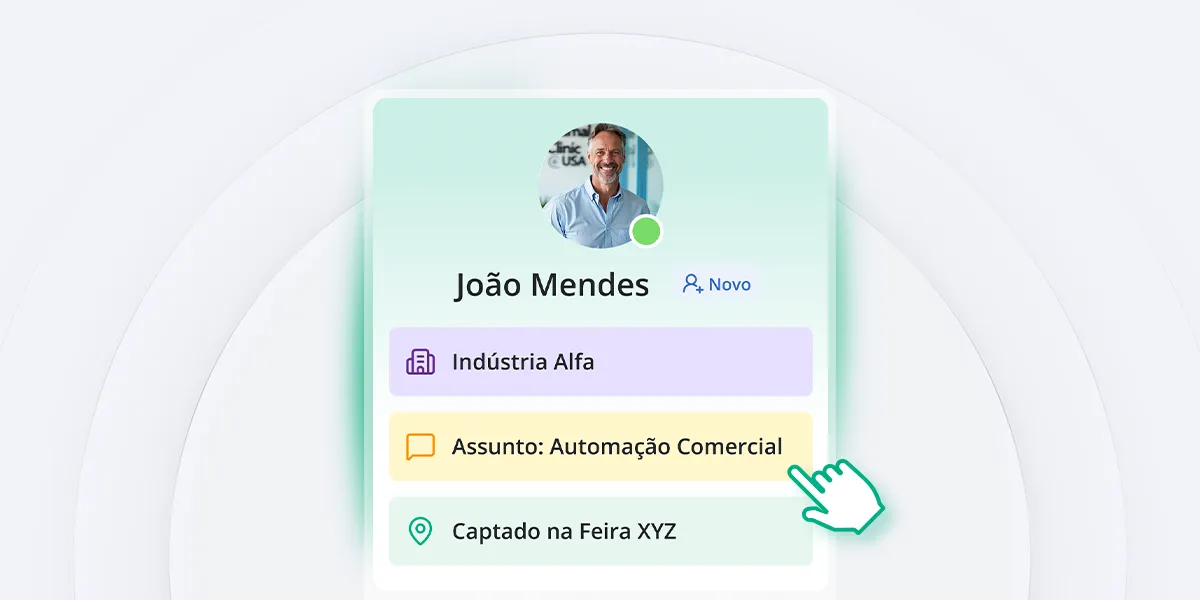
When we talk about an event mailing list, we're talking about a commercial asset. It isn't just a spreadsheet of names and numbers. It's the memory of an interaction that has already happened.
What makes up a good event mailing list:
Contact's full name
Job title and company
Phone number (with or without WhatsApp)
Corporate email
Conversation context (what was discussed, what the person showed interest in)
Capture source (booth, talk, networking, form)
This set of information allows a personalized approach. And personalization, in B2B WhatsApp, isn't optional; it's what separates a campaign that converts from a blast that turns into a report.
The problem starts when the company treats this mailing list as if it were just any list. When the message that goes to the CEO of a chemical manufacturer is the same one that goes to a startup's marketing assistant, the communication loses strength. And when that message arrives with no reference to the event's context, it becomes spam, regardless of the quality of the product or service offered.
What the LGPD says about using these contacts
The General Data Protection Law (Law 13,709/2018) came into full force in 2021. Since then, the use of personal data in Brazil has had clear rules. And business WhatsApp is at the center of this debate.
What counts as personal data under the LGPD?
Name, phone number, email, job title. Any information that makes it possible to identify a natural person. That includes the WhatsApp number collected at an event.
The legal bases for processing data
The LGPD doesn't require everything to go through explicit consent. There are ten legal bases. For B2B commercial communication via WhatsApp, the most relevant are:
Consent (Art. 7, I): The person expressly authorized the sending. It's the safest basis, but not always the most practical in event contexts.
Legitimate interest (Art. 7, IX): Allows the use of data when there is a legitimate interest of the controller, as long as the data subject's rights don't override it. For B2B communication between companies in the same sector, after an in-person interaction, this basis can be applied, as long as it is documented.
Performance of a contract or pre-contractual procedures (Art. 7, V): When the contact is directly related to a proposal or negotiation in progress.
The legal basis must exist before the first contact, not after.
What the LGPD doesn't prohibit
The LGPD doesn't prohibit you from contacting someone you met at an event. It requires that you:
Have a legal basis for it.
Tell the data subject how their data is used.
Allow the data subject to request removal from your list.
Document the capture and processing procedure.
Companies that build this process have much more peace of mind working with event mailing lists. Those that ignore it are exposed to complaints to the ANPD (National Data Protection Authority) and civil lawsuits.
When a company can and can't contact someone on WhatsApp
This is the question that comes up most in practice. The answer isn't binary: it depends on context.
When you can make contact | When you shouldn't make contact |
|---|---|
The contact was established at an event and there was an active exchange of information (business card, form, QR Code). | The number was obtained from a purchased list or one supplied by third parties with no traceability. |
There is a prior or ongoing business relationship. | The data subject has never interacted with your company. |
The data subject authorized receiving communications at the time of capture. | The communication has no relation to the event's context. |
The message is directly related to the context in which the contact was captured. | The message is clearly promotional with no contextualization at all. |
The company has documentation supporting the legal basis used. | The data subject has already asked to be removed from the list. |
A practical rule that helps with this decision: if you can't explain in one sentence why this person should receive your message, they probably shouldn't.
The risks of using lists inappropriately
This is where many companies learn the most expensive way.
Reports and restrictions at Meta
WhatsApp, which belongs to Meta, has a number reputation rating system. Each WhatsApp Business account has a score that rises or falls depending on users' interactions.
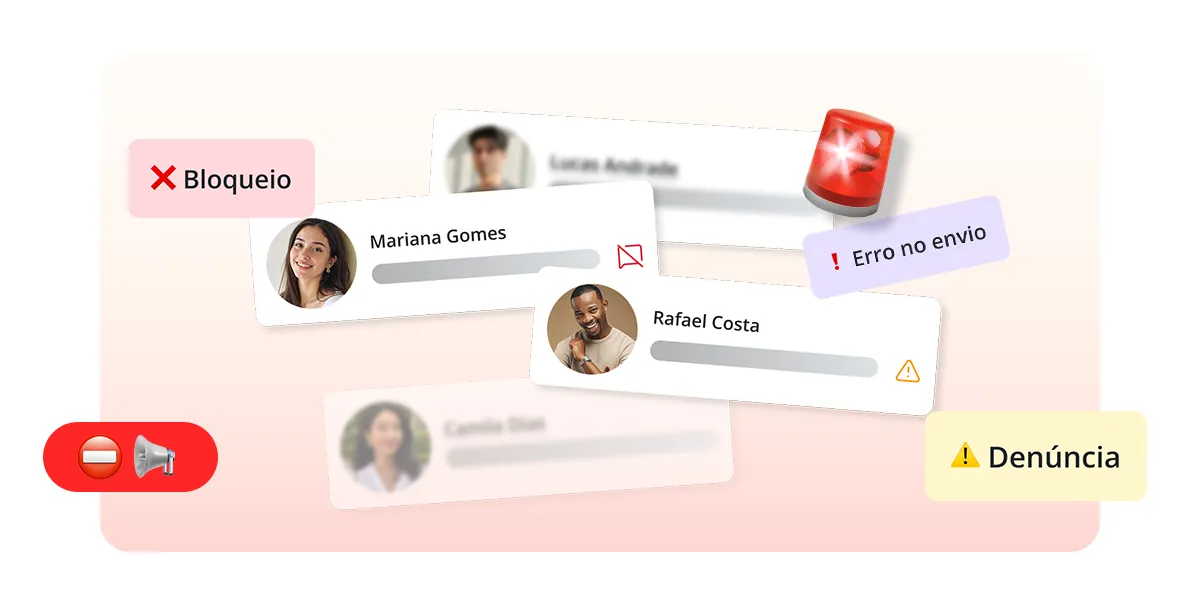
When someone receives a message and marks it as spam, or blocks the number, that counts negatively toward the score. Beyond a certain volume of reports, Meta can:
Reduce the daily message limit the number can send
Put the number under review status
Temporarily suspend the account
Permanently ban the number
Drop in quality and deliverability
The number's reputation directly affects message deliverability. A number with a low reputation starts having messages that simply don't arrive, or arrive late. The channel loses effectiveness before it is formally blocked.
Legal impact
Complaints to the ANPD aren't rare. Fines for LGPD violations can reach 2% of the company's revenue in Brazil in the last fiscal year, capped at R$ 50 million per infraction. In addition, the reputational damage with customers and partners tends to be costlier than the fine itself.
The problem with purchased lists
Buying contact lists is still a common practice in the market, but increasingly risky. These lists generally have no documented legal basis, no consent from data subjects, and tend to be of low quality (outdated numbers, wrong companies, out-of-context job titles).
Using a purchased list on WhatsApp is the fastest path to blocking and lawsuits.
Difference between regular WhatsApp, WhatsApp Business and WhatsApp Business API
This is a frequent point of confusion — and one with direct implications for companies that want to communicate at scale.
Feature | Regular WhatsApp | WhatsApp Business | WhatsApp Business API |
|---|---|---|---|
Target audience | Personal use | Small businesses | Mid-sized and large companies |
Number of devices | 1 main device | 1 main device | Third-party app |
Bulk sending | Not allowed | Broadcast list (limited) | Allowed via approved campaigns |
Message templates | No | No | Yes (approved by Meta) |
Meta compliance | Low | Medium | High |
Risk of blocking | High | Medium | Low (if well operated) |
CRM integration | No | Limited | Yes |
Metrics and reports | No | Basic | Complete |
Chatbot support | No | Yes | Yes |
LGPD suitability | Hard to document | Partial | Yes, with correct processes |
Zapper is an official Meta partner and operates mainly in the WhatsApp Business scenario, for companies that need to keep multiple individual numbers and use them inside the app itself, but with appropriate management.
In addition, we also offer the hybrid path, making it possible to add a WhatsApp API inbox to the account management.
How to create LGPD-compliant WhatsApp campaigns
Compliance isn't an obstacle to commercial communication. It is a structure that, when well set up, protects the company and improves results.
Step 1: Document the capture
At the event, record:
How the contact was obtained (physical form, digital form, business card swap, QR Code)
Whether there was an explicit mention of commercial use of the data
The date and the specific event
This builds the backing for the legal basis you'll use in the communication.
Step 2: Organize the list by segment
Don't mix contacts with different profiles in the same campaign. Segment by:
Industry
Job title and decision level
Interest shown at the event
Funnel stage (hot, warm, cold)
Step 3: Build the first-contact message
The first message to an event contact has to:
Clearly identify your company
Reference the event and the context of the contact
Offer something of value before asking for anything
Include a clear way out (an option to stop receiving messages)
Example structure:
"Hi, [name]. My name is [name], from [company]. We met at [event name] last week, when we talked about [context]. I'd like to share [something of value] and see whether it makes sense for us to talk more. If you'd rather not receive updates here, just let me know."
This structure is longer than many companies usually use, but the positive response rate tends to make up for it. Personalization and context are what set communication apart from spam.
Step 4: Use appropriate infrastructure
Mass sends require intelligence. Our solution understands the context of the send and recommends the best senders for the selected recipients. We created a process based on their conversation history that reduces the risk of bans and can run in a hybrid way, combining sends from WhatsApp Business numbers and the WhatsApp API.
Learn more about Zapper's broadcast feature: https://zapper.to/flow
Step 5: Monitor and optimize
Track:
Message open rate
Reply rate
Number of blocks and reports
Conversions generated
A high number of blocks right at the start is a sign the list is poor quality or the approach is wrong. This needs to be fixed before scaling up the volume.
Best practices for activating event leads
A few practices that separate campaigns that work from those that only generate blocks:
Activate early. The best time to contact an event lead is within 48 to 72 hours after the event. The memory of the conversation is still fresh. After a week, the context starts to fade.
Personalize beyond the name. Mentioning the event is the minimum. Referencing a specific topic that was discussed, a product the person showed interest in, or a problem they mentioned makes all the difference in the reply rate.
Create a sequence, not a single blast. Most conversions don't happen on the first message. An event lead may need three to five touchpoints before replying. Structure a cadence with reasonable spacing between messages.
Respect the hours. Business messages on B2B WhatsApp work best during business hours: Tuesday to Thursday, between 9 a.m. and 6 p.m. Messages outside those hours have lower reply rates and more chance of causing annoyance.
Have content to offer. An approach only works when you have something of value to give before asking. A report, an analysis, a success story relevant to the person's sector, anything that justifies the contact beyond the intent to sell.
Always include a way out. "If you'd rather not receive more messages, just tell me" isn't weakness, it's respect. And in practice, those who ask to leave rarely would have bought anyway.
How to turn event contacts into real business opportunities
The event lead isn't a sale. It's the start of a conversation.
Most companies lose these leads because they treat the follow-up as a single blast of product information. That doesn't work. What works is building relevance over time.
The sequence that tends to work
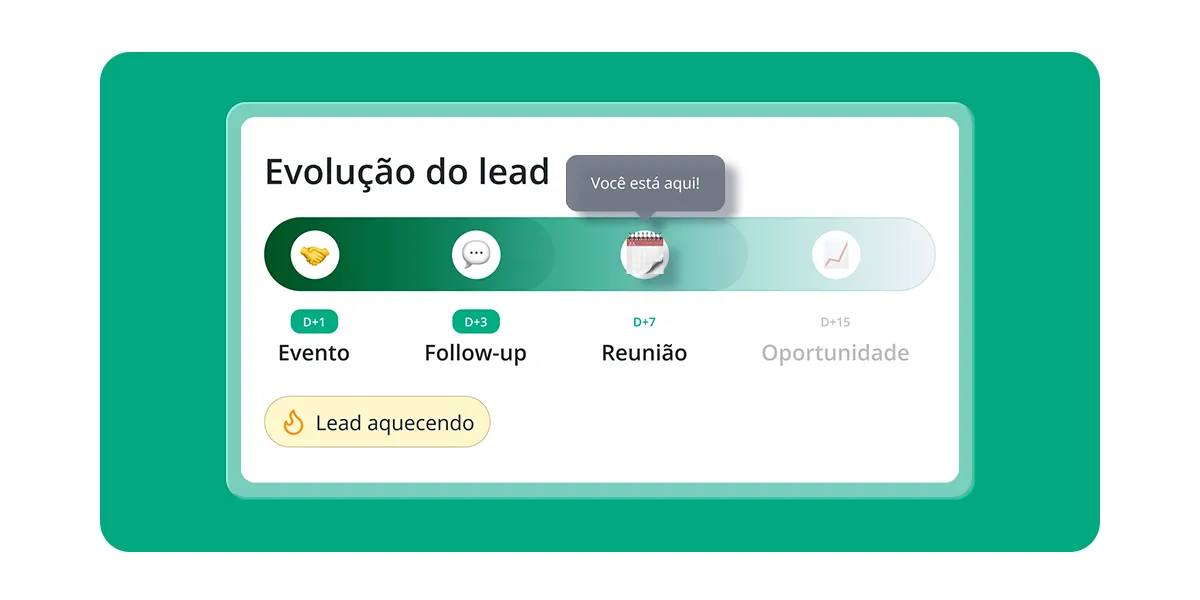
Message 1 (D+1 to D+3 after the event): Picking the context back up. Reference to the conversation. Offer of something useful.
Message 2 (D+7 to D+10): Content relevant to the problem the person mentioned. No direct pitch.
Message 3 (D+15 to D+20): Invitation to a deeper conversation. It can be a demo, a meeting, a free diagnostic — depending on what you sell.
Message 4 (D+30): Check-in. "Has anything changed in your situation?" An open question that makes room to update the context.
If none of these interactions gets engagement, the lead goes to the long-term list — with less frequent, more widely spaced contacts.
FAQ: frequently asked questions about the LGPD and business WhatsApp
Can I message someone I met at an event?
Yes, as long as there is a legal basis for it. Exchanging business cards or filling in a form at the event, when accompanied by clear information about the use of the data for commercial communication, establishes the basis of legitimate interest or consent. The context needs to be documented.
Does the LGPD allow using contacts captured at trade shows and conferences?
It does, but with conditions. The use needs to be compatible with the purpose stated at the time of capture. If the person handed over their card during a conversation about a specific solution, contact about that topic is appropriate. Using that same contact for completely different communication can be challenged.
Can I send messages to a purchased list?
It's not recommended. Purchased lists generally have no documented legal basis, which exposes the company to LGPD violations. In addition, the quality of these lists tends to be low, with a high rate of blocks and reports, which puts the number at risk of being banned by Meta.
How can I avoid blocks by Meta when sending campaigns?
By using approved partner platforms, such as Zapper's solutions, you ensure quality and efficiency for your team and can constantly improve your team's results by reading the stored data. High volumes of blocks and reports are the main triggers for restrictions.
What is a message template on WhatsApp Business?
Templates are message formats pre-approved by Meta for use in campaigns, that is, communications to contacts who haven't yet started a conversation with your company. They need to be registered and approved before use. Messages outside the template can be sent only within active service windows (when the customer started contact in the last 24 hours).
What should I do when a contact asks to be removed from the list?
Remove them immediately and document the removal. The LGPD guarantees the data subject the right to request deletion of their data at any time. Continuing to send messages after that request is a direct violation of the law, and also results in more reports to Meta.
Is there a maximum number of messages I can send per day?
On WhatsApp Business, the daily message limit varies according to the number's quality level and the account type. New accounts start with lower limits and can grow as they demonstrate good sending quality. Accounts with a history of reports have their limits reduced or suspended. With Zapper, your message volume is released per user.
Do I need a lawyer to implement LGPD compliance?
Not necessarily for day-to-day operation, but it's advisable to have at least a legal review of the data capture and processing procedure. For companies with large volumes of data or that operate in regulated sectors, having a designated DPO (Data Protection Officer) may be necessary.
Is business WhatsApp better than email for activating event leads?
For initial event follow-up, generally yes. WhatsApp open rates are significantly higher than corporate email's. But the best results usually come from a combination of the two channels: WhatsApp for initial contact and urgency, email for longer content and formal documentation.
Conclusion: from list to deal, with process and no shortcuts
Corporate events generate real opportunities. Those who invest time and energy in these spaces leave with contacts worth more than any anonymous form lead, because they come with context, with a face, with a conversation.
The problem was never the list. The problem was the lack of a process to activate it.
The LGPD isn't the villain in this story. It established rules that, when followed, protect both the consumer and the company. Commercial communication via WhatsApp is completely viable within the law, as long as there is a documented legal basis, a purpose compatible with the capture context, and respect for the data subject's wishes.
What isn't viable is continuing to use WhatsApp as if it were a mass-spamming channel with no consequences. Meta has control mechanisms that get stronger every year. The cost of a blocked number, in lost leads, in reputation, in rebuilding the channel — is too high to ignore.
Companies that want to communicate at scale via WhatsApp need official infrastructure. And that's where the need for platforms that operate within Meta's policies comes in.
Zapper is a corporate communication platform via WhatsApp built on Meta's official infrastructure. The Campaigns feature lets companies send messages to contact lists with segmentation control, approved templates and deliverability monitoring, all within the platform's policies.
For sales teams that need to activate event lists with consistency and traceability, this means being able to scale follow-up without compromising the channel. With proper segmentation, message personalization and integration with the CRM process, it is possible to turn a list of 300 contacts from an event into a real pipeline, without risking a block, without exposing the company to LGPD penalties, and without relying on operational workarounds.
The difference between a list sitting idle and a campaign that converts lies in the process. The process exists. The infrastructure exists. What's missing, in many cases, is simply getting started.
Quick glossary
LGPD: General Data Protection Law (Law 13,709/2018). Regulates the processing of personal data in Brazil.
ANPD: National Data Protection Authority. The body responsible for overseeing compliance with the LGPD.
Legal basis: Legal foundation that authorizes the processing of personal data. Without a legal basis, any use of data is irregular.
Legitimate interest: One of the LGPD's legal bases. Allows data processing when there is a legitimate interest of the controller, as long as it doesn't override the data subject's rights.
WhatsApp Business API: Meta's official infrastructure for corporate communication at scale via WhatsApp. Requires approval and use through partner platforms.
BSP (Business Solution Provider): A partner company approved by Meta to offer access to the WhatsApp Business API.
Message template: Message format pre-approved by Meta for use in WhatsApp Business API campaigns.
DPO (Data Protection Officer): The person in charge of data protection. A role defined by the LGPD for organizations that process large volumes of personal data.
Mailing: List of contacts used for direct communication — by email, WhatsApp or other channels.
Reputation rating (Meta): Score Meta assigns to WhatsApp Business API numbers based on the quality of interactions. It influences send limits and the risk of blocking.
Trade shows, conferences, business roundtables, industry expos. Anyone who works in B2B sales knows these events have a value that goes beyond coffee and badge pickup. It's where business cards become lists, where conversations become opportunities, where the pipeline starts to take shape.
The problem is what comes after.
Most companies collect contacts at events with some efficiency. But when it's time to activate those leads, things start to unravel. Either the company sends messages indiscriminately and ends up blocked, or it leaves the list sitting for fear of getting it wrong. In both cases, the money invested in the event goes down the drain.
And the LGPD added fuel to the fire. Not because it banned commercial communication — it didn't. But because it set rules that, if ignored, turn into lawsuits, fines and a damaged reputation.
This article was written for those who want to understand how to use these contacts correctly: what the law allows, what Meta tolerates, and how to structure WhatsApp campaigns that actually generate results.
Why events remain one of the biggest sources of leads
There is a market logic that doesn't change: people who show up at industry events have already passed through a filter. They have at least some interest in the topic, they have a budget to be there, and they usually hold a decision-making or influencing role.
That's rare in ordinary digital traffic.
When you buy a lead via Google Ads or a website form, you know almost nothing about who filled it in. When you swap business cards in the aisle of an industry trade show, you already have context: the company, the role, the subject being discussed at that moment. That context is worth a lot to whoever is doing the follow-up.
Data from the events sector in Brazil points to consistent growth in the number of corporate trade shows and conferences since 2022, with a strong post-pandemic recovery. Sectors such as healthcare, agribusiness, technology, construction and education run annual calendars with dozens of medium and large events.
The event lead also tends to convert better. The reason is simple: the context of trust has already been established. The person met you, attended a talk, visited your booth. They have a real reference. That shortens the sales cycle.
But all of this only works if the follow-up is done well. And WhatsApp, given its reach and the level at which messages get opened (read rates that reach 90% in B2B), is the channel that makes the most sense for that first approach.
The strategic value of mailing lists captured at events
When we talk about an event mailing list, we're talking about a commercial asset. It isn't just a spreadsheet of names and numbers. It's the memory of an interaction that has already happened.
What makes up a good event mailing list:
Contact's full name
Job title and company
Phone number (with or without WhatsApp)
Corporate email
Conversation context (what was discussed, what the person showed interest in)
Capture source (booth, talk, networking, form)
This set of information allows a personalized approach. And personalization, in B2B WhatsApp, isn't optional; it's what separates a campaign that converts from a blast that turns into a report.
The problem starts when the company treats this mailing list as if it were just any list. When the message that goes to the CEO of a chemical manufacturer is the same one that goes to a startup's marketing assistant, the communication loses strength. And when that message arrives with no reference to the event's context, it becomes spam, regardless of the quality of the product or service offered.
What the LGPD says about using these contacts
The General Data Protection Law (Law 13,709/2018) came into full force in 2021. Since then, the use of personal data in Brazil has had clear rules. And business WhatsApp is at the center of this debate.
What counts as personal data under the LGPD?
Name, phone number, email, job title. Any information that makes it possible to identify a natural person. That includes the WhatsApp number collected at an event.
The legal bases for processing data
The LGPD doesn't require everything to go through explicit consent. There are ten legal bases. For B2B commercial communication via WhatsApp, the most relevant are:
Consent (Art. 7, I): The person expressly authorized the sending. It's the safest basis, but not always the most practical in event contexts.
Legitimate interest (Art. 7, IX): Allows the use of data when there is a legitimate interest of the controller, as long as the data subject's rights don't override it. For B2B communication between companies in the same sector, after an in-person interaction, this basis can be applied, as long as it is documented.
Performance of a contract or pre-contractual procedures (Art. 7, V): When the contact is directly related to a proposal or negotiation in progress.
The legal basis must exist before the first contact, not after.
What the LGPD doesn't prohibit
The LGPD doesn't prohibit you from contacting someone you met at an event. It requires that you:
Have a legal basis for it.
Tell the data subject how their data is used.
Allow the data subject to request removal from your list.
Document the capture and processing procedure.
Companies that build this process have much more peace of mind working with event mailing lists. Those that ignore it are exposed to complaints to the ANPD (National Data Protection Authority) and civil lawsuits.
When a company can and can't contact someone on WhatsApp
This is the question that comes up most in practice. The answer isn't binary: it depends on context.
When you can make contact | When you shouldn't make contact |
|---|---|
The contact was established at an event and there was an active exchange of information (business card, form, QR Code). | The number was obtained from a purchased list or one supplied by third parties with no traceability. |
There is a prior or ongoing business relationship. | The data subject has never interacted with your company. |
The data subject authorized receiving communications at the time of capture. | The communication has no relation to the event's context. |
The message is directly related to the context in which the contact was captured. | The message is clearly promotional with no contextualization at all. |
The company has documentation supporting the legal basis used. | The data subject has already asked to be removed from the list. |
A practical rule that helps with this decision: if you can't explain in one sentence why this person should receive your message, they probably shouldn't.
The risks of using lists inappropriately
This is where many companies learn the most expensive way.
Reports and restrictions at Meta
WhatsApp, which belongs to Meta, has a number reputation rating system. Each WhatsApp Business account has a score that rises or falls depending on users' interactions.
When someone receives a message and marks it as spam, or blocks the number, that counts negatively toward the score. Beyond a certain volume of reports, Meta can:
Reduce the daily message limit the number can send
Put the number under review status
Temporarily suspend the account
Permanently ban the number
Drop in quality and deliverability
The number's reputation directly affects message deliverability. A number with a low reputation starts having messages that simply don't arrive, or arrive late. The channel loses effectiveness before it is formally blocked.
Legal impact
Complaints to the ANPD aren't rare. Fines for LGPD violations can reach 2% of the company's revenue in Brazil in the last fiscal year, capped at R$ 50 million per infraction. In addition, the reputational damage with customers and partners tends to be costlier than the fine itself.
The problem with purchased lists
Buying contact lists is still a common practice in the market, but increasingly risky. These lists generally have no documented legal basis, no consent from data subjects, and tend to be of low quality (outdated numbers, wrong companies, out-of-context job titles).
Using a purchased list on WhatsApp is the fastest path to blocking and lawsuits.
Difference between regular WhatsApp, WhatsApp Business and WhatsApp Business API
This is a frequent point of confusion — and one with direct implications for companies that want to communicate at scale.
Feature | Regular WhatsApp | WhatsApp Business | WhatsApp Business API |
|---|---|---|---|
Target audience | Personal use | Small businesses | Mid-sized and large companies |
Number of devices | 1 main device | 1 main device | Third-party app |
Bulk sending | Not allowed | Broadcast list (limited) | Allowed via approved campaigns |
Message templates | No | No | Yes (approved by Meta) |
Meta compliance | Low | Medium | High |
Risk of blocking | High | Medium | Low (if well operated) |
CRM integration | No | Limited | Yes |
Metrics and reports | No | Basic | Complete |
Chatbot support | No | Yes | Yes |
LGPD suitability | Hard to document | Partial | Yes, with correct processes |
Zapper is an official Meta partner and operates mainly in the WhatsApp Business scenario, for companies that need to keep multiple individual numbers and use them inside the app itself, but with appropriate management.
In addition, we also offer the hybrid path, making it possible to add a WhatsApp API inbox to the account management.
How to create LGPD-compliant WhatsApp campaigns
Compliance isn't an obstacle to commercial communication. It is a structure that, when well set up, protects the company and improves results.
Step 1: Document the capture
At the event, record:
How the contact was obtained (physical form, digital form, business card swap, QR Code)
Whether there was an explicit mention of commercial use of the data
The date and the specific event
This builds the backing for the legal basis you'll use in the communication.
Step 2: Organize the list by segment
Don't mix contacts with different profiles in the same campaign. Segment by:
Industry
Job title and decision level
Interest shown at the event
Funnel stage (hot, warm, cold)
Step 3: Build the first-contact message
The first message to an event contact has to:
Clearly identify your company
Reference the event and the context of the contact
Offer something of value before asking for anything
Include a clear way out (an option to stop receiving messages)
Example structure:
"Hi, [name]. My name is [name], from [company]. We met at [event name] last week, when we talked about [context]. I'd like to share [something of value] and see whether it makes sense for us to talk more. If you'd rather not receive updates here, just let me know."
This structure is longer than many companies usually use, but the positive response rate tends to make up for it. Personalization and context are what set communication apart from spam.
Step 4: Use appropriate infrastructure
Mass sends require intelligence. Our solution understands the context of the send and recommends the best senders for the selected recipients. We created a process based on their conversation history that reduces the risk of bans and can run in a hybrid way, combining sends from WhatsApp Business numbers and the WhatsApp API.
Learn more about Zapper's broadcast feature: https://zapper.to/flow
Step 5: Monitor and optimize
Track:
Message open rate
Reply rate
Number of blocks and reports
Conversions generated
A high number of blocks right at the start is a sign the list is poor quality or the approach is wrong. This needs to be fixed before scaling up the volume.
Best practices for activating event leads
A few practices that separate campaigns that work from those that only generate blocks:
Activate early. The best time to contact an event lead is within 48 to 72 hours after the event. The memory of the conversation is still fresh. After a week, the context starts to fade.
Personalize beyond the name. Mentioning the event is the minimum. Referencing a specific topic that was discussed, a product the person showed interest in, or a problem they mentioned makes all the difference in the reply rate.
Create a sequence, not a single blast. Most conversions don't happen on the first message. An event lead may need three to five touchpoints before replying. Structure a cadence with reasonable spacing between messages.
Respect the hours. Business messages on B2B WhatsApp work best during business hours: Tuesday to Thursday, between 9 a.m. and 6 p.m. Messages outside those hours have lower reply rates and more chance of causing annoyance.
Have content to offer. An approach only works when you have something of value to give before asking. A report, an analysis, a success story relevant to the person's sector, anything that justifies the contact beyond the intent to sell.
Always include a way out. "If you'd rather not receive more messages, just tell me" isn't weakness, it's respect. And in practice, those who ask to leave rarely would have bought anyway.
How to turn event contacts into real business opportunities
The event lead isn't a sale. It's the start of a conversation.
Most companies lose these leads because they treat the follow-up as a single blast of product information. That doesn't work. What works is building relevance over time.
The sequence that tends to work
Message 1 (D+1 to D+3 after the event): Picking the context back up. Reference to the conversation. Offer of something useful.
Message 2 (D+7 to D+10): Content relevant to the problem the person mentioned. No direct pitch.
Message 3 (D+15 to D+20): Invitation to a deeper conversation. It can be a demo, a meeting, a free diagnostic — depending on what you sell.
Message 4 (D+30): Check-in. "Has anything changed in your situation?" An open question that makes room to update the context.
If none of these interactions gets engagement, the lead goes to the long-term list — with less frequent, more widely spaced contacts.
FAQ: frequently asked questions about the LGPD and business WhatsApp
Can I message someone I met at an event?
Yes, as long as there is a legal basis for it. Exchanging business cards or filling in a form at the event, when accompanied by clear information about the use of the data for commercial communication, establishes the basis of legitimate interest or consent. The context needs to be documented.
Does the LGPD allow using contacts captured at trade shows and conferences?
It does, but with conditions. The use needs to be compatible with the purpose stated at the time of capture. If the person handed over their card during a conversation about a specific solution, contact about that topic is appropriate. Using that same contact for completely different communication can be challenged.
Can I send messages to a purchased list?
It's not recommended. Purchased lists generally have no documented legal basis, which exposes the company to LGPD violations. In addition, the quality of these lists tends to be low, with a high rate of blocks and reports, which puts the number at risk of being banned by Meta.
How can I avoid blocks by Meta when sending campaigns?
By using approved partner platforms, such as Zapper's solutions, you ensure quality and efficiency for your team and can constantly improve your team's results by reading the stored data. High volumes of blocks and reports are the main triggers for restrictions.
What is a message template on WhatsApp Business?
Templates are message formats pre-approved by Meta for use in campaigns, that is, communications to contacts who haven't yet started a conversation with your company. They need to be registered and approved before use. Messages outside the template can be sent only within active service windows (when the customer started contact in the last 24 hours).
What should I do when a contact asks to be removed from the list?
Remove them immediately and document the removal. The LGPD guarantees the data subject the right to request deletion of their data at any time. Continuing to send messages after that request is a direct violation of the law, and also results in more reports to Meta.
Is there a maximum number of messages I can send per day?
On WhatsApp Business, the daily message limit varies according to the number's quality level and the account type. New accounts start with lower limits and can grow as they demonstrate good sending quality. Accounts with a history of reports have their limits reduced or suspended. With Zapper, your message volume is released per user.
Do I need a lawyer to implement LGPD compliance?
Not necessarily for day-to-day operation, but it's advisable to have at least a legal review of the data capture and processing procedure. For companies with large volumes of data or that operate in regulated sectors, having a designated DPO (Data Protection Officer) may be necessary.
Is business WhatsApp better than email for activating event leads?
For initial event follow-up, generally yes. WhatsApp open rates are significantly higher than corporate email's. But the best results usually come from a combination of the two channels: WhatsApp for initial contact and urgency, email for longer content and formal documentation.
Conclusion: from list to deal, with process and no shortcuts
Corporate events generate real opportunities. Those who invest time and energy in these spaces leave with contacts worth more than any anonymous form lead, because they come with context, with a face, with a conversation.
The problem was never the list. The problem was the lack of a process to activate it.
The LGPD isn't the villain in this story. It established rules that, when followed, protect both the consumer and the company. Commercial communication via WhatsApp is completely viable within the law, as long as there is a documented legal basis, a purpose compatible with the capture context, and respect for the data subject's wishes.
What isn't viable is continuing to use WhatsApp as if it were a mass-spamming channel with no consequences. Meta has control mechanisms that get stronger every year. The cost of a blocked number, in lost leads, in reputation, in rebuilding the channel — is too high to ignore.
Companies that want to communicate at scale via WhatsApp need official infrastructure. And that's where the need for platforms that operate within Meta's policies comes in.
Zapper is a corporate communication platform via WhatsApp built on Meta's official infrastructure. The Campaigns feature lets companies send messages to contact lists with segmentation control, approved templates and deliverability monitoring, all within the platform's policies.
For sales teams that need to activate event lists with consistency and traceability, this means being able to scale follow-up without compromising the channel. With proper segmentation, message personalization and integration with the CRM process, it is possible to turn a list of 300 contacts from an event into a real pipeline, without risking a block, without exposing the company to LGPD penalties, and without relying on operational workarounds.
The difference between a list sitting idle and a campaign that converts lies in the process. The process exists. The infrastructure exists. What's missing, in many cases, is simply getting started.
Quick glossary
LGPD: General Data Protection Law (Law 13,709/2018). Regulates the processing of personal data in Brazil.
ANPD: National Data Protection Authority. The body responsible for overseeing compliance with the LGPD.
Legal basis: Legal foundation that authorizes the processing of personal data. Without a legal basis, any use of data is irregular.
Legitimate interest: One of the LGPD's legal bases. Allows data processing when there is a legitimate interest of the controller, as long as it doesn't override the data subject's rights.
WhatsApp Business API: Meta's official infrastructure for corporate communication at scale via WhatsApp. Requires approval and use through partner platforms.
BSP (Business Solution Provider): A partner company approved by Meta to offer access to the WhatsApp Business API.
Message template: Message format pre-approved by Meta for use in WhatsApp Business API campaigns.
DPO (Data Protection Officer): The person in charge of data protection. A role defined by the LGPD for organizations that process large volumes of personal data.
Mailing: List of contacts used for direct communication — by email, WhatsApp or other channels.
Reputation rating (Meta): Score Meta assigns to WhatsApp Business API numbers based on the quality of interactions. It influences send limits and the risk of blocking.