

Gestão
Feedback without data is opinion disguised as leadership
No more feedback based on "I think so." Turn your team’s communication into real data for fair, high-performance management.
Zapper Team
·
·
11 min of reading

Let's speak the truth: most feedback sessions in the corporate world fail. The manager sits down with an employee for a conversation that should be constructive, but which is often based on impressions, recent memories, and subjective feelings. Phrases like "I feel you could be more proactive" or "I got the impression that your engagement dropped last month" are common. The problem? Without concrete evidence, that is not feedback. It is opinion.
And basing your decision-making solely on your opinion is dangerous ground for people management. Decisions like this open the door to biases, insecurities and, in the end, do not offer a clear path for development. The employee leaves the room confused, without exactly understanding what needs to change, and the leader leaves frustrated, feeling that the conversation did not have the desired impact.
The truth is that effective leadership in the 21st century can no longer rely only on intuition. Organizational maturity requires one more step: complement human judgment with what is unquestionable. And what is unquestionable is data.
This article will show why memory-based feedback is a trap and how to turn your team's daily communication into a rich source of evidence for fair, transparent, and truly effective performance management. It is time to move from a culture of opinion to a culture of data-based feedback.
Memory-based feedback is structurally limited
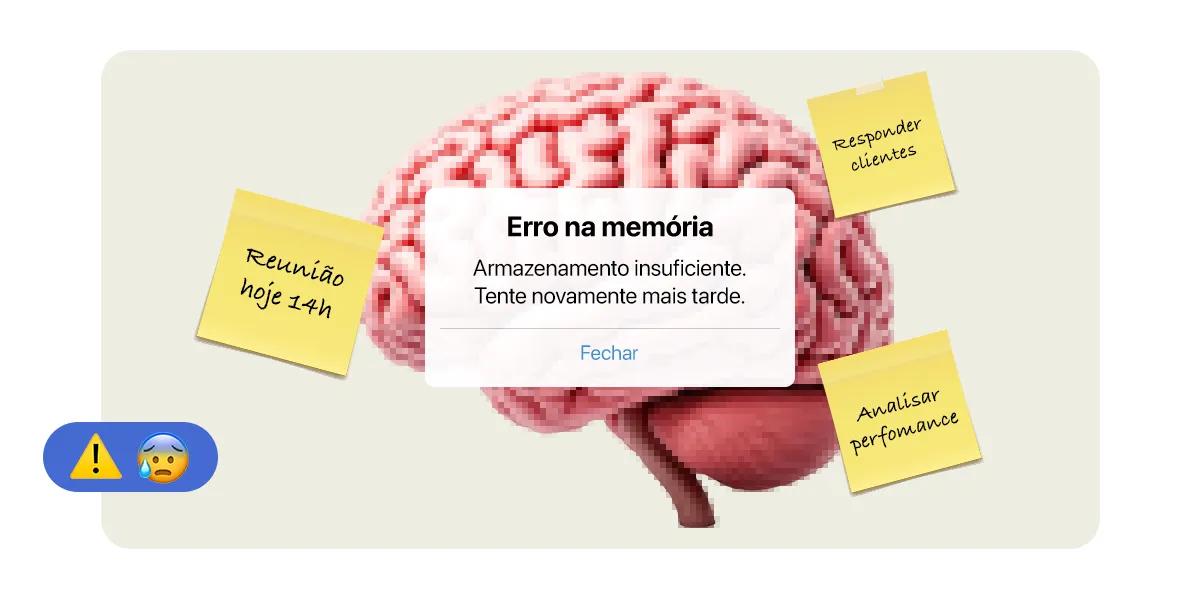
The human brain is a fantastic processing machine, but a terrible archivist. When a leader relies exclusively on memory to give feedback about a six-month or one-year period, they are, without realizing it, falling into cognitive traps that distort reality. Selective memory is not a character flaw; it is a feature of our neurological system.
Leaders tend to remember two kinds of events more clearly: those that happened recently and those that had a strong emotional impact. Consistent, daily work without much fanfare, which often makes up most of an employee's performance, ends up getting lost in the fog of time. This cognitive bias in leadership compromises the fairness and accuracy of any performance review that is not structured.
The effect of recent memory
Recency bias is one of the biggest villains in corporate feedback. Imagine a salesperson who consistently hit targets for eleven months, but had a weak last month due to a crisis in the industry. At annual review time, it is very likely that this last month will weigh disproportionately in the manager's perception. The brain gives priority to the freshest information.
The result is distorted feedback, focused on the recent slip and ignoring a long track record of success. The employee feels wronged, because their ongoing effort was overshadowed by a one-off event. A structured performance review, based on performance data across the entire period, would eliminate this problem, showing the full picture and not just the last chapter.
The weight of emotional impact
Events with a strong emotional charge, whether extremely positive or negative, are recorded in our memory much more intensely. A single project that went very wrong and created a crisis with an important client can stain the perception of an employee for an entire year. Likewise, a major success, a spectacular sale, or the solution to a complex problem can create a "halo effect," where the leader begins to ignore small recurring flaws.
Leadership that relies on these emotional peaks to assess performance is, in practice, judging exceptions instead of the rule. Effective performance management needs to analyze the average, the consistency, and the progress, not just the outliers that drew the most attention.
Patterns ignored over time
The direct consequence of recency and emotional-impact biases is the inability to see long-term behavior patterns. An employee who consistently delivers their tasks one day late, for example, may never receive feedback about it if the delay never triggers an emotional crisis. It is a small problem, but one that, when accumulated over the year, can have a significant impact on the team's productivity.
Likewise, a professional who shows constant proactivity in small daily actions, such as helping colleagues or suggesting simple improvements, may go unnoticed if they never perform a major "heroic act." Without monitoring interactions and collecting behavioral metrics, these valuable patterns — both positive and negative — remain invisible, and the opportunity for development is lost.
Without data, feedback creates insecurity

When feedback is subjective, the negative impact extends beyond inaccuracy. It creates an unstable and anxious work environment. The lack of objective evidence to support evaluations undermines trust, makes professional growth difficult, and may even be perceived as harassment or favoritism.
For the employee, the feeling is like walking on eggshells. The rules of the game are not clear, and success seems to depend more on pleasing the leader's perception than on delivering concrete results. This uncertainty is toxic for motivation and for building a relationship of trust, which is the foundation of any high-performance team.
Unclear criteria
"I need you to be more assertive." What does that mean, exactly? That the employee should speak more in meetings? Make decisions without consulting the manager? Deliver tasks before the deadline? Without data and concrete examples, feedback like this is just noise.
The lack of objective criteria leaves the employee in the dark. They do not have a roadmap for improvement. Transparent feedback, on the other hand, would be: "I noticed that in the last 30 leads you contacted, in 25 of them the first interaction took more than 24 hours. We need to reduce that time to no more than 8 hours to increase our conversion rate." Here, the problem is clear, measurable, and actionable.
Sense of unfairness
The perception of unfairness is the fastest way to destroy an employee's engagement. When an employee who is dedicated and delivers consistent results receives negative feedback based on a recent failure or on the leader's subjective impression, distrust sets in. They begin to question the integrity of the process and the impartiality of leadership.
This distrust can spread throughout the team, creating a "us versus them" atmosphere. Employees begin to protect themselves instead of collaborating, and the feedback culture, which should be a tool for growth, turns into a tribunal of perceptions. Confidence in decisions, for both the leader and the person being led, is only achieved when the conversation is backed by evidence.
Development without metrics
The ultimate goal of feedback is professional development. But how do you measure progress without a baseline? If the starting point is "you need to improve your communication with the client," how do you know whether the employee actually improved after three months?
Data-driven professional development establishes clear metrics. Instead of vague advice, the manager can say: "Let's analyze the history of your conversations and identify opportunities to use more empathetic language. Our goal is to increase the customer satisfaction score in your interactions by 15% next quarter." With a metric, development stops being an abstraction and becomes a concrete project, with a beginning, middle, and end.
Daily communication already contains valuable data
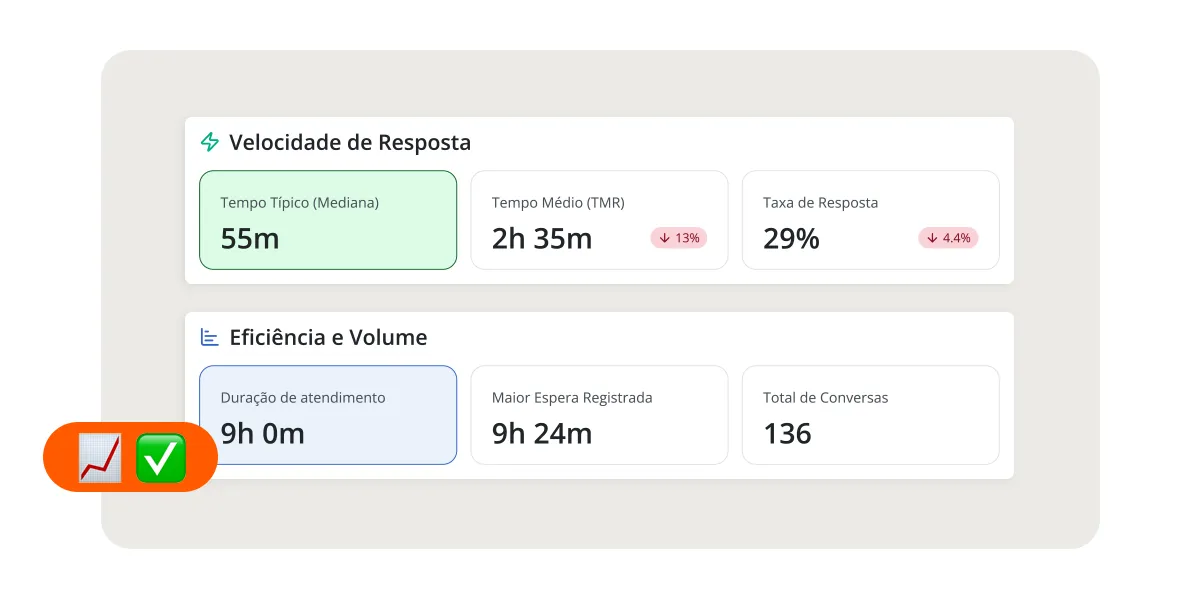
Many companies believe that implementing a data-based feedback culture requires investing in complex and expensive performance management systems. The truth is that, for many of them, especially those that use WhatsApp for sales and service, the largest source of behavioral data already exists and is being completely ignored: daily communication.
Every interaction with a customer, every reply to a lead, every message exchanged in a team group is data. Together, they form a mosaic that reveals behavior, efficiency, and engagement patterns much more accurately than any manager's memory. The challenge is not generating data, but structuring and analyzing it.
Interaction frequency
How many conversations does a salesperson start per day? What is the average response time of a service agent? The frequency and speed of interactions are simple but powerful metrics. They can indicate proactivity, agility, and level of dedication.
A leader who has access to these numbers can quickly identify who is overloaded, who is underutilized, and who is performing at an ideal pace. It is objective information that serves as a starting point for much more productive conversations about time management and productivity.
Engagement with campaigns and leads
Analysis can go far beyond volume. By crossing corporate communication data with CRM information, it is possible to measure real engagement. Of all the leads generated by a marketing campaign and assigned to a salesperson, how many did they actually interact with? How many of those conversations turned into a proposal?
This engagement analysis turns the assessment of a "good salesperson" from a perception into a metric. It allows you to compare the effectiveness of different approaches and identify which team members are most efficient at converting cold contacts into warm opportunities, providing insights to train the rest of the team.
Recurring behavior patterns
This is where the magic happens. By analyzing the content and flow of conversations over time, a manager can identify patterns that would be invisible to the naked eye. Does an employee consistently use positive and empathetic language? Does another resort to discounts too quickly? Does a third show difficulty in overcoming a specific objection?
These are the raw behavioral data that fuel transformative feedback. The central thesis is this: mature leadership does not replace human judgment, it amplifies it. It complements the manager's intuition and experience with a layer of behavioral evidence that makes the feedback conversation unquestionable, fair, and focused on real development.
Organizational maturity is about structuring communication
The transition from opinion-based management to data-driven leadership is a clear sign of organizational maturity. Mature companies understand that their most valuable assets are not only their products or customers, but also the intelligence generated in their daily operations. And communication is perhaps the richest and most underused source of that intelligence.
Structuring communication does not mean making it robotic or rigid. It means implementing processes and tools that capture the interactions that are already happening, turn informal conversations into analyzable metrics, and create a structured communication history. It is about giving meaning to the everyday communication "chaos" in order to extract valuable insights.
An organization that reaches this level of maturity stops putting out fires and starts preventing them from happening. It uses evidence to identify high-performance patterns and replicate them, and to detect deviations from the path before they become chronic problems. Communication stops being merely operational and becomes strategic, a primary source of data for continuous improvement and talent development.
While the conversation is informal, Zapper is evidence
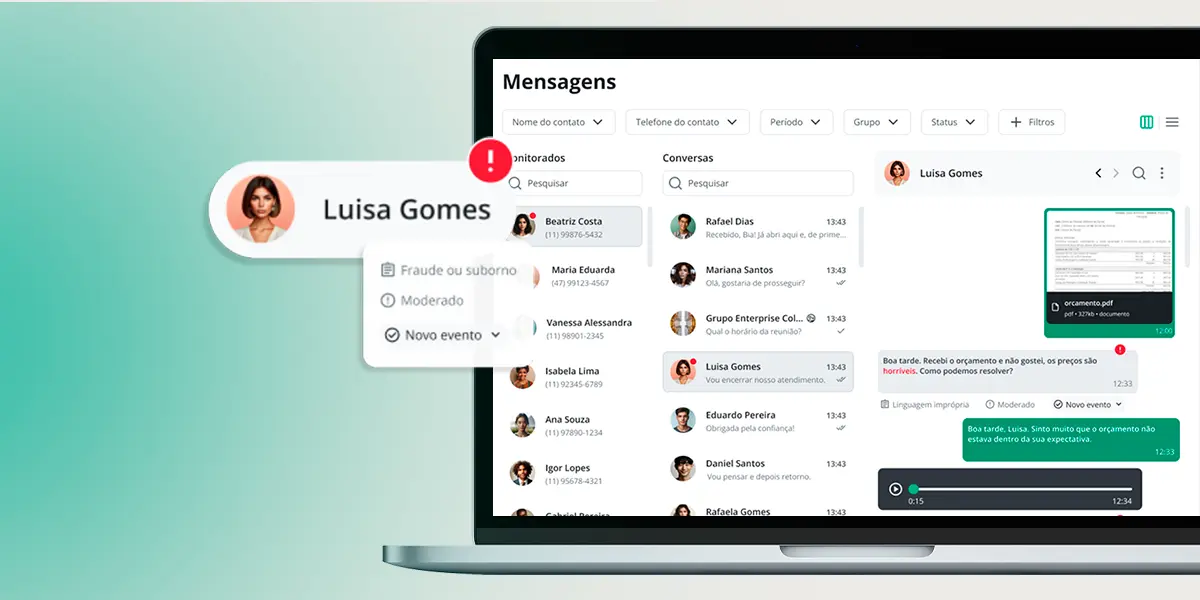
The big challenge for many companies is that the most valuable communication happens on informal platforms like WhatsApp. How do you extract structured data from an environment designed for informality? This is exactly where a strategic technology layer becomes essential.
Zapper was developed to be that layer of evidence. It connects to your WhatsApp operation and turns the continuous flow of messages into an organizational intelligence dashboard. The conversation remains fluid and human for the customer and for the employee, but for the manager it becomes a source of clear, actionable data.
With the tool, managers have access to a complete view of team performance, based on facts, not impressions:
Overview of employees and message volume: Quickly and visually understand who the most active people are and how the workload is distributed.
Distribution and evolution of interactions: Track performance over time, identifying productivity and engagement trends, neutralizing recency bias.
Lead and campaign engagement: Measure the real effectiveness of your marketing and sales actions, knowing exactly how many leads each employee contacted and how those conversations progressed.
Identification of high performance: Use objective data to identify your best talent, understanding what they do differently so you can train the rest of the team.
Alert monitoring and classification: Set up alerts for sensitive keywords (such as "competitor", "complaint", "consumer protection agency") and be notified in real time, allowing a quick and effective intervention.
Exportable communication history: Generate reports and export the full conversation history for audits, detailed performance analysis, or to comply with data governance requirements (LGPD).
The ultimate benefit is the transformation of the feedback process. With Zapper, the conversation about performance changes radically. The manager no longer says "I think that..."; they say "the data shows that...". Feedback stops being a subjective impression and starts to consider real behavior patterns, documented and analyzable. It becomes fair, transparent, and, above all, constructive. This is how you build a true feedback culture, driven by data and focused on growth.
Let's speak the truth: most feedback sessions in the corporate world fail. The manager sits down with an employee for a conversation that should be constructive, but which is often based on impressions, recent memories, and subjective feelings. Phrases like "I feel you could be more proactive" or "I got the impression that your engagement dropped last month" are common. The problem? Without concrete evidence, that is not feedback. It is opinion.
And basing your decision-making solely on your opinion is dangerous ground for people management. Decisions like this open the door to biases, insecurities and, in the end, do not offer a clear path for development. The employee leaves the room confused, without exactly understanding what needs to change, and the leader leaves frustrated, feeling that the conversation did not have the desired impact.
The truth is that effective leadership in the 21st century can no longer rely only on intuition. Organizational maturity requires one more step: complement human judgment with what is unquestionable. And what is unquestionable is data.
This article will show why memory-based feedback is a trap and how to turn your team's daily communication into a rich source of evidence for fair, transparent, and truly effective performance management. It is time to move from a culture of opinion to a culture of data-based feedback.
Memory-based feedback is structurally limited
The human brain is a fantastic processing machine, but a terrible archivist. When a leader relies exclusively on memory to give feedback about a six-month or one-year period, they are, without realizing it, falling into cognitive traps that distort reality. Selective memory is not a character flaw; it is a feature of our neurological system.
Leaders tend to remember two kinds of events more clearly: those that happened recently and those that had a strong emotional impact. Consistent, daily work without much fanfare, which often makes up most of an employee's performance, ends up getting lost in the fog of time. This cognitive bias in leadership compromises the fairness and accuracy of any performance review that is not structured.
The effect of recent memory
Recency bias is one of the biggest villains in corporate feedback. Imagine a salesperson who consistently hit targets for eleven months, but had a weak last month due to a crisis in the industry. At annual review time, it is very likely that this last month will weigh disproportionately in the manager's perception. The brain gives priority to the freshest information.
The result is distorted feedback, focused on the recent slip and ignoring a long track record of success. The employee feels wronged, because their ongoing effort was overshadowed by a one-off event. A structured performance review, based on performance data across the entire period, would eliminate this problem, showing the full picture and not just the last chapter.
The weight of emotional impact
Events with a strong emotional charge, whether extremely positive or negative, are recorded in our memory much more intensely. A single project that went very wrong and created a crisis with an important client can stain the perception of an employee for an entire year. Likewise, a major success, a spectacular sale, or the solution to a complex problem can create a "halo effect," where the leader begins to ignore small recurring flaws.
Leadership that relies on these emotional peaks to assess performance is, in practice, judging exceptions instead of the rule. Effective performance management needs to analyze the average, the consistency, and the progress, not just the outliers that drew the most attention.
Patterns ignored over time
The direct consequence of recency and emotional-impact biases is the inability to see long-term behavior patterns. An employee who consistently delivers their tasks one day late, for example, may never receive feedback about it if the delay never triggers an emotional crisis. It is a small problem, but one that, when accumulated over the year, can have a significant impact on the team's productivity.
Likewise, a professional who shows constant proactivity in small daily actions, such as helping colleagues or suggesting simple improvements, may go unnoticed if they never perform a major "heroic act." Without monitoring interactions and collecting behavioral metrics, these valuable patterns — both positive and negative — remain invisible, and the opportunity for development is lost.
Without data, feedback creates insecurity
When feedback is subjective, the negative impact extends beyond inaccuracy. It creates an unstable and anxious work environment. The lack of objective evidence to support evaluations undermines trust, makes professional growth difficult, and may even be perceived as harassment or favoritism.
For the employee, the feeling is like walking on eggshells. The rules of the game are not clear, and success seems to depend more on pleasing the leader's perception than on delivering concrete results. This uncertainty is toxic for motivation and for building a relationship of trust, which is the foundation of any high-performance team.
Unclear criteria
"I need you to be more assertive." What does that mean, exactly? That the employee should speak more in meetings? Make decisions without consulting the manager? Deliver tasks before the deadline? Without data and concrete examples, feedback like this is just noise.
The lack of objective criteria leaves the employee in the dark. They do not have a roadmap for improvement. Transparent feedback, on the other hand, would be: "I noticed that in the last 30 leads you contacted, in 25 of them the first interaction took more than 24 hours. We need to reduce that time to no more than 8 hours to increase our conversion rate." Here, the problem is clear, measurable, and actionable.
Sense of unfairness
The perception of unfairness is the fastest way to destroy an employee's engagement. When an employee who is dedicated and delivers consistent results receives negative feedback based on a recent failure or on the leader's subjective impression, distrust sets in. They begin to question the integrity of the process and the impartiality of leadership.
This distrust can spread throughout the team, creating a "us versus them" atmosphere. Employees begin to protect themselves instead of collaborating, and the feedback culture, which should be a tool for growth, turns into a tribunal of perceptions. Confidence in decisions, for both the leader and the person being led, is only achieved when the conversation is backed by evidence.
Development without metrics
The ultimate goal of feedback is professional development. But how do you measure progress without a baseline? If the starting point is "you need to improve your communication with the client," how do you know whether the employee actually improved after three months?
Data-driven professional development establishes clear metrics. Instead of vague advice, the manager can say: "Let's analyze the history of your conversations and identify opportunities to use more empathetic language. Our goal is to increase the customer satisfaction score in your interactions by 15% next quarter." With a metric, development stops being an abstraction and becomes a concrete project, with a beginning, middle, and end.
Daily communication already contains valuable data
Many companies believe that implementing a data-based feedback culture requires investing in complex and expensive performance management systems. The truth is that, for many of them, especially those that use WhatsApp for sales and service, the largest source of behavioral data already exists and is being completely ignored: daily communication.
Every interaction with a customer, every reply to a lead, every message exchanged in a team group is data. Together, they form a mosaic that reveals behavior, efficiency, and engagement patterns much more accurately than any manager's memory. The challenge is not generating data, but structuring and analyzing it.
Interaction frequency
How many conversations does a salesperson start per day? What is the average response time of a service agent? The frequency and speed of interactions are simple but powerful metrics. They can indicate proactivity, agility, and level of dedication.
A leader who has access to these numbers can quickly identify who is overloaded, who is underutilized, and who is performing at an ideal pace. It is objective information that serves as a starting point for much more productive conversations about time management and productivity.
Engagement with campaigns and leads
Analysis can go far beyond volume. By crossing corporate communication data with CRM information, it is possible to measure real engagement. Of all the leads generated by a marketing campaign and assigned to a salesperson, how many did they actually interact with? How many of those conversations turned into a proposal?
This engagement analysis turns the assessment of a "good salesperson" from a perception into a metric. It allows you to compare the effectiveness of different approaches and identify which team members are most efficient at converting cold contacts into warm opportunities, providing insights to train the rest of the team.
Recurring behavior patterns
This is where the magic happens. By analyzing the content and flow of conversations over time, a manager can identify patterns that would be invisible to the naked eye. Does an employee consistently use positive and empathetic language? Does another resort to discounts too quickly? Does a third show difficulty in overcoming a specific objection?
These are the raw behavioral data that fuel transformative feedback. The central thesis is this: mature leadership does not replace human judgment, it amplifies it. It complements the manager's intuition and experience with a layer of behavioral evidence that makes the feedback conversation unquestionable, fair, and focused on real development.
Organizational maturity is about structuring communication
The transition from opinion-based management to data-driven leadership is a clear sign of organizational maturity. Mature companies understand that their most valuable assets are not only their products or customers, but also the intelligence generated in their daily operations. And communication is perhaps the richest and most underused source of that intelligence.
Structuring communication does not mean making it robotic or rigid. It means implementing processes and tools that capture the interactions that are already happening, turn informal conversations into analyzable metrics, and create a structured communication history. It is about giving meaning to the everyday communication "chaos" in order to extract valuable insights.
An organization that reaches this level of maturity stops putting out fires and starts preventing them from happening. It uses evidence to identify high-performance patterns and replicate them, and to detect deviations from the path before they become chronic problems. Communication stops being merely operational and becomes strategic, a primary source of data for continuous improvement and talent development.
While the conversation is informal, Zapper is evidence
The big challenge for many companies is that the most valuable communication happens on informal platforms like WhatsApp. How do you extract structured data from an environment designed for informality? This is exactly where a strategic technology layer becomes essential.
Zapper was developed to be that layer of evidence. It connects to your WhatsApp operation and turns the continuous flow of messages into an organizational intelligence dashboard. The conversation remains fluid and human for the customer and for the employee, but for the manager it becomes a source of clear, actionable data.
With the tool, managers have access to a complete view of team performance, based on facts, not impressions:
Overview of employees and message volume: Quickly and visually understand who the most active people are and how the workload is distributed.
Distribution and evolution of interactions: Track performance over time, identifying productivity and engagement trends, neutralizing recency bias.
Lead and campaign engagement: Measure the real effectiveness of your marketing and sales actions, knowing exactly how many leads each employee contacted and how those conversations progressed.
Identification of high performance: Use objective data to identify your best talent, understanding what they do differently so you can train the rest of the team.
Alert monitoring and classification: Set up alerts for sensitive keywords (such as "competitor", "complaint", "consumer protection agency") and be notified in real time, allowing a quick and effective intervention.
Exportable communication history: Generate reports and export the full conversation history for audits, detailed performance analysis, or to comply with data governance requirements (LGPD).
The ultimate benefit is the transformation of the feedback process. With Zapper, the conversation about performance changes radically. The manager no longer says "I think that..."; they say "the data shows that...". Feedback stops being a subjective impression and starts to consider real behavior patterns, documented and analyzable. It becomes fair, transparent, and, above all, constructive. This is how you build a true feedback culture, driven by data and focused on growth.