

Management
Performance and compliance on WhatsApp: why do both agendas require management?
Learn why performance and compliance need the same foundation: management.
Zapper Team
·
·
12 min of reading

Response time has increased. The volume of messages has changed. Part of the team is handling more interactions than another. For whoever leads the operation, this information raises an immediate question: what is happening and where do we need to look?
At another moment, the question may be different.
A customer resumes a negotiation started weeks ago, but the responsible professional has changed. A decision needs to be revisited. Someone needs to understand what was agreed, what information remained available and how that interaction was handled.
The first situation seems to be about performance. The second, about compliance.
They are different concerns, with different goals. But they have something in common: both become hard to manage when the company can't see, preserve and reconstruct what happens in its WhatsApp operation.
This is the point where performance and compliance stop being completely separate discussions and find a shared need: management of the WhatsApp operation.
For Zapper, this is the core category. Monitoring messages or consulting indicators may be part of the process, but the discussion is bigger: making a critical WhatsApp operation more manageable, connecting visibility, continuity, compliance and operational decisions.
Performance and compliance seem like different agendas
Performance usually comes onto the agenda when the company wants to understand how its operation is working.
Is the volume consistent with expected behavior? Has response time changed? Are there differences between teams or periods? Does the service maintain continuity? Do the indicators help understand where a relevant change exists?
These are questions tied to execution.
Compliance starts from a different kind of concern. The company needs to be able to recover context, consult history, keep records accessible and have enough traceability to understand events in the operation.
One agenda looks mainly at how the operation works.
The other needs to answer what happened and what remains available for consultation.
Mixing the two concepts would be an oversimplification. But separating them completely can also create an incomplete view.
After all, both performance and compliance depend on organized information about the same operation. This convergence calls for a layer of business WhatsApp management capable of turning distributed interactions into useful context for the company.
What does performance mean in a WhatsApp operation?
Performance on WhatsApp shouldn't be reduced to sending more messages, replying faster or reducing volume.
The first step is being able to understand the behavior of the operation.
Imagine that message volume increased in a given period. That data point may be relevant, but it doesn't explain the reason on its own.
Did demand increase? Did the average number of messages per conversation change? Did a process change? Did team dynamics shift? Did certain interactions start requiring more context?
The same goes for response time.
A variation may signal a change that deserves attention, but the indicator alone doesn't deliver a diagnosis.
That's why improving performance first requires building visibility.
How do you improve an operation the company can't see?
When management depends only on individual reports or manual reconstruction, it's harder to tell a one-off episode from a pattern.
Indicators help precisely because they create observation points.
Message volume, response metrics, message views and available analyses can support the manager in identifying where to investigate. The goal isn't to turn every change into a problem, but to give enough context so a decision doesn't depend only on perception.
An indicator shows that something happened.
Management begins when the company can investigate why it happened before deciding what to do.
Performance, therefore, starts less with the idea of optimizing at any cost and more with the ability to explain how the operation works.
And what does compliance require from that same operation?
Compliance introduces another set of questions.
If a conversation needs to be revisited, will the history be accessible?
If a professional changes roles or leaves the team, will the context remain available?
If a situation needs to be understood weeks later, will there be enough records to recover the sequence of events?
These questions shouldn't be confused with legal interpretation. Formal requirements vary by company, sector, process and regulatory context.
From the standpoint of operations management, however, there is a clear need: important information can't depend exclusively on the memory of those who took part in the conversation.
History, retention, records and events help make the operation more traceable.
This even changes how we think about compliance.
Instead of treating the topic only as something that appears when there is a review or a specific request, organizing information becomes part of the routine.
Traceability is built while the operation happens.
That logic is what brings compliance closer to management: preserving context today improves the ability to understand what happened tomorrow.
Where do performance and compliance meet?
The convergence appears when we put the questions side by side.
Performance asks: how is the operation working?
Compliance asks: what happened in the operation and can we recover that context?
To answer both well, the company needs a common foundation.
It needs to see the behavior of the operation, preserve history when people or processes change, keep information searchable and use that data to make decisions with judgment.
That's where Zapper's four pillars stop looking like independent topics.
Visibility helps the company understand what is happening.
Continuity keeps context accessible even when the operation changes.
Compliance organizes history, records, retention and traceability.
And strategic operation turns that information into criteria for deciding how to work.
They aren't four features gathered under one name.
They are four needs that help a company administer a channel that has become critical for customer service, relationships, collections or sales.
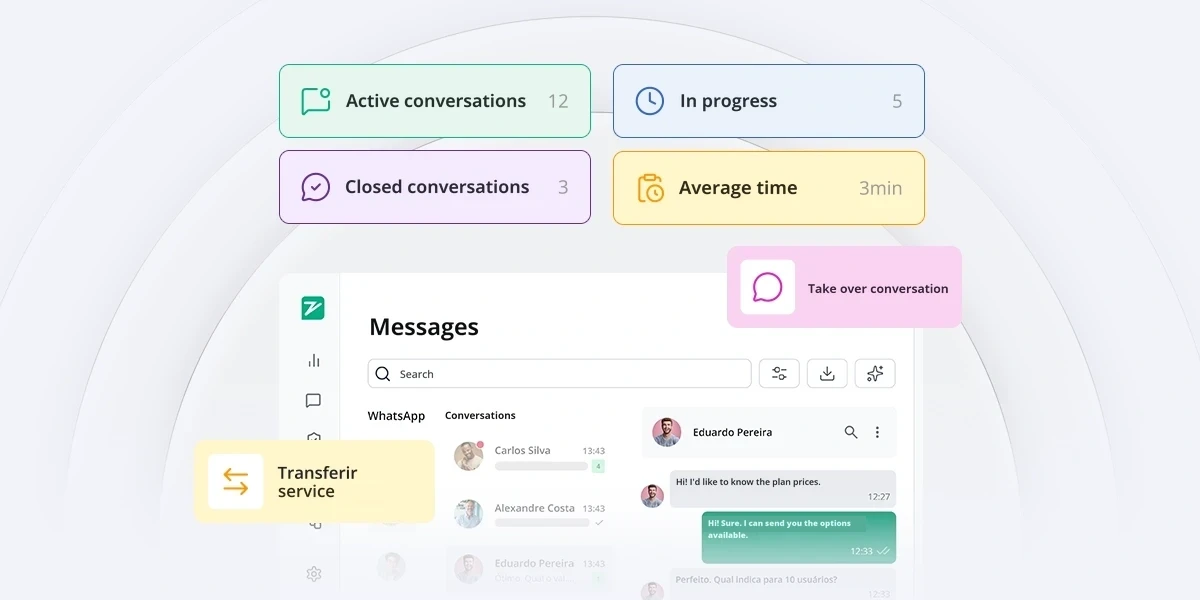
Visibility: without data, there is no management
Imagine a manager who notices a change in efficiency but has to ask different people what happened until they manage to build a hypothesis.
This manager may have reports. They don't necessarily have an organized view of the operation yet.
Visibility means being able to consult enough information to ask better questions.
Did the volume change?
Did response time become different?
Did the change happen across the whole operation or in a group of interactions?
Is it recurring, or did it happen only once?
Dashboards, message views, response metrics and available analyses come in at exactly this point: not as the purpose of management, but as evidence of a broader ability to track the operation.
For performance, this helps locate relevant signals.
For management as a whole, it reduces dependence on reconstructions based only on individual perception.
The data points to where to look.
The investigation has to explain the rest.
Continuity: history can't depend on a single person
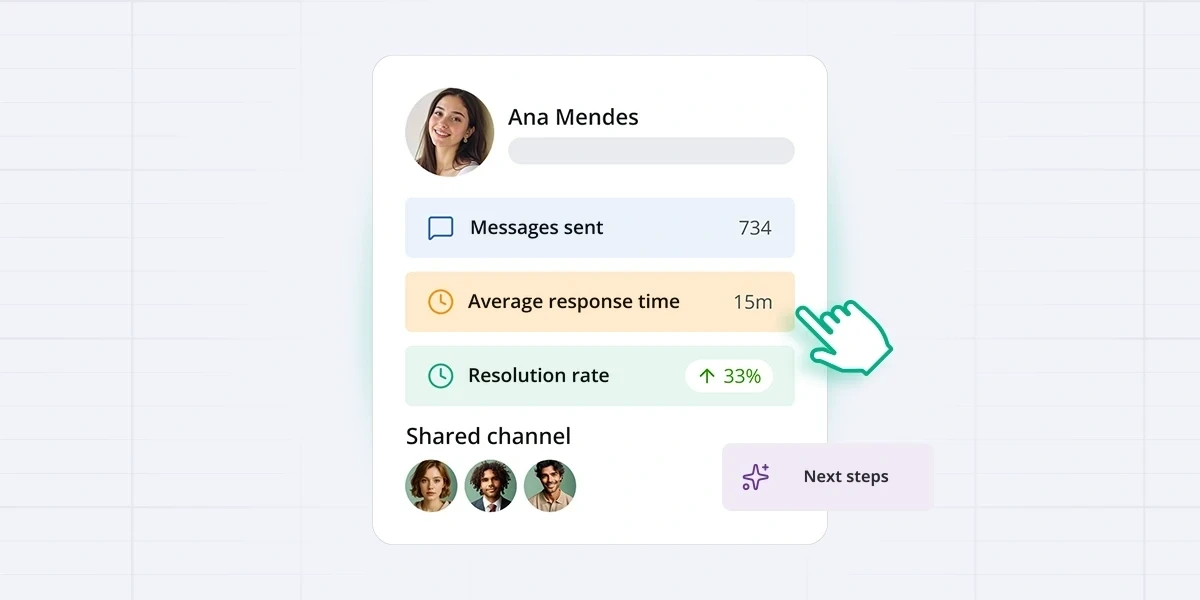
An operation can have good indicators and still be fragile when context is concentrated in people.
An agent goes on vacation. Another takes over.
A professional changes roles.
A negotiation passes from one person to another.
The customer returns days later.
If each change requires rebuilding the whole history, there is an operational problem affecting different areas at the same time.
For performance, this can create additional effort and harm the continuity of service.
For compliance and governance, it can reduce the ability to recover the context of a situation.
That's why history shouldn't be seen merely as an archive of past conversations.
It can be an active part of the operation.
When it remains accessible, it helps whoever takes over an interaction understand what has already happened, what was agreed and what still needs to be done.
That is precisely the importance of maintaining accessible history and operational continuity when people, responsibilities or processes change.
The more critical WhatsApp is to the company, the less sense it makes to allow knowledge about each relationship to depend exclusively on who took part in it.
Compliance: traceability is also part of the operation
Not every need for traceability arises from an exceptional situation.
Consider something simple: a condition negotiated with a customer needs to be revisited after a few weeks.
Who took part?
What was the context?
What was recorded?
Is there enough information to understand how that decision came about?
If the answer depends on finding a specific person and asking them to remember the situation, the company comes to depend on individual memory to recover events from its own operation.
History, retention, records and events help create another condition: relevant information remains available for consultation.
This doesn't mean that a tool, on its own, guarantees compliance.
It means that a more organized and traceable operation offers a better foundation for administering its own information.
That is the perspective that matters here.
Compliance not as a legal promise, but as a dimension of an operation that can preserve records and recover context when needed.
Strategic operation: management is also deciding how to operate
The discussion about management doesn't end at tracking what has already happened.
It also involves deciding how the operation should work.
Companies can use different ways of operating in the WhatsApp ecosystem, and the choice needs to be tied to the purpose of that communication, the existing authorization, the applicable conditions, the scale of the operation, the necessary integrations and the importance of keeping context accessible.
The WhatsApp Business App and the WhatsApp API, for example, shouldn't be treated as if they were the same thing.
This distinction becomes even more important given the pricing changes planned for the API starting October 1, 2026.
The change needs to be understood specifically in the context of the WhatsApp API. That doesn't mean saying "WhatsApp became paid", nor automatically extending the same logic to the app.
This is a good example of why strategic operation requires judgment.
Changes in rules, cost or process shouldn't produce an automatic reaction. They add variables the manager needs to understand.
Hybrid sending can be part of this discussion when different sending methods are evaluated according to the purpose of the operation.
This doesn't mean Zapper automatically chooses between channels.
The operational decision needs to consider purpose, authorization, context, scale and the possibilities available for that operation.
Technology expands possibilities.
Management defines how to use them.
The pricing change reinforces a need that already existed
Meta's new pricing creates an additional variable for companies that use the WhatsApp API.
But it didn't create the need to track volume, understand behavior, preserve history or maintain traceability.
Those needs already existed.
What changes is that an external shift can make some questions more urgent.
If the messaging picture changed, why?
Did the team's behavior change too?
Did volume increase because there was more demand or because the dynamics of conversations became different?
Did a change made in pursuit of efficiency preserve continuity and context?
These questions show why analyzing only the financial outcome isn't enough.
The cost can show a consequence.
The operation needs to help build the explanation.
That's why the pricing change works better as context than as the center of the discussion about Zapper.
The permanent territory remains management of the WhatsApp operation.
Can your operation answer these questions?
A good way to identify management gaps is to look at which questions the company can answer without depending on extensive reconstruction:
How many messages are part of the operation's normal behavior?
Can the manager track response time and other available indicators?
When an indicator changes, is there context to investigate the reason?
Does the history remain accessible when an agent changes roles or leaves the team?
Can a person who takes over a conversation understand what has already happened?
Is it possible to recover relevant records and events from an interaction?
Can the company keep track of the different WhatsApp numbers used by the team in an organized way?
Do process changes preserve history and context?
Can the company explain why an operation changed before deciding on the next adjustment?
The goal isn't to turn these questions into a maturity score.
They work as a diagnostic.
If a good part of the answers depends on consulting several people, gathering scattered information or reconstructing events manually, there is room to make the operation more manageable.
Performance and compliance need the same foundation: management
Performance and compliance are not synonyms.
Nor is there any reason to put one agenda above the other.
Performance seeks to understand and improve how the operation works.
Compliance needs organization, context, records and traceability so that events remain understandable over time.
When WhatsApp becomes a critical channel, these two needs run through the same management infrastructure.
The company needs to see what is happening.
It needs to preserve context when people and processes change.
It needs to keep records accessible.
And it needs to turn information into operational decisions made with judgment.
Visibility, continuity, compliance and strategic operation therefore form something bigger than a collection of features.
They form the conditions for the company to administer its WhatsApp operation with more context.
That convergence is what positions Zapper beyond monitoring: management of the WhatsApp operation, to make the channel more manageable.

Does your company need to connect performance, history and traceability in a single view of the operation? Get to know Zapper and understand how to apply WhatsApp operation management to your scenario.
Response time has increased. The volume of messages has changed. Part of the team is handling more interactions than another. For whoever leads the operation, this information raises an immediate question: what is happening and where do we need to look?
At another moment, the question may be different.
A customer resumes a negotiation started weeks ago, but the responsible professional has changed. A decision needs to be revisited. Someone needs to understand what was agreed, what information remained available and how that interaction was handled.
The first situation seems to be about performance. The second, about compliance.
They are different concerns, with different goals. But they have something in common: both become hard to manage when the company can't see, preserve and reconstruct what happens in its WhatsApp operation.
This is the point where performance and compliance stop being completely separate discussions and find a shared need: management of the WhatsApp operation.
For Zapper, this is the core category. Monitoring messages or consulting indicators may be part of the process, but the discussion is bigger: making a critical WhatsApp operation more manageable, connecting visibility, continuity, compliance and operational decisions.
Performance and compliance seem like different agendas
Performance usually comes onto the agenda when the company wants to understand how its operation is working.
Is the volume consistent with expected behavior? Has response time changed? Are there differences between teams or periods? Does the service maintain continuity? Do the indicators help understand where a relevant change exists?
These are questions tied to execution.
Compliance starts from a different kind of concern. The company needs to be able to recover context, consult history, keep records accessible and have enough traceability to understand events in the operation.
One agenda looks mainly at how the operation works.
The other needs to answer what happened and what remains available for consultation.
Mixing the two concepts would be an oversimplification. But separating them completely can also create an incomplete view.
After all, both performance and compliance depend on organized information about the same operation. This convergence calls for a layer of business WhatsApp management capable of turning distributed interactions into useful context for the company.
What does performance mean in a WhatsApp operation?
Performance on WhatsApp shouldn't be reduced to sending more messages, replying faster or reducing volume.
The first step is being able to understand the behavior of the operation.
Imagine that message volume increased in a given period. That data point may be relevant, but it doesn't explain the reason on its own.
Did demand increase? Did the average number of messages per conversation change? Did a process change? Did team dynamics shift? Did certain interactions start requiring more context?
The same goes for response time.
A variation may signal a change that deserves attention, but the indicator alone doesn't deliver a diagnosis.
That's why improving performance first requires building visibility.
How do you improve an operation the company can't see?
When management depends only on individual reports or manual reconstruction, it's harder to tell a one-off episode from a pattern.
Indicators help precisely because they create observation points.
Message volume, response metrics, message views and available analyses can support the manager in identifying where to investigate. The goal isn't to turn every change into a problem, but to give enough context so a decision doesn't depend only on perception.
An indicator shows that something happened.
Management begins when the company can investigate why it happened before deciding what to do.
Performance, therefore, starts less with the idea of optimizing at any cost and more with the ability to explain how the operation works.
And what does compliance require from that same operation?
Compliance introduces another set of questions.
If a conversation needs to be revisited, will the history be accessible?
If a professional changes roles or leaves the team, will the context remain available?
If a situation needs to be understood weeks later, will there be enough records to recover the sequence of events?
These questions shouldn't be confused with legal interpretation. Formal requirements vary by company, sector, process and regulatory context.
From the standpoint of operations management, however, there is a clear need: important information can't depend exclusively on the memory of those who took part in the conversation.
History, retention, records and events help make the operation more traceable.
This even changes how we think about compliance.
Instead of treating the topic only as something that appears when there is a review or a specific request, organizing information becomes part of the routine.
Traceability is built while the operation happens.
That logic is what brings compliance closer to management: preserving context today improves the ability to understand what happened tomorrow.
Where do performance and compliance meet?
The convergence appears when we put the questions side by side.
Performance asks: how is the operation working?
Compliance asks: what happened in the operation and can we recover that context?
To answer both well, the company needs a common foundation.
It needs to see the behavior of the operation, preserve history when people or processes change, keep information searchable and use that data to make decisions with judgment.
That's where Zapper's four pillars stop looking like independent topics.
Visibility helps the company understand what is happening.
Continuity keeps context accessible even when the operation changes.
Compliance organizes history, records, retention and traceability.
And strategic operation turns that information into criteria for deciding how to work.
They aren't four features gathered under one name.
They are four needs that help a company administer a channel that has become critical for customer service, relationships, collections or sales.
Visibility: without data, there is no management
Imagine a manager who notices a change in efficiency but has to ask different people what happened until they manage to build a hypothesis.
This manager may have reports. They don't necessarily have an organized view of the operation yet.
Visibility means being able to consult enough information to ask better questions.
Did the volume change?
Did response time become different?
Did the change happen across the whole operation or in a group of interactions?
Is it recurring, or did it happen only once?
Dashboards, message views, response metrics and available analyses come in at exactly this point: not as the purpose of management, but as evidence of a broader ability to track the operation.
For performance, this helps locate relevant signals.
For management as a whole, it reduces dependence on reconstructions based only on individual perception.
The data points to where to look.
The investigation has to explain the rest.
Continuity: history can't depend on a single person
An operation can have good indicators and still be fragile when context is concentrated in people.
An agent goes on vacation. Another takes over.
A professional changes roles.
A negotiation passes from one person to another.
The customer returns days later.
If each change requires rebuilding the whole history, there is an operational problem affecting different areas at the same time.
For performance, this can create additional effort and harm the continuity of service.
For compliance and governance, it can reduce the ability to recover the context of a situation.
That's why history shouldn't be seen merely as an archive of past conversations.
It can be an active part of the operation.
When it remains accessible, it helps whoever takes over an interaction understand what has already happened, what was agreed and what still needs to be done.
That is precisely the importance of maintaining accessible history and operational continuity when people, responsibilities or processes change.
The more critical WhatsApp is to the company, the less sense it makes to allow knowledge about each relationship to depend exclusively on who took part in it.
Compliance: traceability is also part of the operation
Not every need for traceability arises from an exceptional situation.
Consider something simple: a condition negotiated with a customer needs to be revisited after a few weeks.
Who took part?
What was the context?
What was recorded?
Is there enough information to understand how that decision came about?
If the answer depends on finding a specific person and asking them to remember the situation, the company comes to depend on individual memory to recover events from its own operation.
History, retention, records and events help create another condition: relevant information remains available for consultation.
This doesn't mean that a tool, on its own, guarantees compliance.
It means that a more organized and traceable operation offers a better foundation for administering its own information.
That is the perspective that matters here.
Compliance not as a legal promise, but as a dimension of an operation that can preserve records and recover context when needed.
Strategic operation: management is also deciding how to operate
The discussion about management doesn't end at tracking what has already happened.
It also involves deciding how the operation should work.
Companies can use different ways of operating in the WhatsApp ecosystem, and the choice needs to be tied to the purpose of that communication, the existing authorization, the applicable conditions, the scale of the operation, the necessary integrations and the importance of keeping context accessible.
The WhatsApp Business App and the WhatsApp API, for example, shouldn't be treated as if they were the same thing.
This distinction becomes even more important given the pricing changes planned for the API starting October 1, 2026.
The change needs to be understood specifically in the context of the WhatsApp API. That doesn't mean saying "WhatsApp became paid", nor automatically extending the same logic to the app.
This is a good example of why strategic operation requires judgment.
Changes in rules, cost or process shouldn't produce an automatic reaction. They add variables the manager needs to understand.
Hybrid sending can be part of this discussion when different sending methods are evaluated according to the purpose of the operation.
This doesn't mean Zapper automatically chooses between channels.
The operational decision needs to consider purpose, authorization, context, scale and the possibilities available for that operation.
Technology expands possibilities.
Management defines how to use them.
The pricing change reinforces a need that already existed
Meta's new pricing creates an additional variable for companies that use the WhatsApp API.
But it didn't create the need to track volume, understand behavior, preserve history or maintain traceability.
Those needs already existed.
What changes is that an external shift can make some questions more urgent.
If the messaging picture changed, why?
Did the team's behavior change too?
Did volume increase because there was more demand or because the dynamics of conversations became different?
Did a change made in pursuit of efficiency preserve continuity and context?
These questions show why analyzing only the financial outcome isn't enough.
The cost can show a consequence.
The operation needs to help build the explanation.
That's why the pricing change works better as context than as the center of the discussion about Zapper.
The permanent territory remains management of the WhatsApp operation.
Can your operation answer these questions?
A good way to identify management gaps is to look at which questions the company can answer without depending on extensive reconstruction:
How many messages are part of the operation's normal behavior?
Can the manager track response time and other available indicators?
When an indicator changes, is there context to investigate the reason?
Does the history remain accessible when an agent changes roles or leaves the team?
Can a person who takes over a conversation understand what has already happened?
Is it possible to recover relevant records and events from an interaction?
Can the company keep track of the different WhatsApp numbers used by the team in an organized way?
Do process changes preserve history and context?
Can the company explain why an operation changed before deciding on the next adjustment?
The goal isn't to turn these questions into a maturity score.
They work as a diagnostic.
If a good part of the answers depends on consulting several people, gathering scattered information or reconstructing events manually, there is room to make the operation more manageable.
Performance and compliance need the same foundation: management
Performance and compliance are not synonyms.
Nor is there any reason to put one agenda above the other.
Performance seeks to understand and improve how the operation works.
Compliance needs organization, context, records and traceability so that events remain understandable over time.
When WhatsApp becomes a critical channel, these two needs run through the same management infrastructure.
The company needs to see what is happening.
It needs to preserve context when people and processes change.
It needs to keep records accessible.
And it needs to turn information into operational decisions made with judgment.
Visibility, continuity, compliance and strategic operation therefore form something bigger than a collection of features.
They form the conditions for the company to administer its WhatsApp operation with more context.
That convergence is what positions Zapper beyond monitoring: management of the WhatsApp operation, to make the channel more manageable.
Does your company need to connect performance, history and traceability in a single view of the operation? Get to know Zapper and understand how to apply WhatsApp operation management to your scenario.