

Vendas
Quanto sua empresa perde quando um vendedor sai levando os clientes
Calcule quanto sua empresa realmente perde quando um vendedor deixa o time e por que centralizar os relacionamentos no WhatsApp pode ser a proteção mais barata que existe.
Zapper Team
·
·
8 min of reading

It was Friday afternoon when Pedro resigned. You thanked him for his two years of service, arranged the transition period, and wished him good luck.
The following Monday, three clients called asking for him.
One wanted to know about a proposal that was "almost closing." Another had a technical question about an implementation Pedro had promised to follow up on. The third just wanted to know if he was still with the company, which already says a lot about where the relationship stood.
No one on the team knew the history of these conversations. Pedro used his personal WhatsApp. The conversations went away with his phone.
This scenario is more common than it seems. And its cost is much higher than what appears on any termination spreadsheet.
What goes into the equation when a salesperson leaves
Most companies calculate the cost of turnover by looking at the wrong side. They focus on direct costs:
Severance pay and termination benefits
Cost of the recruitment process for a replacement
Time and cost of training the new salesperson
Drop in productivity during the learning curve
These are real numbers, but they are the smaller part of the story.
What rarely goes into the equation is this: each client who leaves with the salesperson represents a CAC that your company has already paid and will never recover. And along with the client goes the LTV, the value they would generate over the coming months or years, which now goes to the competitor.
Let's put numbers on this.
The math no one does (but should)
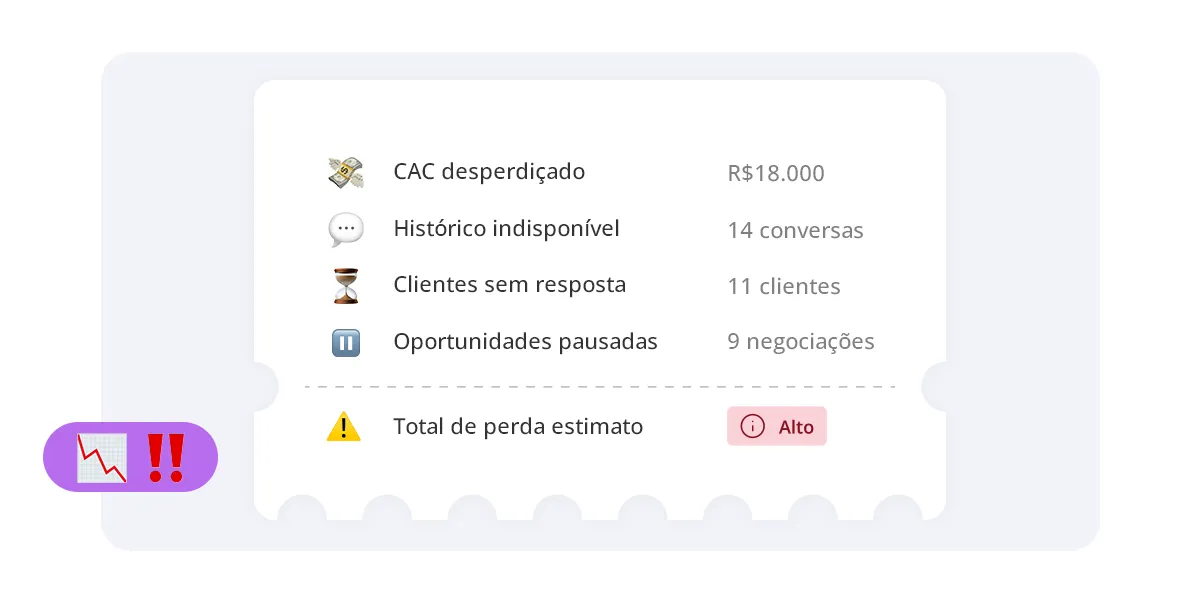
In the Brazilian B2B market, the average CAC varies greatly by segment. In companies with a consultative sales cycle, it rarely falls below R$ 3,000 per new client. In operations with longer processes, more complex products, or larger average ticket sizes, it can reach R$ 15,000 or more.
Now think of a salesperson with an active portfolio of 30 clients. This is not an absurd number. It is the reality of a large portion of B2B operations with teams of five to fifty people.
If this salesperson leaves and 20% of their portfolio clients decide not to continue, either because they went with them to the new job, or because the relationship didn't transfer and they used the switch to re-evaluate the supplier, you have lost six clients.
Scenario | Average CAC | Lost clients | Wasted CAC |
|---|---|---|---|
Smaller operation | R$ 3,000 | 6 | R$ 18,000 |
Larger operation | R$ 15,000 | 6 | R$ 90,000 |
And that's not even counting the LTV. If those six clients had an average contract of R$ 2,000 per month and stayed, on average, two years with the company, you lost R$ 288,000 in future revenue, already discounting the first year of contract which might have been renewing.
In a single resignation.
Now consider that turnover in commercial teams is usually not an isolated event. In many companies, it is almost structural. Good salespeople are highly sought after, receive offers, and leave. The average tenure in sales roles in Brazil is between 18 and 24 months. In two years, a large portion of your team has rotated.
The SHRM (Society for Human Resource Management) estimates that the cost of replacing an employee can range between 50% and 200% of their annual salary, depending on seniority and role complexity. For a salesperson with a salary plus commission of R$ 8,000 monthly, this represents between R$ 48,000 and R$ 192,000 per resignation, adding everything up.
The problem is not the salesperson who left. The problem is that your company was not protected for when it happened.
Why personal WhatsApp is a systemic point of failure
It is not the salesperson's fault for using their own phone to serve clients. In many companies, no one ever established a different way of doing things. WhatsApp was the most practical channel, the client preferred it, the salesperson used it, and it became the standard without anyone deciding it should be.
The problem is that this operational convenience comes at a high strategic cost.
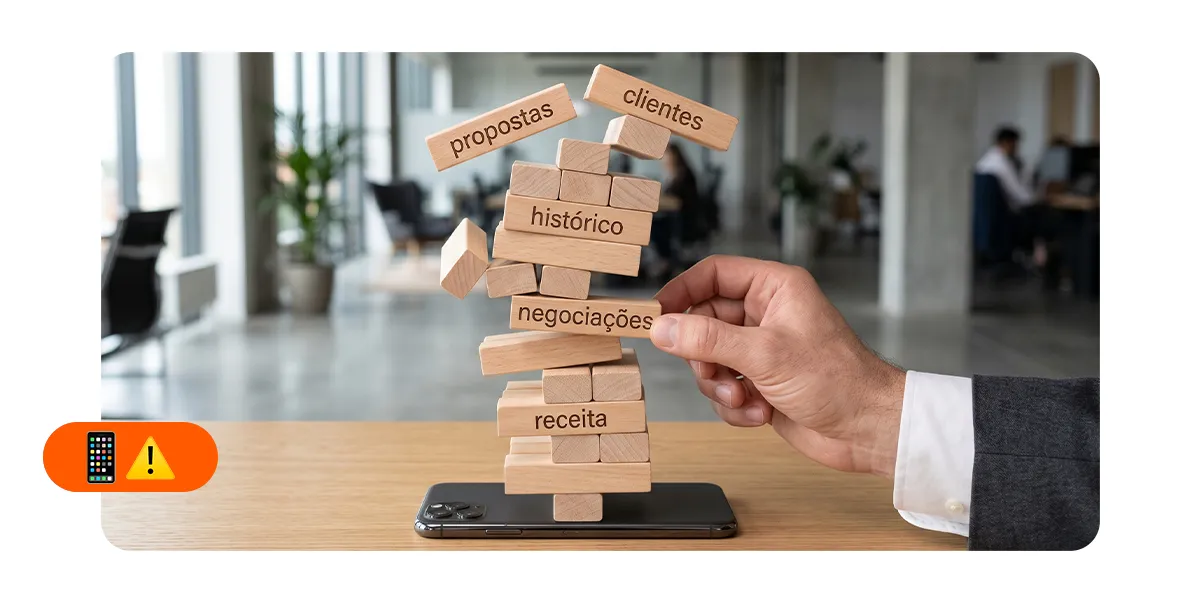
When the business relationship lives on the salesperson's personal WhatsApp, the company has no visibility into any of those conversations. It doesn't know what was promised, what is being negotiated, what the client complained about last week, or what is stalling a closing. The manager only finds out when the salesperson shares, and what they share is always just a snapshot.
When that salesperson leaves, the history goes with them. And there is no way to recover it.
Data confirms that this is the rule, not the exception:
Problem | % of companies affected |
|---|---|
No visibility into corporate WhatsApp | 73% |
Have already lost information due to lack of traceability | 65% |
Have already faced legal issues through the channel | 41% |
The legal risk deserves separate attention. When the relationship is on the salesperson's personal phone, the company loses control over what is being said in its name. Agreements made by the salesperson that the company cannot prove or disprove turn into liabilities.
The practical result of all this is simple: the client becomes the salesperson's property, not the company's. And when the salesperson leaves, they take what they consider theirs.
What changes when you centralize the relationship
The paradigm shift is not technological. It is conceptual.
The premise is as follows: the client belongs to the company. The relationship with them is a company asset, not the property of the professional who manages that relationship day-to-day. This is not about dehumanizing sales. It is about protecting the business from a real and calculable risk.
When all sales communication goes through a platform with a shared inbox, a few things change in a very concrete way:
The manager has visibility into the operation in real-time.
No need to wait for the salesperson to report back. They can track the progress of negotiations, identify bottlenecks, and notice when an important client has been left unanswered longer than they should have been.
The history remains with the company, not with the salesperson.
When someone leaves, the new representative taking over the portfolio doesn't start from scratch. They can read the context, understand what was discussed, where the negotiation stood, and what the client values.
The continuity of the relationship stops depending on personal memory.
The client experiences less disruption. They don't have to explain everything all over again to someone who just arrived.
This matters because most clients who leave after a salesperson change do not leave due to dissatisfaction with the product. They leave because the relationship was interrupted and no one took the trouble to resume it. Sometimes that is exactly what the competitor needs: a window of attention that your company left wide open.
How Zapper solves this in practice
Zapper is a WhatsApp management platform. What it delivers in practice is strategic visibility into what is happening in your sales team's conversations.
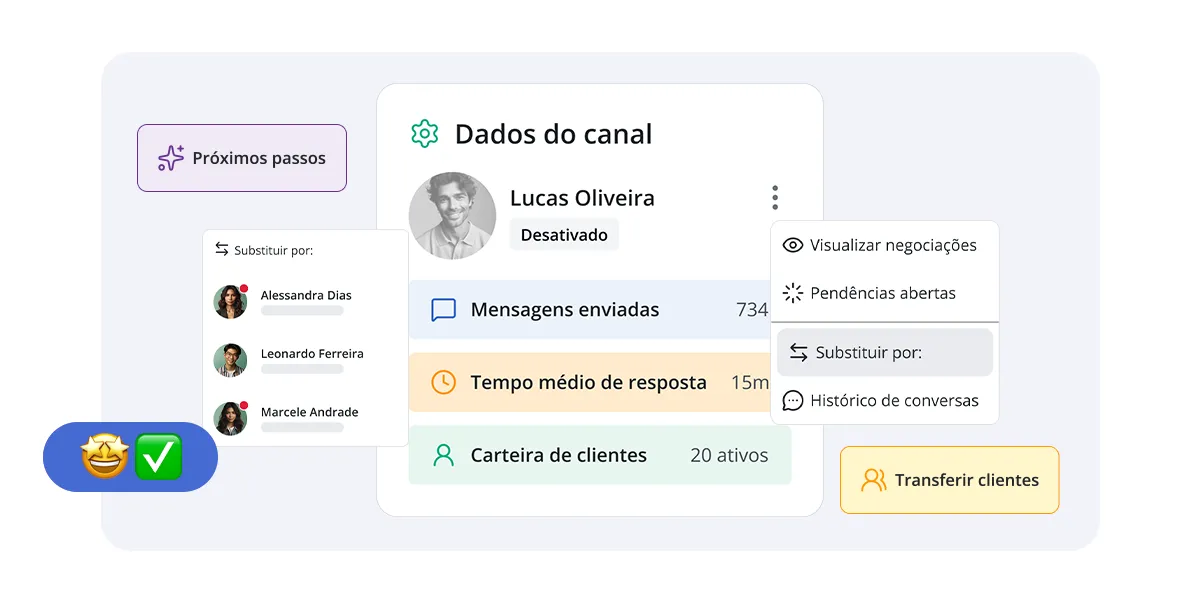
Salespeople can use their own WhatsApp or work through Zapper where all communication goes through a shared inbox. Managers can monitor conversations, redistribute interactions, transfer portfolios, and maintain a complete history, regardless of who was handling the service before.
When an representative leaves, the next one to take over the conversation finds everything available:
Complete history of conversations
Tone and context of the relationship with the client
What was promised and what was pending
Where the negotiation stood at the time of departure
Zapper's AI can summarize long conversations and suggest next steps, which accelerates the resumption of the relationship and reduces the time the new representative needs to understand the context.
This is not employee monitoring. It is visibility into the relationship with the client, which is a company asset, not the salesperson's.
Today, more than 250 companies in five countries use Zapper for this. Together, they manage over 600 million messages per year. This volume says one thing: the problem the platform solves is real, recurring, and too expensive to ignore.
The risk of dependency on people is manageable
Every company has a risk of dependency on people. This will not change. People are a central part of any commercial operation, and good people are highly sought after.
What is manageable is the impact that a person's departure causes.
When the customer relationship is centralized in a system with visibility for the manager and a retained history independent of who handled the service, the departure of a salesperson becomes a transition process, not a crisis. The company is able to:
Know exactly which clients were being served by whom
Understand where each of the negotiations stood
Plan the transition in an organized way
Communicate with clients at the right moment
Ensure that the new salesperson arrives prepared
This doesn't eliminate the impact of losing a good professional. But it separates the human impact from the commercial impact. And the commercial part, at least, remains under control.

One last calculation
Take your operation and do this exercise.
Variable | Your operation |
|---|---|
Number of salespeople | |
Average portfolio size per salesperson | |
Average CAC per client | |
Average LTV per client | |
Clients who leave in case of a salesperson switch (estimate) |
Now multiply: if a salesperson leaves tomorrow and 20% of their portfolio goes with them, how much do you lose?
If the answer is a number that hurts to look at, the next step is simpler than it seems: centralize the relationship with the client in a channel that the company controls.
The cost of doing this is less than the cost of not doing it. And you will only find this out the hard way when the next Pedro resigns on Friday.
If you don't know what is in your team's conversations today, you also don't know what you are going to lose tomorrow. Zapper shows you.
It was Friday afternoon when Pedro resigned. You thanked him for his two years of service, arranged the transition period, and wished him good luck.
The following Monday, three clients called asking for him.
One wanted to know about a proposal that was "almost closing." Another had a technical question about an implementation Pedro had promised to follow up on. The third just wanted to know if he was still with the company, which already says a lot about where the relationship stood.
No one on the team knew the history of these conversations. Pedro used his personal WhatsApp. The conversations went away with his phone.
This scenario is more common than it seems. And its cost is much higher than what appears on any termination spreadsheet.
What goes into the equation when a salesperson leaves
Most companies calculate the cost of turnover by looking at the wrong side. They focus on direct costs:
Severance pay and termination benefits
Cost of the recruitment process for a replacement
Time and cost of training the new salesperson
Drop in productivity during the learning curve
These are real numbers, but they are the smaller part of the story.
What rarely goes into the equation is this: each client who leaves with the salesperson represents a CAC that your company has already paid and will never recover. And along with the client goes the LTV, the value they would generate over the coming months or years, which now goes to the competitor.
Let's put numbers on this.
The math no one does (but should)
In the Brazilian B2B market, the average CAC varies greatly by segment. In companies with a consultative sales cycle, it rarely falls below R$ 3,000 per new client. In operations with longer processes, more complex products, or larger average ticket sizes, it can reach R$ 15,000 or more.
Now think of a salesperson with an active portfolio of 30 clients. This is not an absurd number. It is the reality of a large portion of B2B operations with teams of five to fifty people.
If this salesperson leaves and 20% of their portfolio clients decide not to continue, either because they went with them to the new job, or because the relationship didn't transfer and they used the switch to re-evaluate the supplier, you have lost six clients.
Scenario | Average CAC | Lost clients | Wasted CAC |
|---|---|---|---|
Smaller operation | R$ 3,000 | 6 | R$ 18,000 |
Larger operation | R$ 15,000 | 6 | R$ 90,000 |
And that's not even counting the LTV. If those six clients had an average contract of R$ 2,000 per month and stayed, on average, two years with the company, you lost R$ 288,000 in future revenue, already discounting the first year of contract which might have been renewing.
In a single resignation.
Now consider that turnover in commercial teams is usually not an isolated event. In many companies, it is almost structural. Good salespeople are highly sought after, receive offers, and leave. The average tenure in sales roles in Brazil is between 18 and 24 months. In two years, a large portion of your team has rotated.
The SHRM (Society for Human Resource Management) estimates that the cost of replacing an employee can range between 50% and 200% of their annual salary, depending on seniority and role complexity. For a salesperson with a salary plus commission of R$ 8,000 monthly, this represents between R$ 48,000 and R$ 192,000 per resignation, adding everything up.
The problem is not the salesperson who left. The problem is that your company was not protected for when it happened.
Why personal WhatsApp is a systemic point of failure
It is not the salesperson's fault for using their own phone to serve clients. In many companies, no one ever established a different way of doing things. WhatsApp was the most practical channel, the client preferred it, the salesperson used it, and it became the standard without anyone deciding it should be.
The problem is that this operational convenience comes at a high strategic cost.
When the business relationship lives on the salesperson's personal WhatsApp, the company has no visibility into any of those conversations. It doesn't know what was promised, what is being negotiated, what the client complained about last week, or what is stalling a closing. The manager only finds out when the salesperson shares, and what they share is always just a snapshot.
When that salesperson leaves, the history goes with them. And there is no way to recover it.
Data confirms that this is the rule, not the exception:
Problem | % of companies affected |
|---|---|
No visibility into corporate WhatsApp | 73% |
Have already lost information due to lack of traceability | 65% |
Have already faced legal issues through the channel | 41% |
The legal risk deserves separate attention. When the relationship is on the salesperson's personal phone, the company loses control over what is being said in its name. Agreements made by the salesperson that the company cannot prove or disprove turn into liabilities.
The practical result of all this is simple: the client becomes the salesperson's property, not the company's. And when the salesperson leaves, they take what they consider theirs.
What changes when you centralize the relationship
The paradigm shift is not technological. It is conceptual.
The premise is as follows: the client belongs to the company. The relationship with them is a company asset, not the property of the professional who manages that relationship day-to-day. This is not about dehumanizing sales. It is about protecting the business from a real and calculable risk.
When all sales communication goes through a platform with a shared inbox, a few things change in a very concrete way:
The manager has visibility into the operation in real-time.
No need to wait for the salesperson to report back. They can track the progress of negotiations, identify bottlenecks, and notice when an important client has been left unanswered longer than they should have been.
The history remains with the company, not with the salesperson.
When someone leaves, the new representative taking over the portfolio doesn't start from scratch. They can read the context, understand what was discussed, where the negotiation stood, and what the client values.
The continuity of the relationship stops depending on personal memory.
The client experiences less disruption. They don't have to explain everything all over again to someone who just arrived.
This matters because most clients who leave after a salesperson change do not leave due to dissatisfaction with the product. They leave because the relationship was interrupted and no one took the trouble to resume it. Sometimes that is exactly what the competitor needs: a window of attention that your company left wide open.
How Zapper solves this in practice
Zapper is a WhatsApp management platform. What it delivers in practice is strategic visibility into what is happening in your sales team's conversations.
Salespeople can use their own WhatsApp or work through Zapper where all communication goes through a shared inbox. Managers can monitor conversations, redistribute interactions, transfer portfolios, and maintain a complete history, regardless of who was handling the service before.
When an representative leaves, the next one to take over the conversation finds everything available:
Complete history of conversations
Tone and context of the relationship with the client
What was promised and what was pending
Where the negotiation stood at the time of departure
Zapper's AI can summarize long conversations and suggest next steps, which accelerates the resumption of the relationship and reduces the time the new representative needs to understand the context.
This is not employee monitoring. It is visibility into the relationship with the client, which is a company asset, not the salesperson's.
Today, more than 250 companies in five countries use Zapper for this. Together, they manage over 600 million messages per year. This volume says one thing: the problem the platform solves is real, recurring, and too expensive to ignore.
The risk of dependency on people is manageable
Every company has a risk of dependency on people. This will not change. People are a central part of any commercial operation, and good people are highly sought after.
What is manageable is the impact that a person's departure causes.
When the customer relationship is centralized in a system with visibility for the manager and a retained history independent of who handled the service, the departure of a salesperson becomes a transition process, not a crisis. The company is able to:
Know exactly which clients were being served by whom
Understand where each of the negotiations stood
Plan the transition in an organized way
Communicate with clients at the right moment
Ensure that the new salesperson arrives prepared
This doesn't eliminate the impact of losing a good professional. But it separates the human impact from the commercial impact. And the commercial part, at least, remains under control.
One last calculation
Take your operation and do this exercise.
Variable | Your operation |
|---|---|
Number of salespeople | |
Average portfolio size per salesperson | |
Average CAC per client | |
Average LTV per client | |
Clients who leave in case of a salesperson switch (estimate) |
Now multiply: if a salesperson leaves tomorrow and 20% of their portfolio goes with them, how much do you lose?
If the answer is a number that hurts to look at, the next step is simpler than it seems: centralize the relationship with the client in a channel that the company controls.
The cost of doing this is less than the cost of not doing it. And you will only find this out the hard way when the next Pedro resigns on Friday.
If you don't know what is in your team's conversations today, you also don't know what you are going to lose tomorrow. Zapper shows you.