

Inteligência
WhatsApp Trends for 2026
Why companies need to anticipate to continue selling, serving, and operating safely on WhatsApp Business.
Zapper Team
·
·
8 min of reading

If you think WhatsApp has already reached its maximum potential as a business tool, get ready for a surprise. The most popular messaging app in Brazil is about to enter a new era, and what we will see by 2026 will completely redefine how companies communicate, sell, and serve their customers. It’s no longer just about replying to messages; we are talking about a revolution in business communication.
Meta, the parent company of WhatsApp, has ambitious plans that will transform the app into a complete business ecosystem. For companies, ignoring these changes is not an option. Anticipating the WhatsApp trends for 2026 is the key to remaining relevant, competitive, and, above all, operating with the security and governance that the digital landscape demands. Let’s dive into the future of WhatsApp and understand what your company needs to do today to prepare for tomorrow.
WhatsApp enters a new corporate phase
Do you remember when WhatsApp was just an app for chatting with friends and family? That phase has been long gone. The introduction of WhatsApp Business and, later, the WhatsApp Business API (now called the WhatsApp Business Platform), signaled a paradigm shift. Meta recognized the immense potential of the app as a direct and personal bridge between brands and consumers.
This new corporate phase goes far beyond a simple service channel. WhatsApp is establishing itself as a pillar of digital transformation for businesses of all sizes. The vision is clear: to transform the app into a central platform where the entire customer journey can take place, from the first contact and marketing to the final sale and post-sale support.

We are shifting from a reactive model, where companies waited for the customer to reach out, to a proactive and conversational model. The messaging technology has evolved to allow intelligent automations, deep integrations with management systems (CRMs, ERPs), and robust data analysis. The professional WhatsApp of 2026 will be less about sending messages and more about building relationships, optimizing processes, and generating revenue in a scalable and secure manner.
Key WhatsApp trends for 2026
The future of WhatsApp for businesses is shaped by technology, data, and a deep understanding of user experience. The innovations we will see in the coming years are not just incremental improvements; they are fundamental changes. Here are the key trends you need to keep an eye on.
1. Hyperautomation with generative artificial intelligence
The chatbots we know today will seem primitive in 2026. The big turning point is the massive integration of Generative Artificial Intelligence, similar to the technology behind ChatGPT. This means that customer service bots on WhatsApp will be able to:
Understand context and sentiment: they will not just respond to keywords but will understand the intent, frustration, or satisfaction of the customer, adapting the tone of the conversation.
Perform complex tasks: scheduling services, processing returns, checking real-time stock, and even cross-selling based on customer history will be common tasks for AI.
Continuously learn: each interaction will make the system smarter, improving the quality of responses and service efficiency.
Assist human agents: AI will be able to summarize long conversations for a human attendant, suggest the best responses, and automate data entry into the CRM, dramatically increasing productivity.
2. Conversational commerce at scale
The idea of selling directly via chat will become the norm. WhatsApp and business will be intrinsically linked. The purchase journey will be simplified to the max, happening entirely within the conversation window:
Interactive and dynamic catalogs: customers will be able to browse products, watch videos, explore variations, and add them to a cart without leaving the app.
Integrated and secure payments: the completion of purchases will be done with one click, using popular payment methods like Pix, credit cards, and digital wallets, directly in the conversation.
Personalized shopping experiences: based on conversation and purchase history, AI will be able to offer highly relevant product recommendations, turning each chat into a sales opportunity.
3. Deep and unified omnichannel integration
The word "omnichannel" will gain a new meaning. The integration of platforms will be so seamless that the boundaries between communication channels will disappear. If a customer starts a conversation on the website, continues it on Instagram, and finishes it on WhatsApp, the attendant (or bot) will have access to the entire history on one screen. This allows for a 360º view of the customer, resulting in contextualized and efficient service, strengthening relationships and enhancing the WhatsApp user experience.
4. Absolute focus on security, privacy, and governance
With the increased volume of sensitive data flowing through the corporate WhatsApp, security will become the number one priority. Compliance on WhatsApp, especially with laws like LGPD, will be non-negotiable. We will see advancements in:
Audit tools: management platforms will allow managers to monitor conversations to ensure quality and compliance without violating privacy.
Access control: companies will have more control over which data each employee can access, minimizing risks.
Fraud prevention: Meta will invest heavily in technologies to identify and block attempts at scams and spam, protecting both businesses and consumers.
5. Data analysis and business intelligence
Conversations on WhatsApp are a goldmine of information. Companies will use advanced analytics tools to extract valuable insights from this data (anonymously and in aggregate). It will be possible to identify consumption trends, predict future demands, detect recurring issues in service, and optimize WhatsApp marketing campaigns based on real data about customer behavior.
Why WhatsApp has become strategic for businesses
Understanding trends is the first step. The second is to understand why adopting them is a matter of survival and growth. WhatsApp is no longer just a convenient channel; it is a fundamental strategic piece for the success of any modern business.
The main reason is reach. In Brazil, WhatsApp is installed on almost every smartphone. It’s where your customers already are, and they prefer to communicate there. Being present on WhatsApp is no longer a differential; it is a consumer expectation. Ignoring this is like closing the doors of your store on the busiest street in the city.
Additionally, the automation and efficiency provided by the platform lead to a significant reduction in operational costs. A single well-configured bot can handle thousands of inquiries simultaneously, 24/7, freeing your human team to focus on strategic and high-value tasks.
From a sales perspective, the immediate and personal nature of the app breaks down barriers and reduces friction in the purchasing process. A quick response to a question about a product can be the difference between a completed sale and a lost customer to the competition. Communication strategies on WhatsApp, when well-executed, generate conversion rates far superior to those of traditional channels like email.
The consolidation of WhatsApp as a corporate channel
The path is clear. The future of WhatsApp is to be the operating system for business communication. It will no longer be an isolated tool but rather the central hub that connects marketing, sales, service, and operations. Companies that recognize this consolidation and prepare now will reap the benefits in the coming years.
Preparing means looking beyond the basic app. It means adopting robust management platforms that allow for the implementation of these trends: automation with AI, integrations with other systems, ensuring security and compliance, and the ability to analyze data to make smarter decisions.
The digital transformation does not wait. The communication trends point to a more conversational, immediate, and personalized future. WhatsApp for business is at the center of this revolution. The question every manager should ask is not whether to invest in a corporate WhatsApp strategy, but how to start doing it today to stay ahead of the competition in 2026.
How Zapper prepares companies for WhatsApp in 2026
Given this scenario, Zapper emerges as an essential layer of structure, security, and intelligence for companies using WhatsApp as a strategic channel.
The platform allows organizations to operate aligned with the new demands of the ecosystem, offering:
Pillar | How Zapper acts |
|---|---|
Governance and control | Complete conversation monitoring with traceability of interactions and continuous supervision |
Security and compliance | Risk term alerts and mechanisms for preventing deviations, adhering to LGPD |
Operational continuity | Secure storage of messages, media, and histories, even in device changes or employee exits |
Standardization | Configurable policies and rules to ensure good practices in sales, support, and relationships |
Data intelligence | Reports with engagement, performance metrics, and communication patterns |
Artificial intelligence | Conversational analysis to identify sentiments, intentions, recurring themes, and opportunities for improvement |
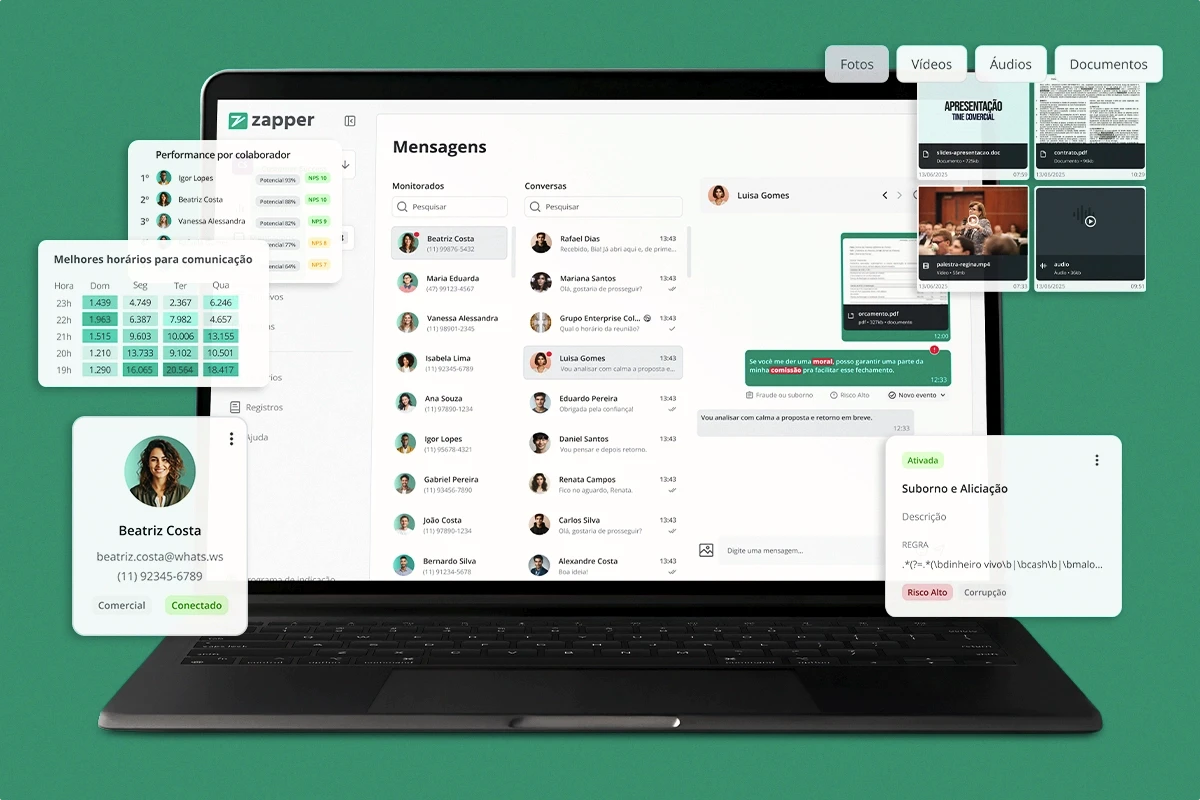
With these resources, Zapper transforms WhatsApp into a structured, auditable channel driven by data, ready to operate at scale and in compliance with future demands.
Professional WhatsApp in 2026 requires control, not improvisation
The trends point to a clear scenario: operating on WhatsApp without control becomes unfeasible. As the app evolves into a complete corporate platform, companies need to treat the channel with the same level of monitoring, security, and intelligence applied to other critical systems.
Zapper enables this transition to happen in a structured way, transforming the new era of WhatsApp into a competitive advantage. Companies that anticipate not only keep up with the evolution of the channel but also begin to extract more value, efficiency, and trust from every conversation.
If you think WhatsApp has already reached its maximum potential as a business tool, get ready for a surprise. The most popular messaging app in Brazil is about to enter a new era, and what we will see by 2026 will completely redefine how companies communicate, sell, and serve their customers. It’s no longer just about replying to messages; we are talking about a revolution in business communication.
Meta, the parent company of WhatsApp, has ambitious plans that will transform the app into a complete business ecosystem. For companies, ignoring these changes is not an option. Anticipating the WhatsApp trends for 2026 is the key to remaining relevant, competitive, and, above all, operating with the security and governance that the digital landscape demands. Let’s dive into the future of WhatsApp and understand what your company needs to do today to prepare for tomorrow.
WhatsApp enters a new corporate phase
Do you remember when WhatsApp was just an app for chatting with friends and family? That phase has been long gone. The introduction of WhatsApp Business and, later, the WhatsApp Business API (now called the WhatsApp Business Platform), signaled a paradigm shift. Meta recognized the immense potential of the app as a direct and personal bridge between brands and consumers.
This new corporate phase goes far beyond a simple service channel. WhatsApp is establishing itself as a pillar of digital transformation for businesses of all sizes. The vision is clear: to transform the app into a central platform where the entire customer journey can take place, from the first contact and marketing to the final sale and post-sale support.
We are shifting from a reactive model, where companies waited for the customer to reach out, to a proactive and conversational model. The messaging technology has evolved to allow intelligent automations, deep integrations with management systems (CRMs, ERPs), and robust data analysis. The professional WhatsApp of 2026 will be less about sending messages and more about building relationships, optimizing processes, and generating revenue in a scalable and secure manner.
Key WhatsApp trends for 2026
The future of WhatsApp for businesses is shaped by technology, data, and a deep understanding of user experience. The innovations we will see in the coming years are not just incremental improvements; they are fundamental changes. Here are the key trends you need to keep an eye on.
1. Hyperautomation with generative artificial intelligence
The chatbots we know today will seem primitive in 2026. The big turning point is the massive integration of Generative Artificial Intelligence, similar to the technology behind ChatGPT. This means that customer service bots on WhatsApp will be able to:
Understand context and sentiment: they will not just respond to keywords but will understand the intent, frustration, or satisfaction of the customer, adapting the tone of the conversation.
Perform complex tasks: scheduling services, processing returns, checking real-time stock, and even cross-selling based on customer history will be common tasks for AI.
Continuously learn: each interaction will make the system smarter, improving the quality of responses and service efficiency.
Assist human agents: AI will be able to summarize long conversations for a human attendant, suggest the best responses, and automate data entry into the CRM, dramatically increasing productivity.
2. Conversational commerce at scale
The idea of selling directly via chat will become the norm. WhatsApp and business will be intrinsically linked. The purchase journey will be simplified to the max, happening entirely within the conversation window:
Interactive and dynamic catalogs: customers will be able to browse products, watch videos, explore variations, and add them to a cart without leaving the app.
Integrated and secure payments: the completion of purchases will be done with one click, using popular payment methods like Pix, credit cards, and digital wallets, directly in the conversation.
Personalized shopping experiences: based on conversation and purchase history, AI will be able to offer highly relevant product recommendations, turning each chat into a sales opportunity.
3. Deep and unified omnichannel integration
The word "omnichannel" will gain a new meaning. The integration of platforms will be so seamless that the boundaries between communication channels will disappear. If a customer starts a conversation on the website, continues it on Instagram, and finishes it on WhatsApp, the attendant (or bot) will have access to the entire history on one screen. This allows for a 360º view of the customer, resulting in contextualized and efficient service, strengthening relationships and enhancing the WhatsApp user experience.
4. Absolute focus on security, privacy, and governance
With the increased volume of sensitive data flowing through the corporate WhatsApp, security will become the number one priority. Compliance on WhatsApp, especially with laws like LGPD, will be non-negotiable. We will see advancements in:
Audit tools: management platforms will allow managers to monitor conversations to ensure quality and compliance without violating privacy.
Access control: companies will have more control over which data each employee can access, minimizing risks.
Fraud prevention: Meta will invest heavily in technologies to identify and block attempts at scams and spam, protecting both businesses and consumers.
5. Data analysis and business intelligence
Conversations on WhatsApp are a goldmine of information. Companies will use advanced analytics tools to extract valuable insights from this data (anonymously and in aggregate). It will be possible to identify consumption trends, predict future demands, detect recurring issues in service, and optimize WhatsApp marketing campaigns based on real data about customer behavior.
Why WhatsApp has become strategic for businesses
Understanding trends is the first step. The second is to understand why adopting them is a matter of survival and growth. WhatsApp is no longer just a convenient channel; it is a fundamental strategic piece for the success of any modern business.
The main reason is reach. In Brazil, WhatsApp is installed on almost every smartphone. It’s where your customers already are, and they prefer to communicate there. Being present on WhatsApp is no longer a differential; it is a consumer expectation. Ignoring this is like closing the doors of your store on the busiest street in the city.
Additionally, the automation and efficiency provided by the platform lead to a significant reduction in operational costs. A single well-configured bot can handle thousands of inquiries simultaneously, 24/7, freeing your human team to focus on strategic and high-value tasks.
From a sales perspective, the immediate and personal nature of the app breaks down barriers and reduces friction in the purchasing process. A quick response to a question about a product can be the difference between a completed sale and a lost customer to the competition. Communication strategies on WhatsApp, when well-executed, generate conversion rates far superior to those of traditional channels like email.
The consolidation of WhatsApp as a corporate channel
The path is clear. The future of WhatsApp is to be the operating system for business communication. It will no longer be an isolated tool but rather the central hub that connects marketing, sales, service, and operations. Companies that recognize this consolidation and prepare now will reap the benefits in the coming years.
Preparing means looking beyond the basic app. It means adopting robust management platforms that allow for the implementation of these trends: automation with AI, integrations with other systems, ensuring security and compliance, and the ability to analyze data to make smarter decisions.
The digital transformation does not wait. The communication trends point to a more conversational, immediate, and personalized future. WhatsApp for business is at the center of this revolution. The question every manager should ask is not whether to invest in a corporate WhatsApp strategy, but how to start doing it today to stay ahead of the competition in 2026.
How Zapper prepares companies for WhatsApp in 2026
Given this scenario, Zapper emerges as an essential layer of structure, security, and intelligence for companies using WhatsApp as a strategic channel.
The platform allows organizations to operate aligned with the new demands of the ecosystem, offering:
Pillar | How Zapper acts |
|---|---|
Governance and control | Complete conversation monitoring with traceability of interactions and continuous supervision |
Security and compliance | Risk term alerts and mechanisms for preventing deviations, adhering to LGPD |
Operational continuity | Secure storage of messages, media, and histories, even in device changes or employee exits |
Standardization | Configurable policies and rules to ensure good practices in sales, support, and relationships |
Data intelligence | Reports with engagement, performance metrics, and communication patterns |
Artificial intelligence | Conversational analysis to identify sentiments, intentions, recurring themes, and opportunities for improvement |
With these resources, Zapper transforms WhatsApp into a structured, auditable channel driven by data, ready to operate at scale and in compliance with future demands.
Professional WhatsApp in 2026 requires control, not improvisation
The trends point to a clear scenario: operating on WhatsApp without control becomes unfeasible. As the app evolves into a complete corporate platform, companies need to treat the channel with the same level of monitoring, security, and intelligence applied to other critical systems.
Zapper enables this transition to happen in a structured way, transforming the new era of WhatsApp into a competitive advantage. Companies that anticipate not only keep up with the evolution of the channel but also begin to extract more value, efficiency, and trust from every conversation.