

Gestão
Using corporate WhatsApp to strengthen people, processes, and decisions
When WhatsApp becomes infrastructure and remains invisible, management loses control and decision-making capacity.
Zapper Team
·
·
5 min of reading
If we ask what the most essential communication tool for a company today is, the answer is likely to be neither email nor telephone. It will be WhatsApp.
The app, which was born for personal conversations, has transformed into a true work infrastructure, a central nervous system through which communication with clients, partners, and internal teams flows.

The paradox is evident. While companies have structured, monitored, and professionalized almost all their systems, from CRM to finance, the main communication channel of the business still operates, in many cases, like a black box.
Many managers associate the idea of monitoring corporate WhatsApp with surveillance or invasion of privacy. This perception, in addition to being misguided, exposes the company to operational, legal, and strategic risks. Monitoring corporate WhatsApp is not about watching people. It is a modern management practice, guided by transparency, security, and data-driven decision-making.
Corporate WhatsApp has become work infrastructure
In the day-to-day operations of companies, WhatsApp is present in virtually all areas. Sales negotiate proposals, send quotes, and close deals. Customer service resolves demands, manages crises, and collects feedback. Marketing engages with leads and tracks campaigns. HR communicates internally and even conducts recruitment processes.
In this flow, critical and sensitive information circulates. Strategic decisions and operational alignments are made through messages. Promises and commercial agreements create real obligations. Client data, documents, and confidential information are shared. Negotiations with suppliers and partners happen in real time.
WhatsApp has ceased to be just a messaging app. It has become the primary channel of relationship and a living repository of the company's intelligence. Operating without any institutional visibility over this flow is like conducting a complex operation without control instruments. Everything happens, but no one sees the big picture.
Monitoring corporate WhatsApp is not about watching people
The resistance to monitoring corporate WhatsApp usually stems from a misguided association between visibility and invasion of privacy. This happens because WhatsApp has personal origins, which makes it difficult to perceive its use as an institutional tool.
However, when we talk about numbers, devices, or accounts used for professional purposes, the logic needs to be different. The lack of visibility does not protect the employee. It only creates a risk environment for the company and for those who work there.

What visibility means in corporate WhatsApp, in practice
Visibility is not espionage. It is structured communication management. In practice, monitoring corporate WhatsApp means understanding how the channel is being used, analyzing conversation volumes and recurring themes. It means ensuring alignment with internal policies, brand voice, and compliance guidelines. It means protecting employees and the company with records that serve as evidence in conflicts or disputes. It means preserving history and intelligence, preventing strategic information from being lost when someone leaves the organization. It means, above all, improving processes based on real data, replacing guesswork with concrete analysis.
This logic is already widely accepted in other corporate systems. A CRM does not monitor the salesperson. It organizes the funnel and guides decisions. BI tools do not monitor managers. They transform data into intelligence. Audits do not monitor financial areas. They ensure compliance and security.
Corporate WhatsApp follows exactly the same principle. Organize, protect, and guide decisions.
The real risks of corporate WhatsApp without visibility
Keeping WhatsApp outside the management structure generates immediate and cumulative risks. The history and relationship with clients are lost when employees leave. There is no way to audit behaviors in the face of complaints or conflicts. Communication with clients becomes inconsistent, with contradictory messages. Decisions are made without data on the quality of service. The company is exposed to compliance and LGPD risks when dealing with sensitive data out of control. Additionally, it loses business intelligence hidden in individual conversations.

WhatsApp conversations carry valuable insights about clients, products, objections, and opportunities. When they remain invisible, the company loses competitiveness and operational maturity.
Visibility in corporate WhatsApp also protects the employee
One frequently overlooked point is that visibility also serves as a layer of protection for those on the front lines.
In environments without institutional records, the employee is exposed to misinterpretations, unfounded accusations, and unfounded conflicts. Visibility allows for the verification of correct approaches and professional conduct. It prevents common context distortions in written communication. It provides institutional backing in negotiations and sensitive situations. It enhances the quality of service and makes communication more professional.
The goal is not to micromanage individuals but to create a safer, fairer, and more professional environment, both for the company and for individuals.
How Zapper enables modern management of corporate WhatsApp
Transforming WhatsApp from a black box into a strategic asset requires the right technology. Zapper was developed to enable this modern model of corporate WhatsApp management, with security, transparency, and intelligence.
With the platform, the company can monitor each corporate WhatsApp account used by its sales, customer service, marketing, or operations teams. This allows for the identification of points for process improvement, evaluation of the accuracy of employee discourse, testing and optimizing service strategies, tracking campaign performance, and detecting deviations or violations of internal policies.
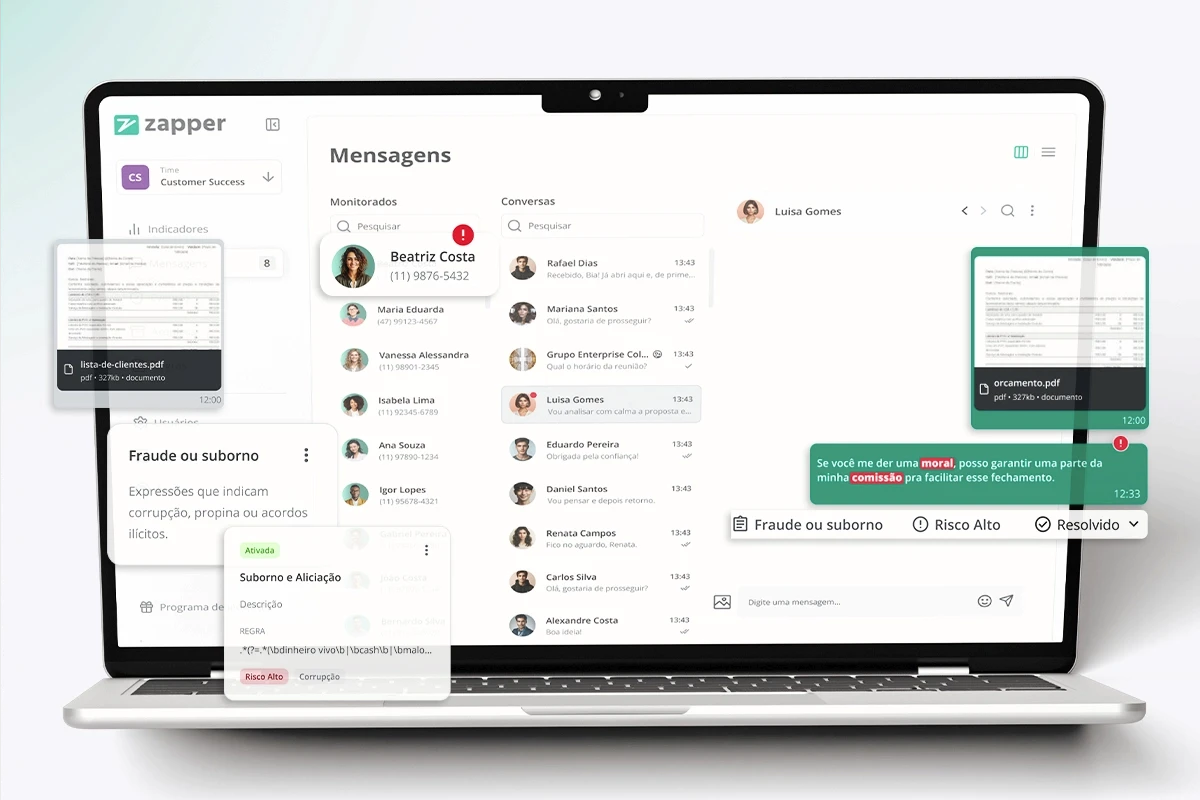
Data is stored in a secure cloud, with access restricted to authorized managers and full compliance with the General Data Protection Law, ensuring protection of sensitive information and legal security.
Transparency and consent as a foundation
Modern management of corporate WhatsApp is only possible with ethics and clarity. At Zapper, connection occurs through QR Code scanning, requiring active participation from the employee, who must be aware and agree to the process.
This monitoring must be provided for in internal policies and communicated transparently. This reinforces that corporate WhatsApp is an institutional tool, not a personal one.
When there is consent, clarity, and purpose, visibility ceases to be control and becomes structure.
Treating corporate WhatsApp as infrastructure is a decision of maturity
Monitoring corporate WhatsApp is not about watching people. It is about protecting teams, organizing processes, and making better decisions.
Mature companies understand that communication is a strategic asset. And strategic assets require governance, data, and accountability.
This is the path to strengthening individuals, processes, and decisions in an increasingly digital environment.
If we ask what the most essential communication tool for a company today is, the answer is likely to be neither email nor telephone. It will be WhatsApp.
The app, which was born for personal conversations, has transformed into a true work infrastructure, a central nervous system through which communication with clients, partners, and internal teams flows.
The paradox is evident. While companies have structured, monitored, and professionalized almost all their systems, from CRM to finance, the main communication channel of the business still operates, in many cases, like a black box.
Many managers associate the idea of monitoring corporate WhatsApp with surveillance or invasion of privacy. This perception, in addition to being misguided, exposes the company to operational, legal, and strategic risks. Monitoring corporate WhatsApp is not about watching people. It is a modern management practice, guided by transparency, security, and data-driven decision-making.
Corporate WhatsApp has become work infrastructure
In the day-to-day operations of companies, WhatsApp is present in virtually all areas. Sales negotiate proposals, send quotes, and close deals. Customer service resolves demands, manages crises, and collects feedback. Marketing engages with leads and tracks campaigns. HR communicates internally and even conducts recruitment processes.
In this flow, critical and sensitive information circulates. Strategic decisions and operational alignments are made through messages. Promises and commercial agreements create real obligations. Client data, documents, and confidential information are shared. Negotiations with suppliers and partners happen in real time.
WhatsApp has ceased to be just a messaging app. It has become the primary channel of relationship and a living repository of the company's intelligence. Operating without any institutional visibility over this flow is like conducting a complex operation without control instruments. Everything happens, but no one sees the big picture.
Monitoring corporate WhatsApp is not about watching people
The resistance to monitoring corporate WhatsApp usually stems from a misguided association between visibility and invasion of privacy. This happens because WhatsApp has personal origins, which makes it difficult to perceive its use as an institutional tool.
However, when we talk about numbers, devices, or accounts used for professional purposes, the logic needs to be different. The lack of visibility does not protect the employee. It only creates a risk environment for the company and for those who work there.
What visibility means in corporate WhatsApp, in practice
Visibility is not espionage. It is structured communication management. In practice, monitoring corporate WhatsApp means understanding how the channel is being used, analyzing conversation volumes and recurring themes. It means ensuring alignment with internal policies, brand voice, and compliance guidelines. It means protecting employees and the company with records that serve as evidence in conflicts or disputes. It means preserving history and intelligence, preventing strategic information from being lost when someone leaves the organization. It means, above all, improving processes based on real data, replacing guesswork with concrete analysis.
This logic is already widely accepted in other corporate systems. A CRM does not monitor the salesperson. It organizes the funnel and guides decisions. BI tools do not monitor managers. They transform data into intelligence. Audits do not monitor financial areas. They ensure compliance and security.
Corporate WhatsApp follows exactly the same principle. Organize, protect, and guide decisions.
The real risks of corporate WhatsApp without visibility
Keeping WhatsApp outside the management structure generates immediate and cumulative risks. The history and relationship with clients are lost when employees leave. There is no way to audit behaviors in the face of complaints or conflicts. Communication with clients becomes inconsistent, with contradictory messages. Decisions are made without data on the quality of service. The company is exposed to compliance and LGPD risks when dealing with sensitive data out of control. Additionally, it loses business intelligence hidden in individual conversations.
WhatsApp conversations carry valuable insights about clients, products, objections, and opportunities. When they remain invisible, the company loses competitiveness and operational maturity.
Visibility in corporate WhatsApp also protects the employee
One frequently overlooked point is that visibility also serves as a layer of protection for those on the front lines.
In environments without institutional records, the employee is exposed to misinterpretations, unfounded accusations, and unfounded conflicts. Visibility allows for the verification of correct approaches and professional conduct. It prevents common context distortions in written communication. It provides institutional backing in negotiations and sensitive situations. It enhances the quality of service and makes communication more professional.
The goal is not to micromanage individuals but to create a safer, fairer, and more professional environment, both for the company and for individuals.
How Zapper enables modern management of corporate WhatsApp
Transforming WhatsApp from a black box into a strategic asset requires the right technology. Zapper was developed to enable this modern model of corporate WhatsApp management, with security, transparency, and intelligence.
With the platform, the company can monitor each corporate WhatsApp account used by its sales, customer service, marketing, or operations teams. This allows for the identification of points for process improvement, evaluation of the accuracy of employee discourse, testing and optimizing service strategies, tracking campaign performance, and detecting deviations or violations of internal policies.
Data is stored in a secure cloud, with access restricted to authorized managers and full compliance with the General Data Protection Law, ensuring protection of sensitive information and legal security.
Transparency and consent as a foundation
Modern management of corporate WhatsApp is only possible with ethics and clarity. At Zapper, connection occurs through QR Code scanning, requiring active participation from the employee, who must be aware and agree to the process.
This monitoring must be provided for in internal policies and communicated transparently. This reinforces that corporate WhatsApp is an institutional tool, not a personal one.
When there is consent, clarity, and purpose, visibility ceases to be control and becomes structure.
Treating corporate WhatsApp as infrastructure is a decision of maturity
Monitoring corporate WhatsApp is not about watching people. It is about protecting teams, organizing processes, and making better decisions.
Mature companies understand that communication is a strategic asset. And strategic assets require governance, data, and accountability.
This is the path to strengthening individuals, processes, and decisions in an increasingly digital environment.