
WhatsApp on Black Friday: management, intelligence, and results
WhatsApp on Black Friday: management, intelligence, and results
The channel that sells the most can also blind the operation. A diagnosis and a path to a solution.

We have arrived in the month of Black Friday, and with it comes a flood of notifications. However, for many companies, the sound that was once synonymous with sales and opportunities now blends with a buzz of anxiety and pressure on commercial teams. WhatsApp, the tool that promised to be the golden bridge to the customer, has turned into an ocean of simultaneous conversations, where each unanswered message is a lost sale and every unmonitored dialogue poses a potential risk.
What started as a convenience: allowing customers to ask questions and make purchases through Brazil's most popular messaging app, quickly scaled up. Today, WhatsApp is no longer an alternative channel. For many businesses, it is the main channel.
During Black Friday, this prominence intensifies, generating a volume of interactions that most commercial structures are not prepared to manage.
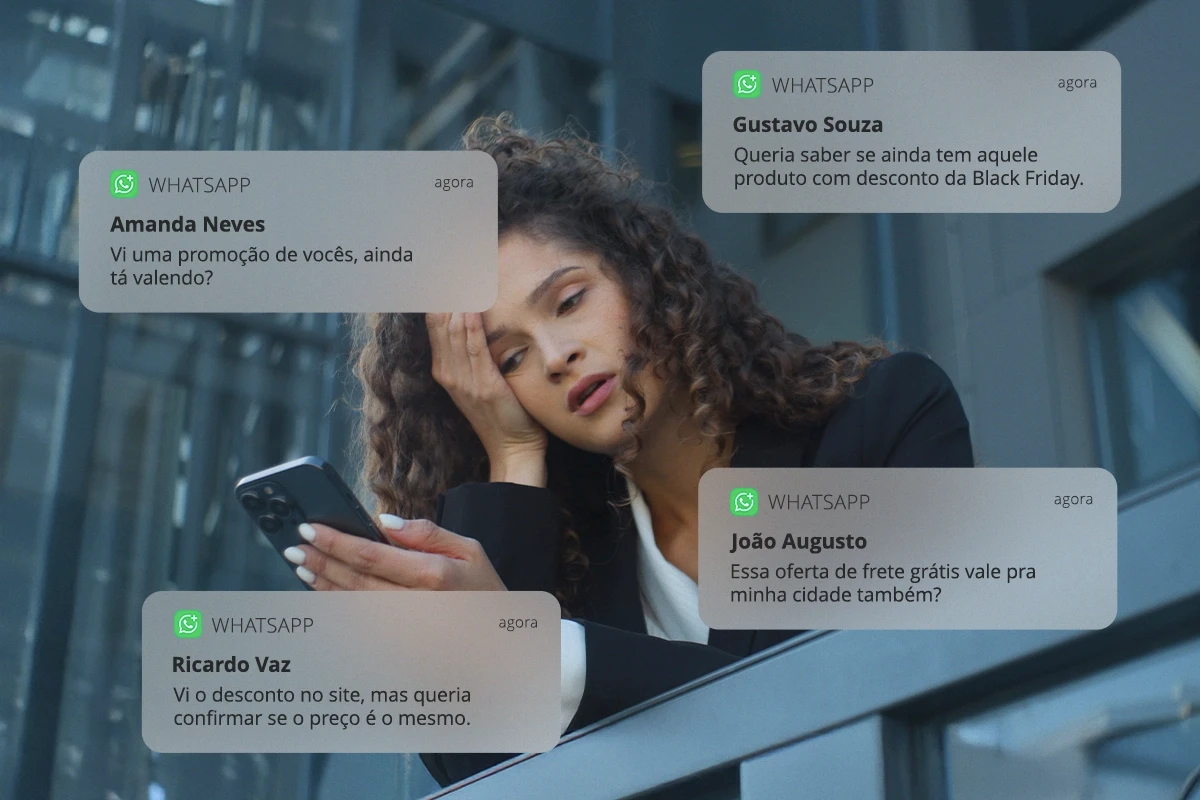
The numbers prove this transformation: 83% of Brazilian consumers use WhatsApp in the purchasing process, and 65% prefer to receive promotions via WhatsApp during promotional periods like Black Friday. Even more impressive: WhatsApp and RCS campaigns during events like Black Friday achieve click-through rates (CTR) of 15-30% or more, far exceeding traditional channels like SMS and email.¹
The result is an invisible chaos. Invisible to the customer, who only perceives the delay in response or lack of information. Invisible to top management, which sees sales numbers but does not see lost opportunities, unrecorded discount promises, or security failures occurring in hundreds of individual conversations.
This is the paradox of Black Friday on WhatsApp: while we celebrate the boom in online sales, a silent problem of management, compliance, and performance grows behind the screens.
How WhatsApp established itself as the main sales channel on Black Friday
There was a time when the buying journey on Black Friday was linear: the customer saw an ad, clicked, went to the website, added the product to the cart, and completed the purchase. Any doubt along the way most often meant abandoning the cart. The arrival of WhatsApp as a corporate sales channel completely shattered this model.
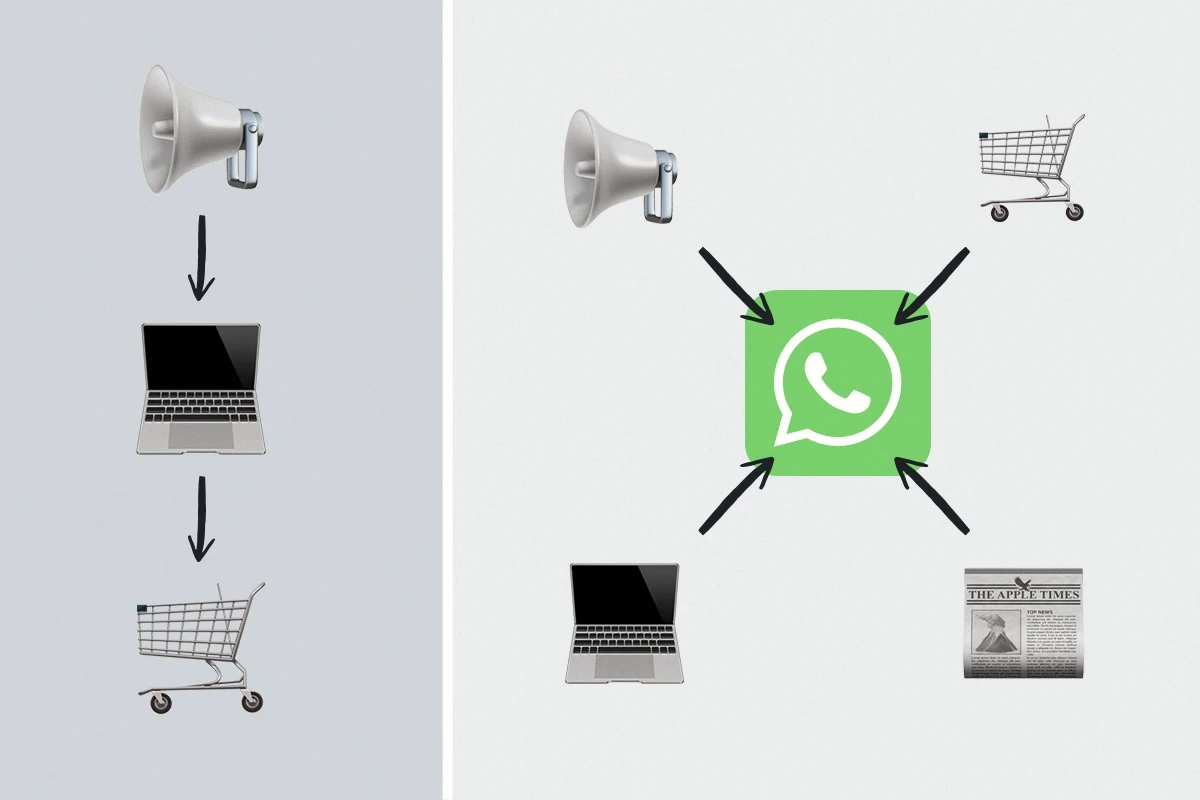
The transformation was not by chance. With more than 90% of smartphones in Brazil having the app installed and message open rates exceeding 98%, WhatsApp provides a direct and personal access to consumers that no other channel can replicate¹. Companies realized they could bring the store to the customer's pocket, transforming a simple conversation into a powerful digital marketing and sales tool.
The Hidden Risks: When the Boom of Conversations Becomes Operational Chaos
The same volume that makes WhatsApp a sales giant on Black Friday is also its Achilles' heel when not managed with the right tools. The avalanche of messages that arrives during the promotional period overwhelms teams and exposes the company to a series of critical risks that go far beyond a lost sale.
The Pressure on Sales and Service Teams
During Black Friday, it is not uncommon for a single seller to manage 50, 100, or even 200 simultaneous conversations. What seems like just "high demand" conceals a dangerous reality:
Team Burnout: the pressure to respond quickly generates stress, errors, and a decrease in the quality of service;
Collective Disorganization: without intelligent prioritization, high-value sales may be neglected while simple queries consume precious time;
Loss of Opportunities: studies show that 75% of consumers expect a response within 5 minutes. Exceeding this time can mean losing the sale.²

Without a management platform for Corporate WhatsApp, the "invisible chaos" sets in and can be costly. Let’s detail the main risks that multiply in this scenario:
1. Loss of Control and Decrease in Performance: Operating Blindly
When each seller uses a WhatsApp account, management becomes blind. Essential questions cannot be answered:
How many conversations is each seller managing?
Has that customer who reached out two hours ago already been attended to?
Which sellers are converting more and why? What arguments are they using?
How do we ensure that the quality standard in customer service is the same for everyone?
Selling via WhatsApp without monitoring or extracting insights from conversations is like operating blindly. Without centralized data and conversational intelligence, the operation functions in the dark. Management cannot identify bottlenecks, train the team based on real data, or optimize the sales process. The result is inconsistent performance, with customers frustrated by delays and an overloaded and directionless team, directly impacting the customer support revenue potential on Black Friday.
2. Compliance Risks and Data Leakage (LGPD)
This is perhaps the most serious risk. In each negotiation via WhatsApp, sensitive data is exchanged: full name, CPF, address, emails, and sometimes even payment information. When these conversations occur on personal devices or on accounts not controlled by the company, it creates a huge vulnerability:
Violation of LGPD: the General Data Protection Law requires that the company have control over how customer data is collected, stored, and used. Without a platform that centralizes and protects this information, the company is in non-compliance, subject to fines that can reach 2% of revenue, limited to R$ 50 million per infraction.²
Information Leakage: an employee leaving the company may take with them the entire history of conversations and the customers' contact list. Strategic information, pricing lists, and customer data can end up in the hands of competitors or be misused.
Information Security: the use of public Wi-Fi networks or the lack of security protocols on devices can expose conversations to attacks, compromising both the company and its customers.
3. Untraceable Promises and Legal Insecurity
During the frenzy of Black Friday, in the eagerness to meet targets, a seller might promise an extra discount, a gift that wasn’t in the script, or an impossible delivery timeframe. If this conversation happens on an unmonitored WhatsApp, this promise gets lost.
Customer Dissatisfaction: when the promise is not fulfilled, customer frustration is inevitable. This leads to complaints, negative reviews, and irreparable damage to the brand's reputation.
Legal Disputes: a conversation on WhatsApp can be considered a contract record. If the company cannot prove what was agreed upon, it may find itself in an unfavorable legal situation. Having an auditable and centralized history of all interactions is fundamental protection for the business.
4. Lack of Attention and Diminished Customer Experience
The great appeal of WhatsApp is the promise of efficient and personalized communication. However, when the team is overwhelmed, the exact opposite happens:
Generic Responses: without time to understand each customer's needs, sellers resort to ready-made and impersonal responses, breaking the human connection;
Ignored Messages: among hundreds of chats, it is easy for a question to get lost. The ignored customer not only gives up on the purchase but also becomes a detractor of the brand;
Lack of Continuity: if a customer is assisted by one seller today and another tomorrow, they need to explain their entire issue again. The absence of a unified history breaks the fluidity of service and irritates the consumer.
Zapper: Transforming Chaos into Strategic Opportunity
Ignoring these risks is like navigating a storm with blindfolded eyes.
The good news? There is a solution that transforms WhatsApp from a chaotic channel into a secure, intelligent, and scalable sales machine.
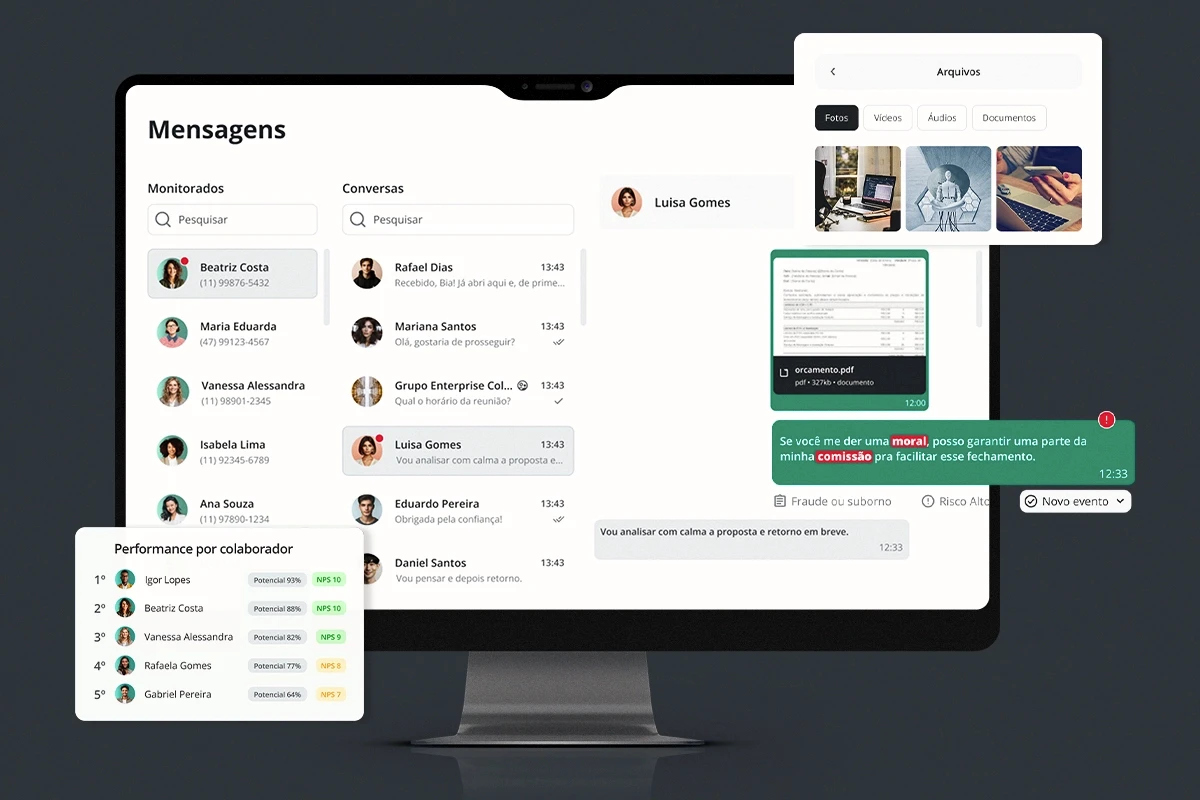
Zapper is the complete management platform for corporate WhatsApp, developed especially for companies that want to leverage the full potential of this channel without compromising security, compliance, or performance.
How Zapper Solves the Challenges of Black Friday on WhatsApp
1. Intelligent Monitoring and Risk Prevention
Comprehensive Monitoring: managers track all conversations conducted by their employees (across multiple accounts) and can access each one individually;
Key Content Alerts: the system automatically detects words and phrases that indicate misconduct, unauthorized promises, or inappropriate language;
Complete Audit: all history is recorded and can be retrieved for dispute resolution or training. Even if the employee deletes something.
2. Conversational Intelligence and Behavior Analysis
Lead Analysis: identify hot, warm, and cold leads based on interaction patterns;
Sales Insights: based on the most frequently used terms and the results of sent messages, uncover which arguments convert best, which objections frequently arise, and how your team can improve;
Churn Prediction: identify dissatisfied customers before it’s too late;
3. Performance and Analytics
Performance Management by Employee: know exactly who is performing well and who needs to evolve;
Automated Reports: export strategic insights in comprehensive reports, without needing to sift through data manually;
4. Data Security and LGPD Compliance
Automatic Backup: all messages and files are stored securely and encrypted
Access Control: set granular permissions for each team member
Guaranteed Compliance: meet LGPD requirements with Zapper resources.
Conclusion: The Black Friday Your Company Deserves
The Black Friday on WhatsApp doesn’t have to be synonymous with chaos. With the right tools, the boom in conversations transforms into a strategic opportunity to sell more, retain customers, and build a strategic, aligned, and effective commercial operation.
The difference between companies that merely survive Black Friday and those that thrive lies in the ability to transform volume into intelligence, conversations into insights, and risks into protection.
Our solutions were developed precisely for this: to help you leverage the full sales potential of WhatsApp without sacrificing security, control, and performance.
This Black Friday, choose not to operate blindly.

Ready to transform your WhatsApp into a professional sales channel? Discover Zapper and find out how leading companies are selling more with security and intelligence.
References:
Accenture/Meta Research: https://consumidormoderno.com.br/2020/08/13/whatsapp-papel-fundamental-para-varejo-brasileiro
https://business.whatsapp.com/blog/where-business-messaging-customers-marketers-agree
WhatsApp Statistics Brazil: https://m.aisensy.com/blog/pt/estatisticas-whatsapp/
OmniChat Study (Conversion): https://www.ecommercebrasil.com.br/noticias/conversao-vendas-whatsapp-comercio-eletronico
Meta Business (Open Rate): https://business.whatsapp.com/blog/where-business-messaging-customers-marketers-agree
Response Time (Opinion Box): https://www.mlabs.com.br/blog/tempo-de-resposta-redes-sociais
We have arrived in the month of Black Friday, and with it comes a flood of notifications. However, for many companies, the sound that was once synonymous with sales and opportunities now blends with a buzz of anxiety and pressure on commercial teams. WhatsApp, the tool that promised to be the golden bridge to the customer, has turned into an ocean of simultaneous conversations, where each unanswered message is a lost sale and every unmonitored dialogue poses a potential risk.
What started as a convenience: allowing customers to ask questions and make purchases through Brazil's most popular messaging app, quickly scaled up. Today, WhatsApp is no longer an alternative channel. For many businesses, it is the main channel.
During Black Friday, this prominence intensifies, generating a volume of interactions that most commercial structures are not prepared to manage.
The numbers prove this transformation: 83% of Brazilian consumers use WhatsApp in the purchasing process, and 65% prefer to receive promotions via WhatsApp during promotional periods like Black Friday. Even more impressive: WhatsApp and RCS campaigns during events like Black Friday achieve click-through rates (CTR) of 15-30% or more, far exceeding traditional channels like SMS and email.¹
The result is an invisible chaos. Invisible to the customer, who only perceives the delay in response or lack of information. Invisible to top management, which sees sales numbers but does not see lost opportunities, unrecorded discount promises, or security failures occurring in hundreds of individual conversations.
This is the paradox of Black Friday on WhatsApp: while we celebrate the boom in online sales, a silent problem of management, compliance, and performance grows behind the screens.
How WhatsApp established itself as the main sales channel on Black Friday
There was a time when the buying journey on Black Friday was linear: the customer saw an ad, clicked, went to the website, added the product to the cart, and completed the purchase. Any doubt along the way most often meant abandoning the cart. The arrival of WhatsApp as a corporate sales channel completely shattered this model.
The transformation was not by chance. With more than 90% of smartphones in Brazil having the app installed and message open rates exceeding 98%, WhatsApp provides a direct and personal access to consumers that no other channel can replicate¹. Companies realized they could bring the store to the customer's pocket, transforming a simple conversation into a powerful digital marketing and sales tool.
The Hidden Risks: When the Boom of Conversations Becomes Operational Chaos
The same volume that makes WhatsApp a sales giant on Black Friday is also its Achilles' heel when not managed with the right tools. The avalanche of messages that arrives during the promotional period overwhelms teams and exposes the company to a series of critical risks that go far beyond a lost sale.
The Pressure on Sales and Service Teams
During Black Friday, it is not uncommon for a single seller to manage 50, 100, or even 200 simultaneous conversations. What seems like just "high demand" conceals a dangerous reality:
Team Burnout: the pressure to respond quickly generates stress, errors, and a decrease in the quality of service;
Collective Disorganization: without intelligent prioritization, high-value sales may be neglected while simple queries consume precious time;
Loss of Opportunities: studies show that 75% of consumers expect a response within 5 minutes. Exceeding this time can mean losing the sale.²
Without a management platform for Corporate WhatsApp, the "invisible chaos" sets in and can be costly. Let’s detail the main risks that multiply in this scenario:
1. Loss of Control and Decrease in Performance: Operating Blindly
When each seller uses a WhatsApp account, management becomes blind. Essential questions cannot be answered:
How many conversations is each seller managing?
Has that customer who reached out two hours ago already been attended to?
Which sellers are converting more and why? What arguments are they using?
How do we ensure that the quality standard in customer service is the same for everyone?
Selling via WhatsApp without monitoring or extracting insights from conversations is like operating blindly. Without centralized data and conversational intelligence, the operation functions in the dark. Management cannot identify bottlenecks, train the team based on real data, or optimize the sales process. The result is inconsistent performance, with customers frustrated by delays and an overloaded and directionless team, directly impacting the customer support revenue potential on Black Friday.
2. Compliance Risks and Data Leakage (LGPD)
This is perhaps the most serious risk. In each negotiation via WhatsApp, sensitive data is exchanged: full name, CPF, address, emails, and sometimes even payment information. When these conversations occur on personal devices or on accounts not controlled by the company, it creates a huge vulnerability:
Violation of LGPD: the General Data Protection Law requires that the company have control over how customer data is collected, stored, and used. Without a platform that centralizes and protects this information, the company is in non-compliance, subject to fines that can reach 2% of revenue, limited to R$ 50 million per infraction.²
Information Leakage: an employee leaving the company may take with them the entire history of conversations and the customers' contact list. Strategic information, pricing lists, and customer data can end up in the hands of competitors or be misused.
Information Security: the use of public Wi-Fi networks or the lack of security protocols on devices can expose conversations to attacks, compromising both the company and its customers.
3. Untraceable Promises and Legal Insecurity
During the frenzy of Black Friday, in the eagerness to meet targets, a seller might promise an extra discount, a gift that wasn’t in the script, or an impossible delivery timeframe. If this conversation happens on an unmonitored WhatsApp, this promise gets lost.
Customer Dissatisfaction: when the promise is not fulfilled, customer frustration is inevitable. This leads to complaints, negative reviews, and irreparable damage to the brand's reputation.
Legal Disputes: a conversation on WhatsApp can be considered a contract record. If the company cannot prove what was agreed upon, it may find itself in an unfavorable legal situation. Having an auditable and centralized history of all interactions is fundamental protection for the business.
4. Lack of Attention and Diminished Customer Experience
The great appeal of WhatsApp is the promise of efficient and personalized communication. However, when the team is overwhelmed, the exact opposite happens:
Generic Responses: without time to understand each customer's needs, sellers resort to ready-made and impersonal responses, breaking the human connection;
Ignored Messages: among hundreds of chats, it is easy for a question to get lost. The ignored customer not only gives up on the purchase but also becomes a detractor of the brand;
Lack of Continuity: if a customer is assisted by one seller today and another tomorrow, they need to explain their entire issue again. The absence of a unified history breaks the fluidity of service and irritates the consumer.
Zapper: Transforming Chaos into Strategic Opportunity
Ignoring these risks is like navigating a storm with blindfolded eyes.
The good news? There is a solution that transforms WhatsApp from a chaotic channel into a secure, intelligent, and scalable sales machine.
Zapper is the complete management platform for corporate WhatsApp, developed especially for companies that want to leverage the full potential of this channel without compromising security, compliance, or performance.
How Zapper Solves the Challenges of Black Friday on WhatsApp
1. Intelligent Monitoring and Risk Prevention
Comprehensive Monitoring: managers track all conversations conducted by their employees (across multiple accounts) and can access each one individually;
Key Content Alerts: the system automatically detects words and phrases that indicate misconduct, unauthorized promises, or inappropriate language;
Complete Audit: all history is recorded and can be retrieved for dispute resolution or training. Even if the employee deletes something.
2. Conversational Intelligence and Behavior Analysis
Lead Analysis: identify hot, warm, and cold leads based on interaction patterns;
Sales Insights: based on the most frequently used terms and the results of sent messages, uncover which arguments convert best, which objections frequently arise, and how your team can improve;
Churn Prediction: identify dissatisfied customers before it’s too late;
3. Performance and Analytics
Performance Management by Employee: know exactly who is performing well and who needs to evolve;
Automated Reports: export strategic insights in comprehensive reports, without needing to sift through data manually;
4. Data Security and LGPD Compliance
Automatic Backup: all messages and files are stored securely and encrypted
Access Control: set granular permissions for each team member
Guaranteed Compliance: meet LGPD requirements with Zapper resources.
Conclusion: The Black Friday Your Company Deserves
The Black Friday on WhatsApp doesn’t have to be synonymous with chaos. With the right tools, the boom in conversations transforms into a strategic opportunity to sell more, retain customers, and build a strategic, aligned, and effective commercial operation.
The difference between companies that merely survive Black Friday and those that thrive lies in the ability to transform volume into intelligence, conversations into insights, and risks into protection.
Our solutions were developed precisely for this: to help you leverage the full sales potential of WhatsApp without sacrificing security, control, and performance.
This Black Friday, choose not to operate blindly.
Ready to transform your WhatsApp into a professional sales channel? Discover Zapper and find out how leading companies are selling more with security and intelligence.
References:
Accenture/Meta Research: https://consumidormoderno.com.br/2020/08/13/whatsapp-papel-fundamental-para-varejo-brasileiro
https://business.whatsapp.com/blog/where-business-messaging-customers-marketers-agree
WhatsApp Statistics Brazil: https://m.aisensy.com/blog/pt/estatisticas-whatsapp/
OmniChat Study (Conversion): https://www.ecommercebrasil.com.br/noticias/conversao-vendas-whatsapp-comercio-eletronico
Meta Business (Open Rate): https://business.whatsapp.com/blog/where-business-messaging-customers-marketers-agree
Response Time (Opinion Box): https://www.mlabs.com.br/blog/tempo-de-resposta-redes-sociais

Zapper Team
Content produced by our team, specialists in optimizing business communication via WhatsApp.
Zapper Team
Content produced by our team, specialists in optimizing business communication via WhatsApp.
Zapper Team
Content produced by our team, specialists in optimizing business communication via WhatsApp.
Share: