

Customer Service
WhatsApp for business: best and worst practices for professional customer service
Discover the practices that separate a professional WhatsApp from an amateur operation, and the mistakes that put your company at risk.
Zapper Team
·
·
6 min of reading

What you'll find in this article
WhatsApp Business vs. WhatsApp Business Platform
Personal use vs. corporate use
Main applications in the business environment
The 10 best practices for using WhatsApp in business
How to use Zapper tools to professionalize the channel
Conclusion
Introduction
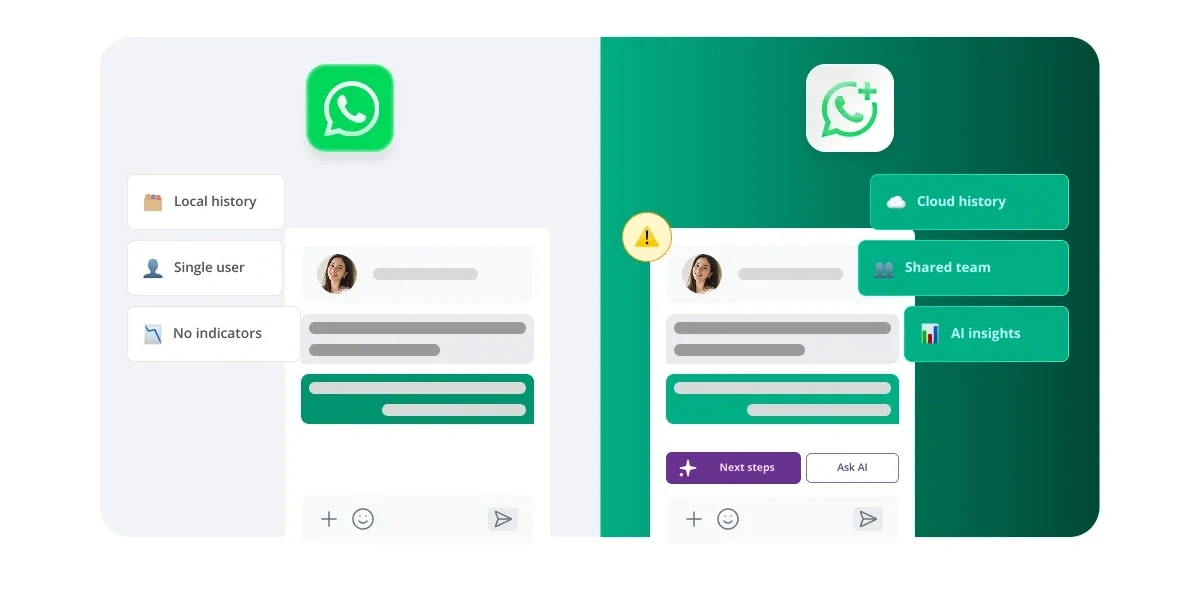
WhatsApp is today the main contact channel between companies and consumers in Brazil: there are 147 million users in the country, more than 96% of the online population¹, and 95% of Brazilian companies have already used the app to talk to customers². The problem is that adoption didn't come with structure. Personal numbers play the role of the company account, negotiation history disappears when a salesperson leaves, and there is no indicator at all of what is being promised in the brand's name.
This guide is direct: it shows the difference between the available tools, where personal use becomes a risk, which applications generate the most return and the ten practices that separate a professional operation from an amateur one.
WhatsApp Business vs. WhatsApp Business Platform
Criterion | WhatsApp Business | WhatsApp Business Platform |
|---|---|---|
Target audience | Small businesses and freelancers | Mid-sized and large companies with service at scale |
Features | Catalog, automatic messages, labels | Multiple simultaneous agents, CRM integration, automations, approved templates |
Limitations | Up to 4 linked devices; no native integration with external systems | No interface of its own; relies on a platform (BSP or Cloud API) to work |
Scalability | Low | High |
Use cases | Neighborhood store, freelance provider, small e-commerce | Banks, retail chains, customer service operations, multiple support teams |
The official name in Meta's documentation for the larger-scale version is WhatsApp Business Platform, although the market also uses "WhatsApp API" and "WhatsApp Business API" as synonyms³.
Personal use vs. corporate use
The difference isn't in the app, it's in governance. In personal use, the conversation belongs to the device and to whoever uses it: if the employee leaves, the history of negotiations, promises and agreements goes with them. In structured corporate use, the conversation is a company asset: documented, auditable and independent of who is handling it at that moment.
This has a concrete cost when ignored: a relationship tied to a salesperson's personal number migrates with them to a competitor; unrecorded promises become disputes with no possible defense for the company; and uncontrolled access to conversation history is, today, one of the main blind spots in digital compliance.
Read more on the subject: Compliance on Business WhatsApp: How to Apply It the Right Way
Main applications in the business environment
Customer service and after-sales support;
Consultative selling and commercial negotiation;
Collections and debt renegotiation;
Conversational marketing and relationships;;
Internal communication between teams;
Confirmation of appointments, deliveries and orders.
Each application requires a different script. Collections call for a script aligned with consumer protection law and rigorous recording of each interaction; conversational marketing calls for attention to send frequency, so as not to trigger blocking or reports. Treating all of them with the same generic script is one of the most common causes of a low resolution rate.
The 10 best practices for using WhatsApp in business
Move from a personal number to a company number. Register the number under the company's tax ID, link the business profile and tell the base that already had contact through the personal number about the change.
Define roles, hours and authority limits. Document who answers, when to escalate and how much discount can be offered without approval: this avoids conflicting promises between different agents.
Standardize scripts without stiffening the conversation. A good script is a skeleton, not a straitjacket: it structures the reply and leaves room for the agent to adapt the tone.
Use labels or a CRM funnel. Without visual organization, important conversations get lost among others and the agent wastes time rereading the history to understand where the negotiation stopped.
Integrate WhatsApp with the CRM. Only then does the company know how many leads came through the channel, how many advanced and how many closed: data that doesn't exist when the negotiation stays isolated on the salesperson's phone.
Document conduct policies. What can be said, shared or promised in the company's name needs to be written down and presented from the moment of hiring.
Adopt monitoring and governance. On larger teams, registering risk keywords (offensive language, promises outside what was agreed) allows preventive action, without depending on manually reading every conversation.
Measure service indicators. First response time, resolution time, volume per agent, conversion rate and CSAT are the minimum for knowing where the real bottlenecks are.
Ensure compliance with LGPD⁴. Review how the customer's number was obtained, who has access to the history and what the flow is for handling data deletion requests.
Scale with technology before scaling with people. A good portion of message volume is concentrated in recurring questions: exactly the type of conversation that benefits most from automation in triage.

How to use Zapper to professionalize the channel
Zapper was designed to cover precisely the gap between "using WhatsApp" and "having governance over business WhatsApp", as a Meta technology partner company, without necessarily needing the API. The connection is made by QR Code (Zapper API), directly on the number the company already uses, without switching apps, installing a technical integration or losing the history of the current operation.
From there, three fronts cover what this guide described:
Monitoring: supervises the dialogues of multiple numbers and, consequently, devices, with configurable alerts for keywords that indicate risk;
Storage: archives messages and media in the cloud, with access restricted to the manager, even if the content is deleted on the device, solving the visibility problem and reinforcing LGPD compliance;
Intelligence (Analytics and Zapper AI): turns the content of conversations into performance indicators per agent and identifies sentiment, intent and risk.
None of this replaces internal process and policy: Zapper gives visibility and security over communication that, without structure, would keep happening blindly.
Conclusion
WhatsApp is already the channel that generates the most contact with the customer, and the question is no longer whether the company should structure it, but how quickly. The ten practices above form the foundation; the difference between an amateur operation and a mature one lies in turning that foundation into routine, with data and governance underpinning every decision.
If your company already depends on WhatsApp to sell, serve or negotiate, the next step is to gain visibility into how those conversations are being handled. Get to know Zapper and see how to turn communication into governance, security and intelligence for the business.

Bibliography
STATISTA. WhatsApp in Brazil: Statistics & Facts. 2024. Cited in: TERRA. Startup Zapper lança solução para o WhatsApp corporativo. Available at: https://www.terra.com.br/noticias/startup-zapper-lanca-solucao-para-o-whatsapp-corporativo,0abed0bcb0c63e35498f71ff780d97f63x47wzjc.html. Accessed on: Jul. 13, 2026.
INTERNATIONAL DATA CORPORATION (IDC); YALO. Research on WhatsApp use by Brazilian companies, Nov. 2022 – Jun. 2023. Cited in: TERRA. Startup Zapper lança solução para o WhatsApp corporativo. Accessed on: Jul. 13, 2026.
META. WhatsApp Business Platform — developer documentation. Available at: https://developers.facebook.com/docs/whatsapp. Accessed on: Jul. 13, 2026.
BRAZIL. Law No. 13,709 of August 14, 2018. General Personal Data Protection Law (LGPD). Available at: http://www.planalto.gov.br/ccivil_03/_ato2015-2018/2018/lei/L13709.htm. Accessed on: Jul. 13, 2026.
What you'll find in this article
WhatsApp Business vs. WhatsApp Business Platform
Personal use vs. corporate use
Main applications in the business environment
The 10 best practices for using WhatsApp in business
How to use Zapper tools to professionalize the channel
Conclusion
Introduction
WhatsApp is today the main contact channel between companies and consumers in Brazil: there are 147 million users in the country, more than 96% of the online population¹, and 95% of Brazilian companies have already used the app to talk to customers². The problem is that adoption didn't come with structure. Personal numbers play the role of the company account, negotiation history disappears when a salesperson leaves, and there is no indicator at all of what is being promised in the brand's name.
This guide is direct: it shows the difference between the available tools, where personal use becomes a risk, which applications generate the most return and the ten practices that separate a professional operation from an amateur one.
WhatsApp Business vs. WhatsApp Business Platform
Criterion | WhatsApp Business | WhatsApp Business Platform |
|---|---|---|
Target audience | Small businesses and freelancers | Mid-sized and large companies with service at scale |
Features | Catalog, automatic messages, labels | Multiple simultaneous agents, CRM integration, automations, approved templates |
Limitations | Up to 4 linked devices; no native integration with external systems | No interface of its own; relies on a platform (BSP or Cloud API) to work |
Scalability | Low | High |
Use cases | Neighborhood store, freelance provider, small e-commerce | Banks, retail chains, customer service operations, multiple support teams |
The official name in Meta's documentation for the larger-scale version is WhatsApp Business Platform, although the market also uses "WhatsApp API" and "WhatsApp Business API" as synonyms³.
Personal use vs. corporate use
The difference isn't in the app, it's in governance. In personal use, the conversation belongs to the device and to whoever uses it: if the employee leaves, the history of negotiations, promises and agreements goes with them. In structured corporate use, the conversation is a company asset: documented, auditable and independent of who is handling it at that moment.
This has a concrete cost when ignored: a relationship tied to a salesperson's personal number migrates with them to a competitor; unrecorded promises become disputes with no possible defense for the company; and uncontrolled access to conversation history is, today, one of the main blind spots in digital compliance.
Read more on the subject: Compliance on Business WhatsApp: How to Apply It the Right Way
Main applications in the business environment
Customer service and after-sales support;
Consultative selling and commercial negotiation;
Collections and debt renegotiation;
Conversational marketing and relationships;;
Internal communication between teams;
Confirmation of appointments, deliveries and orders.
Each application requires a different script. Collections call for a script aligned with consumer protection law and rigorous recording of each interaction; conversational marketing calls for attention to send frequency, so as not to trigger blocking or reports. Treating all of them with the same generic script is one of the most common causes of a low resolution rate.
The 10 best practices for using WhatsApp in business
Move from a personal number to a company number. Register the number under the company's tax ID, link the business profile and tell the base that already had contact through the personal number about the change.
Define roles, hours and authority limits. Document who answers, when to escalate and how much discount can be offered without approval: this avoids conflicting promises between different agents.
Standardize scripts without stiffening the conversation. A good script is a skeleton, not a straitjacket: it structures the reply and leaves room for the agent to adapt the tone.
Use labels or a CRM funnel. Without visual organization, important conversations get lost among others and the agent wastes time rereading the history to understand where the negotiation stopped.
Integrate WhatsApp with the CRM. Only then does the company know how many leads came through the channel, how many advanced and how many closed: data that doesn't exist when the negotiation stays isolated on the salesperson's phone.
Document conduct policies. What can be said, shared or promised in the company's name needs to be written down and presented from the moment of hiring.
Adopt monitoring and governance. On larger teams, registering risk keywords (offensive language, promises outside what was agreed) allows preventive action, without depending on manually reading every conversation.
Measure service indicators. First response time, resolution time, volume per agent, conversion rate and CSAT are the minimum for knowing where the real bottlenecks are.
Ensure compliance with LGPD⁴. Review how the customer's number was obtained, who has access to the history and what the flow is for handling data deletion requests.
Scale with technology before scaling with people. A good portion of message volume is concentrated in recurring questions: exactly the type of conversation that benefits most from automation in triage.
How to use Zapper to professionalize the channel
Zapper was designed to cover precisely the gap between "using WhatsApp" and "having governance over business WhatsApp", as a Meta technology partner company, without necessarily needing the API. The connection is made by QR Code (Zapper API), directly on the number the company already uses, without switching apps, installing a technical integration or losing the history of the current operation.
From there, three fronts cover what this guide described:
Monitoring: supervises the dialogues of multiple numbers and, consequently, devices, with configurable alerts for keywords that indicate risk;
Storage: archives messages and media in the cloud, with access restricted to the manager, even if the content is deleted on the device, solving the visibility problem and reinforcing LGPD compliance;
Intelligence (Analytics and Zapper AI): turns the content of conversations into performance indicators per agent and identifies sentiment, intent and risk.
None of this replaces internal process and policy: Zapper gives visibility and security over communication that, without structure, would keep happening blindly.
Conclusion
WhatsApp is already the channel that generates the most contact with the customer, and the question is no longer whether the company should structure it, but how quickly. The ten practices above form the foundation; the difference between an amateur operation and a mature one lies in turning that foundation into routine, with data and governance underpinning every decision.
If your company already depends on WhatsApp to sell, serve or negotiate, the next step is to gain visibility into how those conversations are being handled. Get to know Zapper and see how to turn communication into governance, security and intelligence for the business.
Bibliography
STATISTA. WhatsApp in Brazil: Statistics & Facts. 2024. Cited in: TERRA. Startup Zapper lança solução para o WhatsApp corporativo. Available at: https://www.terra.com.br/noticias/startup-zapper-lanca-solucao-para-o-whatsapp-corporativo,0abed0bcb0c63e35498f71ff780d97f63x47wzjc.html. Accessed on: Jul. 13, 2026.
INTERNATIONAL DATA CORPORATION (IDC); YALO. Research on WhatsApp use by Brazilian companies, Nov. 2022 – Jun. 2023. Cited in: TERRA. Startup Zapper lança solução para o WhatsApp corporativo. Accessed on: Jul. 13, 2026.
META. WhatsApp Business Platform — developer documentation. Available at: https://developers.facebook.com/docs/whatsapp. Accessed on: Jul. 13, 2026.
BRAZIL. Law No. 13,709 of August 14, 2018. General Personal Data Protection Law (LGPD). Available at: http://www.planalto.gov.br/ccivil_03/_ato2015-2018/2018/lei/L13709.htm. Accessed on: Jul. 13, 2026.

