Professional WhatsApp: how visibility into your team becomes real productivity
Professional WhatsApp: how visibility into your team becomes real productivity
Discover how to transform data obtained from WhatsApp Business into strategic intelligence for your operations.
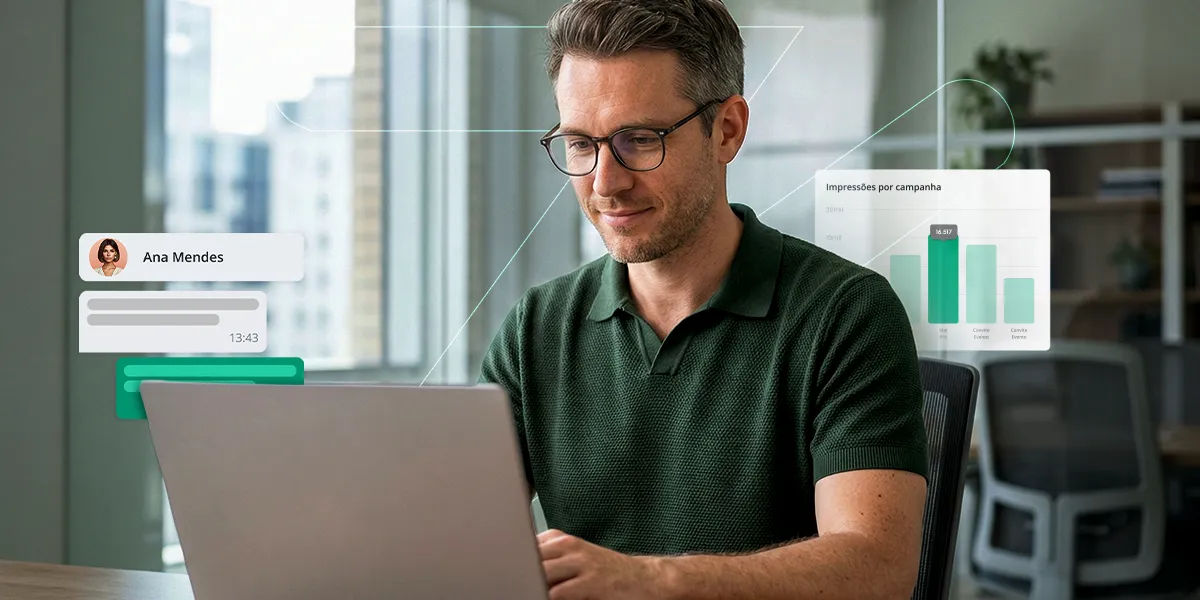
Can the company analyze the team's WhatsApp conversations? The answer is yes, but with very specific conditions that most institutions still don't know. And understanding these conditions makes all the difference between operating a risky channel or turning it into the operation's biggest sales asset.
This question has never been so urgent. WhatsApp has become the backbone of commercial operations across Brazil. There are 147 million users, with message open rates above 90% and 79.3% of Brazilian companies already using the channel for sales and marketing. Sales, CS, and operations managers depend on WhatsApp to close deals, solve problems, and keep customers. In most companies, management of this channel still happens in the dark.
73% of Brazilian companies have no visibility into messages and files exchanged by the team on corporate WhatsApp. 65% have already lost valuable information due to a lack of traceability. 41% have already faced legal problems directly related to the channel. And only 41.2% use automated campaigns, even with the channel available and active.
The paradox is clear: WhatsApp is already ubiquitous in companies, but its management remains amateurish. The manager doesn't know what the team is doing. Loses leads due to lack of follow-up. The employee takes the customer history with them when they leave the company. There is no traceability, there is no data and, when the problem appears, it has already become a loss.
What the CLT says about managing corporate conversations
The CLT has no specific article about WhatsApp Business, conversational service, or shared inbox management. What it has is a set of principles that labor courts apply to assess each concrete situation.
Article 2 defines the employer as the one who "assumes the risks of the economic activity" and "directs the personal provision of services." This directive power includes, according to settled case law, the prerogative to organize and supervise employees' activities, including the use of digital work tools.
The 2017 Labor Reform closed any gap that might have existed. The sole paragraph of Article 6 established that telematic means of command, control, and supervision are equivalent, for purposes of legal subordination, to in-person means. In practical terms: monitoring what happens on corporate messaging platforms, customer service systems, and digital sales channels is a legitimate extension of the employer's directive power.
But this power is not unlimited. Three criteria appear consistently in court decisions:
Proportionality. Conversation analysis needs to be appropriate to the purpose and cannot go beyond what is necessary for the legitimate management of operations.
Purpose. Monitoring needs a clear and documented objective: sales performance, deal traceability, service quality, compliance. It cannot function as an instrument of psychological pressure or personal surveillance.
Transparency. The employee needs to know that conversations carried out on corporate channels may be analyzed. Hidden management is, as a rule, legally prohibited.
What case law says in practice

Brazilian labor courts have already consolidated relevant understandings on the subject. There is still no specific precedent about corporate WhatsApp, but the principles applied to corporate emails, customer service systems, and digital tools apply directly.
When conversation analysis is allowed:
Monitoring conversations on corporate channels, such as numbers registered in the company's name, as long as the employee was informed in advance;
Use of messages as evidence in labor cases: the TRT-3 (Minas Gerais) recognized the lawfulness of audio and WhatsApp messages as valid evidence;
Performance analysis via service systems: the TST, when overturning a TRT-4 decision, held that electronic monitoring by itself is not unlawful and falls within the employer's oversight power.
When it constitutes abuse:
Access to the employee's personal devices without authorization, even if the conversations are work-related;
Monitoring without prior notice: the TRT-3 has already declared dismissal for cause null based on analysis of Skype conversations because the company had not informed the employee;
Use of the data as an instrument of psychological pressure or punishment;
Monitoring outside working hours via personal devices, which violates the right to disconnect.
Personal WhatsApp vs. corporate WhatsApp: where is the real limit
Personal WhatsApp is the employee's number, on the employee's device, with the employee's personal life. The employer has access to that under no circumstances. The LGPD (Law 13,709/2018) guarantees this precisely.
Corporate WhatsApp is something else. When the company provides the number, registers the channel as a commercial asset, or funds the operation, it is a work tool. The analysis of professional conversations carried out on this channel, with prior communication to the team, has solid legal backing.
The LGPD complements the CLT on this point. Article 6 requires that data processing observe clear purpose, adequacy, necessity, and transparency.
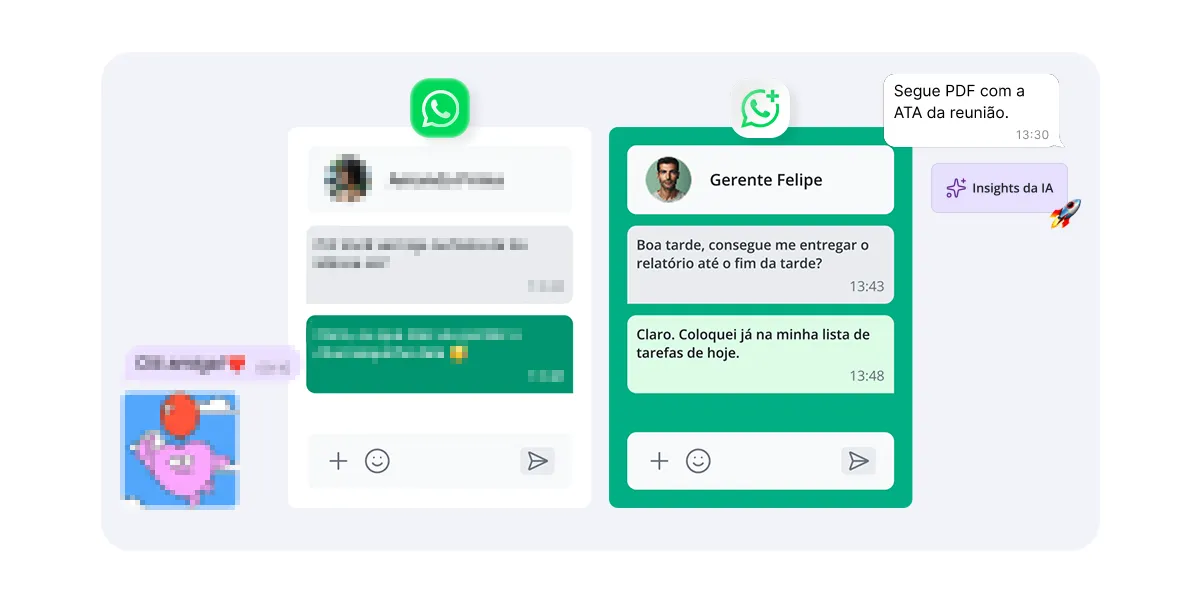
Ethical use framework: five principles for intelligent management
The right question is not "can I analyze my team's WhatsApp conversations?" It is "how do I do this in a way that legally protects the company, respects the employee, and generates real operational intelligence?"
Principle | What it means in practice |
|---|---|
Clarity of purpose | Define and document what you will use conversation analysis for. Sales performance management? Deal traceability? Service quality? The purpose must be legitimate, recorded, and communicable. |
Transparency with the team | Include in the contract or internal policy the information that conversations on corporate channels may be monitored. The TST has already overturned dismissals for cause due to the absence of a formalized policy. Transparency is not just ethical: it is concrete legal protection. |
Use for improvement, not punishment | Conversation data is used to identify bottlenecks in the funnel, calibrate approaches, and raise team performance. When they become an instrument of psychological pressure or a punitive dossier, they cross the line into abuse of directive power. |
Data protection (LGPD) | The storage of corporate conversations requires minimal collection, specific purpose, restricted access, and a defined retention period. The employee has the right to know what is stored about them and may request access at any time. |
Documented management | Written internal policy, communicated and reviewed periodically. Platforms operating with profile-based access control, audit logs, and period traceability eliminate much of the legal risk before it materializes. |
Companies like Zapper build this framework directly into the product: visibility over the team's conversations happens within a controlled environment, with access policies, performance dashboards, and auditable logs, without exposing personal data outside the professional context. That's how managers show up to the meeting with the answer before being asked.
What changes for the employee with structured visibility in operations
There is a narrative that needs to be replaced: that analyzing corporate conversations is always an act of distrust. It is not. What defines the nature of the analysis is what you do with the data afterward.
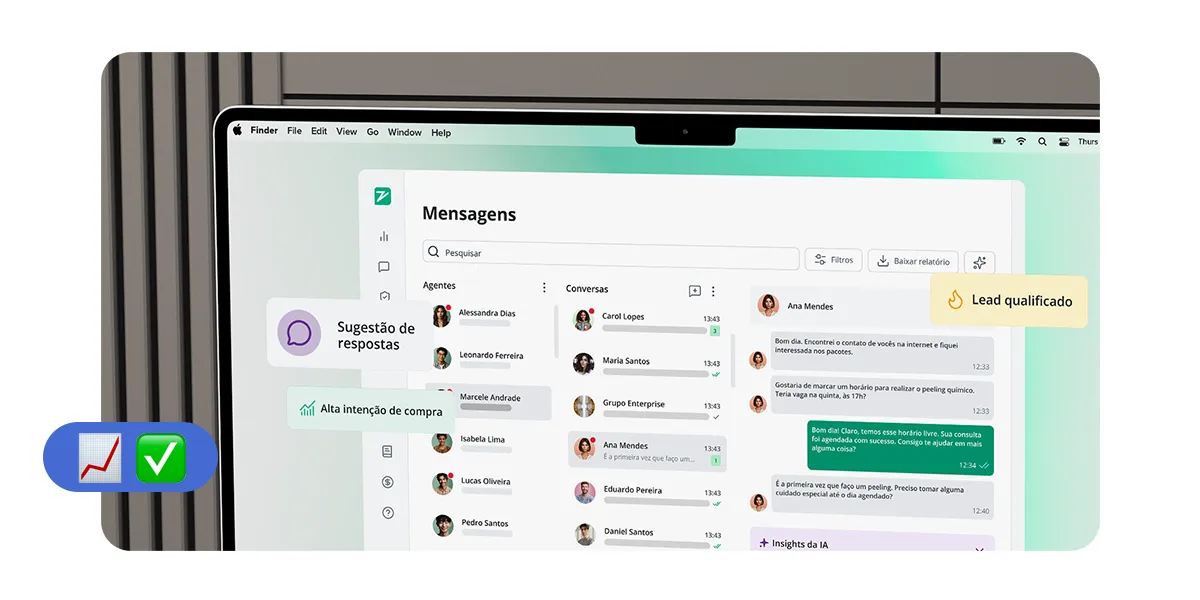
When visibility into conversations is used to support the employee instead of surveilling them, the results are the opposite of what most people imagine. WhatsApp management platforms with native AI, like Zapper, act as a copilot for every conversation: they are inside the service, suggesting responses, identifying opportunities, summarizing histories, and making daily work easier.
Immediate context, without effort. With conversation history available and automatically summarized by AI, the employee does not waste time reconstructing what was said in previous interactions. They enter the conversation already oriented and respond more precisely from the first message;
Faster and more accurate responses. Suggestions generated based on customer history and conversation patterns that convert reduce approach errors and speed up the cycle. The employee does not depend solely on their own intuition to decide what to say;
Feedback based on data, not perception. Instead of "you need to improve your approach," the manager arrives with concrete information: at which stage of the conversational funnel the negotiation stalled, which message caused the customer to go silent, where response time weighed on the decision;
Less pressure, more autonomy. The employee with context available makes better decisions on their own. They don't need to escalate to the manager for every complex interaction. Operational independence grows along with visibility into the operation;
Warning before losing the customer. When the system identifies churn risk in a conversation, whether through recurring negative sentiment, disengagement patterns, or increasing response time, the employee can act before the customer disappears. That is a gain for both sides: the customer stays, the employee closes.
Conclusion: it is not surveillance, it is operational intelligence
The topic of legal WhatsApp monitoring under the CLT has a clear answer in Brazilian courts: monitoring conversations on corporate WhatsApp Business channels is permitted, as long as the channel belongs to the company, the employee was informed in advance, and the purpose is legitimate and documented.
The legal issue, however, is only the beginning. What separates companies that grow with WhatsApp from those that merely use it is structure. Visibility over the team's operations, conversation analysis with intelligence, a shared inbox with traceability, and AI as the copilot for every interaction: these are not control features. They are the management that any critical operating channel requires.
Professional WhatsApp without visibility is a liability. With clear policies, compliance with the LGPD, and a platform that places intelligence inside every conversation, it is the most productive channel a sales operation can have. And the employee who works with these tools does not feel watched. They close more.

This article is for informational purposes only and does not replace specialized legal advice. To structure corporate WhatsApp management policies in compliance with the CLT and the LGPD, consult a labor lawyer.
Can the company analyze the team's WhatsApp conversations? The answer is yes, but with very specific conditions that most institutions still don't know. And understanding these conditions makes all the difference between operating a risky channel or turning it into the operation's biggest sales asset.
This question has never been so urgent. WhatsApp has become the backbone of commercial operations across Brazil. There are 147 million users, with message open rates above 90% and 79.3% of Brazilian companies already using the channel for sales and marketing. Sales, CS, and operations managers depend on WhatsApp to close deals, solve problems, and keep customers. In most companies, management of this channel still happens in the dark.
73% of Brazilian companies have no visibility into messages and files exchanged by the team on corporate WhatsApp. 65% have already lost valuable information due to a lack of traceability. 41% have already faced legal problems directly related to the channel. And only 41.2% use automated campaigns, even with the channel available and active.
The paradox is clear: WhatsApp is already ubiquitous in companies, but its management remains amateurish. The manager doesn't know what the team is doing. Loses leads due to lack of follow-up. The employee takes the customer history with them when they leave the company. There is no traceability, there is no data and, when the problem appears, it has already become a loss.
What the CLT says about managing corporate conversations
The CLT has no specific article about WhatsApp Business, conversational service, or shared inbox management. What it has is a set of principles that labor courts apply to assess each concrete situation.
Article 2 defines the employer as the one who "assumes the risks of the economic activity" and "directs the personal provision of services." This directive power includes, according to settled case law, the prerogative to organize and supervise employees' activities, including the use of digital work tools.
The 2017 Labor Reform closed any gap that might have existed. The sole paragraph of Article 6 established that telematic means of command, control, and supervision are equivalent, for purposes of legal subordination, to in-person means. In practical terms: monitoring what happens on corporate messaging platforms, customer service systems, and digital sales channels is a legitimate extension of the employer's directive power.
But this power is not unlimited. Three criteria appear consistently in court decisions:
Proportionality. Conversation analysis needs to be appropriate to the purpose and cannot go beyond what is necessary for the legitimate management of operations.
Purpose. Monitoring needs a clear and documented objective: sales performance, deal traceability, service quality, compliance. It cannot function as an instrument of psychological pressure or personal surveillance.
Transparency. The employee needs to know that conversations carried out on corporate channels may be analyzed. Hidden management is, as a rule, legally prohibited.
What case law says in practice
Brazilian labor courts have already consolidated relevant understandings on the subject. There is still no specific precedent about corporate WhatsApp, but the principles applied to corporate emails, customer service systems, and digital tools apply directly.
When conversation analysis is allowed:
Monitoring conversations on corporate channels, such as numbers registered in the company's name, as long as the employee was informed in advance;
Use of messages as evidence in labor cases: the TRT-3 (Minas Gerais) recognized the lawfulness of audio and WhatsApp messages as valid evidence;
Performance analysis via service systems: the TST, when overturning a TRT-4 decision, held that electronic monitoring by itself is not unlawful and falls within the employer's oversight power.
When it constitutes abuse:
Access to the employee's personal devices without authorization, even if the conversations are work-related;
Monitoring without prior notice: the TRT-3 has already declared dismissal for cause null based on analysis of Skype conversations because the company had not informed the employee;
Use of the data as an instrument of psychological pressure or punishment;
Monitoring outside working hours via personal devices, which violates the right to disconnect.
Personal WhatsApp vs. corporate WhatsApp: where is the real limit
Personal WhatsApp is the employee's number, on the employee's device, with the employee's personal life. The employer has access to that under no circumstances. The LGPD (Law 13,709/2018) guarantees this precisely.
Corporate WhatsApp is something else. When the company provides the number, registers the channel as a commercial asset, or funds the operation, it is a work tool. The analysis of professional conversations carried out on this channel, with prior communication to the team, has solid legal backing.
The LGPD complements the CLT on this point. Article 6 requires that data processing observe clear purpose, adequacy, necessity, and transparency.
Ethical use framework: five principles for intelligent management
The right question is not "can I analyze my team's WhatsApp conversations?" It is "how do I do this in a way that legally protects the company, respects the employee, and generates real operational intelligence?"
Principle | What it means in practice |
|---|---|
Clarity of purpose | Define and document what you will use conversation analysis for. Sales performance management? Deal traceability? Service quality? The purpose must be legitimate, recorded, and communicable. |
Transparency with the team | Include in the contract or internal policy the information that conversations on corporate channels may be monitored. The TST has already overturned dismissals for cause due to the absence of a formalized policy. Transparency is not just ethical: it is concrete legal protection. |
Use for improvement, not punishment | Conversation data is used to identify bottlenecks in the funnel, calibrate approaches, and raise team performance. When they become an instrument of psychological pressure or a punitive dossier, they cross the line into abuse of directive power. |
Data protection (LGPD) | The storage of corporate conversations requires minimal collection, specific purpose, restricted access, and a defined retention period. The employee has the right to know what is stored about them and may request access at any time. |
Documented management | Written internal policy, communicated and reviewed periodically. Platforms operating with profile-based access control, audit logs, and period traceability eliminate much of the legal risk before it materializes. |
Companies like Zapper build this framework directly into the product: visibility over the team's conversations happens within a controlled environment, with access policies, performance dashboards, and auditable logs, without exposing personal data outside the professional context. That's how managers show up to the meeting with the answer before being asked.
What changes for the employee with structured visibility in operations
There is a narrative that needs to be replaced: that analyzing corporate conversations is always an act of distrust. It is not. What defines the nature of the analysis is what you do with the data afterward.
When visibility into conversations is used to support the employee instead of surveilling them, the results are the opposite of what most people imagine. WhatsApp management platforms with native AI, like Zapper, act as a copilot for every conversation: they are inside the service, suggesting responses, identifying opportunities, summarizing histories, and making daily work easier.
Immediate context, without effort. With conversation history available and automatically summarized by AI, the employee does not waste time reconstructing what was said in previous interactions. They enter the conversation already oriented and respond more precisely from the first message;
Faster and more accurate responses. Suggestions generated based on customer history and conversation patterns that convert reduce approach errors and speed up the cycle. The employee does not depend solely on their own intuition to decide what to say;
Feedback based on data, not perception. Instead of "you need to improve your approach," the manager arrives with concrete information: at which stage of the conversational funnel the negotiation stalled, which message caused the customer to go silent, where response time weighed on the decision;
Less pressure, more autonomy. The employee with context available makes better decisions on their own. They don't need to escalate to the manager for every complex interaction. Operational independence grows along with visibility into the operation;
Warning before losing the customer. When the system identifies churn risk in a conversation, whether through recurring negative sentiment, disengagement patterns, or increasing response time, the employee can act before the customer disappears. That is a gain for both sides: the customer stays, the employee closes.
Conclusion: it is not surveillance, it is operational intelligence
The topic of legal WhatsApp monitoring under the CLT has a clear answer in Brazilian courts: monitoring conversations on corporate WhatsApp Business channels is permitted, as long as the channel belongs to the company, the employee was informed in advance, and the purpose is legitimate and documented.
The legal issue, however, is only the beginning. What separates companies that grow with WhatsApp from those that merely use it is structure. Visibility over the team's operations, conversation analysis with intelligence, a shared inbox with traceability, and AI as the copilot for every interaction: these are not control features. They are the management that any critical operating channel requires.
Professional WhatsApp without visibility is a liability. With clear policies, compliance with the LGPD, and a platform that places intelligence inside every conversation, it is the most productive channel a sales operation can have. And the employee who works with these tools does not feel watched. They close more.
This article is for informational purposes only and does not replace specialized legal advice. To structure corporate WhatsApp management policies in compliance with the CLT and the LGPD, consult a labor lawyer.
Zapper Team
Content produced by our team, specialists in optimizing business communication via WhatsApp.
Zapper Team
Content produced by our team, specialists in optimizing business communication via WhatsApp.
Zapper Team
Content produced by our team, specialists in optimizing business communication via WhatsApp.
Share: