

Management
What makes a WhatsApp operation truly manageable?
Visibility, history and context are part of what turns WhatsApp into a truly manageable operation.
Zapper Team
·
·
12 min of reading

A customer picks up a conversation started days ago. The professional who handled it isn't available. The manager needs to understand what was agreed, who took part in the conversation, where the service stopped and whether anything is pending.
The first reaction may be to ask the team.
Someone looks for the history. Someone else tries to rebuild the context. The manager checks information in different places until they manage to form a picture of what happened.
Now imagine this situation in a company that uses several WhatsApp numbers, has a growing team and depends on the channel daily for customer service, sales, collections or relationship management.
The problem stops being finding a specific message.
It becomes management.
If WhatsApp is a critical channel for the company, one question needs a clear answer: is it really possible to manage what happens in the WhatsApp operation?
A manageable operation isn't defined by the number of features available. It is defined by what the company can see, preserve, record and decide based on what happens in the channel.
This is the logic that guides the management of a WhatsApp operation: visibility, continuity, compliance and strategic operation as dimensions of the same need.
Using WhatsApp isn't the same as managing a WhatsApp operation
A team can use WhatsApp every day and still have little ability to manage the channel.
While few people take part in the routine, a lot of information can be resolved through proximity between colleagues. It's relatively simple to ask who spoke to a given customer or to recover the context of a conversation.
As the operation grows, that logic starts to demand more effort.
More professionals start handling customers. More conversations happen simultaneously. Different WhatsApp numbers are used by the team. Role changes, vacations, transfers and new hires become part of the routine.
In this scenario, relying on reports and manual reconstruction leaves management with a fragmented view.
The difference between using WhatsApp as a channel and having WhatsApp operation management lies precisely in the ability to turn these distributed interactions into information the company can follow and use.
WhatsApp remains the channel where the conversation happens. Management needs to exist in a layer above it.
That's why WhatsApp monitoring can help reveal parts of the operation, just as WhatsApp automation can support certain processes. None of these elements, on its own, sums up what it means to manage an operation.
Managing requires being able to act on what the company sees.
What does a manageable operation need to allow?
A business WhatsApp operation begins to become manageable when certain questions stop depending only on memory or on the team's individual perception.
Can the manager understand what is happening? Does context remain available when people change? Are there searchable records of relevant events? Can the company decide how to use its resources according to each purpose?
These questions can be organized into four pillars: visibility, continuity, compliance and strategic operation.
The logic is simple: first comes the need for management. Then come the capabilities that help make that need real in the routine.
Visibility: knowing what is happening
You can't manage what you can't see.
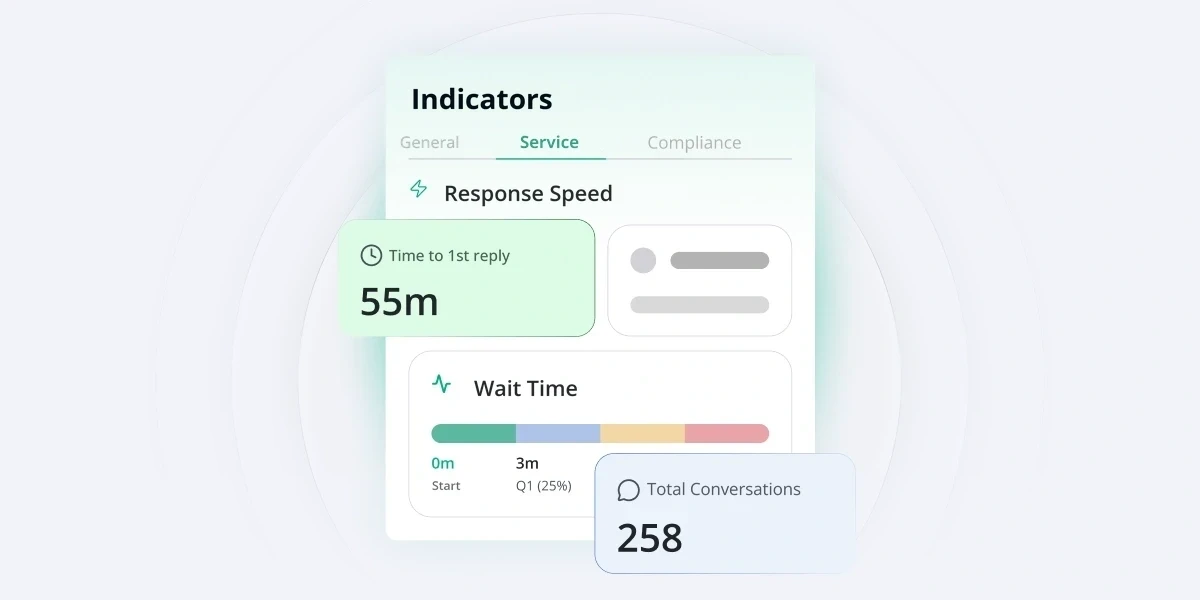
If response time has changed, it's important to be able to notice that change. If a certain period showed different behavior, the company needs information to investigate. If several numbers are part of the operation, you need to know which WhatsApp numbers the team uses and understand how they take part in the routine.
Visibility turns loose questions into a view of the operation.
This doesn't just mean being able to open a conversation. It means being able to consult information that lets you understand the behavior of WhatsApp customer service and observe what deserves attention.
Dashboards, message views, response metrics and available analyses are examples of capabilities that help build this view.
This shift also improves the quality of the questions management asks. Instead of starting only from perceptions like "it seems we're replying more slowly", the manager gets information that helps investigate what changed and which part of the operation deserves a closer look.
An indicator doesn't deliver a diagnosis on its own. It opens an investigation.
And that alone changes the quality of management.
Continuity: history can't depend on one person
People change roles, go on vacation, switch teams or leave the company. These movements are part of any operation.
The relationship with the customer, however, shouldn't have to start over with each change.
Imagine a negotiation that moved forward over several conversations. The customer returns after a few days and finds a different professional. Without access to the earlier context, part of the service has to be rebuilt.
The customer repeats information. The new agent has to find out what has already happened. The team wastes time recovering decisions that had already been made.
That's why history isn't just a way to look back at the past. It takes part in operational continuity.
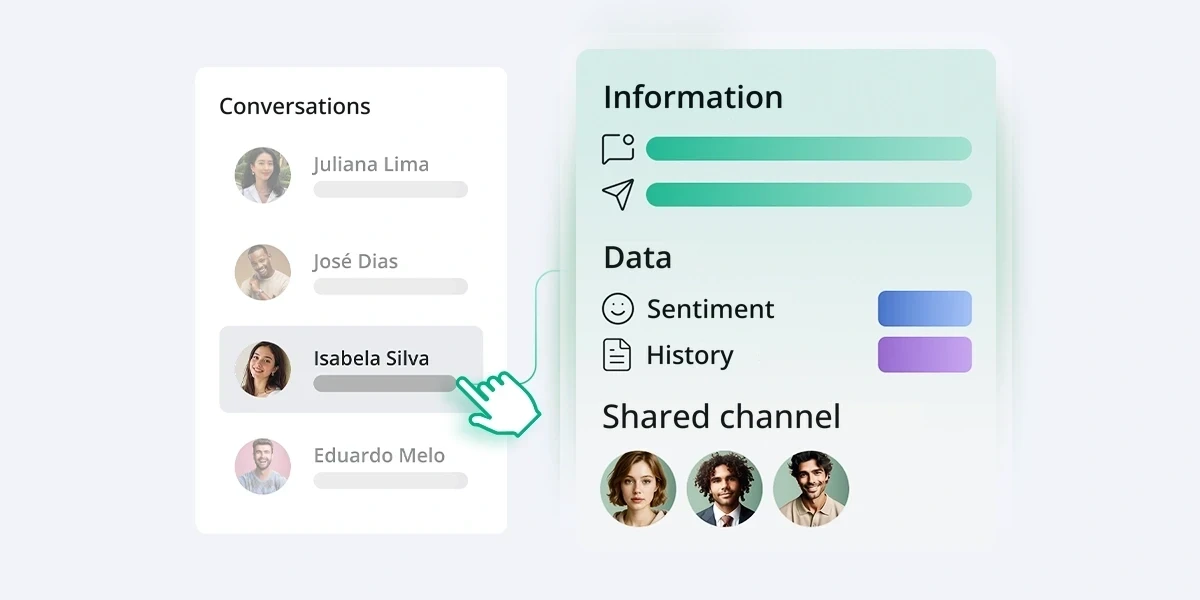
In structured customer service management, context must remain accessible to the company when the person responsible for the interaction changes. This applies to a simple change of agent, a transfer between teams or a larger reorganization of the operation.
The more critical WhatsApp is to the business, the less sense it makes to concentrate essential information only in the memory of those who took part in the conversation.
Continuity means allowing the relationship with the customer to carry on with context, even when the makeup of the team changes.
Compliance: recording is also part of management
Managing an operation also means being able to understand what happened after an interaction has ended.
What was the context? Which events were recorded? Which information remains available for consultation? Is it possible to reconstruct how a given situation was handled?
That is where compliance comes in.
In a professional operation, history, retention, records and events can help make information more traceable and searchable.
This doesn't mean claiming that technology alone guarantees legal compliance. Specific requirements depend on the company's context, its sector, internal processes and the applicable rules.
The role of management is to create better conditions for the organization to have records and context available when it needs to analyze what happened.
This traceability also has value in day-to-day routine.
You don't need to wait for an exceptional situation to realize the importance of keeping information organized. Searchable records can help the company investigate events, understand processes and preserve context over time.
Compliance, therefore, doesn't have to appear as a topic separate from the operation. It is one of the ways the company turns conversations into a more structured management routine.
Strategic operation: every send needs to make sense
A manageable operation doesn't only decide what to track. It also needs to think about how to use the available resources.
Not every message has the same purpose.
An operation can deal with customer service, relationship building, sales follow-up and different forms of communication. Treating all these contexts the same way reduces the ability to make operational decisions with judgment.
Strategic operation begins when the company can link the purpose of the communication to the sending method used.
This is where the hybrid model can enter the discussion.
At Zapper, the hybrid model can be understood as a capability for working with the type of sending appropriate to the purpose of each message.
This shouldn't be interpreted as automatic channel selection.
The distinction matters because strategic operation doesn't simply mean having more technological options. It means knowing why and when to use each of them.
Technology provides capability. Management sets the criteria.
How can you tell whether your WhatsApp operation is truly manageable?
A self-assessment can start with very objective questions:
Can the manager see what happens in the operation without relying only on individual reports?
Does the history remain accessible when a professional changes roles or leaves the team?
Are there indicators that help track the behavior of the operation?
When an indicator changes, is there enough information to investigate possible bottlenecks?
Do important records remain available for consultation when needed?
Does the company know which WhatsApp numbers the team uses?
Does much of the understanding of the operation still depend on spreadsheets, individual questions or manual reconstruction?
Is there clarity about which sending method makes sense for each purpose?
No single question defines the maturity of the whole operation.
The value of the checklist lies in noticing a pattern.
The more answers depend on a specific person, on manual reconstruction or on scattered information, the lower the ability tends to be to manage the channel as an integrated operation.
On the other hand, when the company can see, preserve context, consult records and make decisions with more information, WhatsApp begins to occupy a different place in management.
It stops being just the place where messages happen.
It becomes an operation the company can understand.
Technology is the means. Management is the goal.
Adding a tool to the routine doesn't automatically turn a WhatsApp operation into a manageable one.
You need to know which problem is being solved.
A dashboard only has value when it helps the manager see something relevant. A history only gains importance when it preserves the context needed for continuity. Records make sense when they help make events searchable and traceable. Different sending methods are useful when the company can choose with judgment which one best serves a given purpose.
That is why, at Zapper, features are designed to support the management of the WhatsApp operation.
Each feature has a role in that management, helping the company see what happens, preserve context and make decisions with more information.
This logic also helps tell management apart from a mere sum of features.
Professional business WhatsApp isn't just bringing together messages, automation, history and indicators. It's making these elements contribute to an operation the manager can interpret and administer.
That combination is what turns technology into a management structure.

A manageable operation is ready to grow
The growth of a WhatsApp operation doesn't happen only when the number of messages increases.
Complexity grows when new professionals join, more numbers are added, new processes appear, communication has different purposes and dependence on the channel keeps rising.
In this scenario, the challenge isn't simply adding features.
It's increasing the company's ability to handle that complexity without losing visibility, context, records and the judgment to make decisions.
A manageable operation creates a foundation for that.
Not because it eliminates all management difficulties, but because it reduces dependence on scattered information and allows WhatsApp to be understood as part of the company's operation.
That's the central shift: moving from a logic in which the organization merely uses the channel to one in which it can administer it.
Because when WhatsApp becomes critical for sales, customer service or relationships, the question is no longer just whether the company can send and receive messages.
The question becomes whether it can understand what is happening, preserve what matters, record what is necessary and decide what to do from there.
That is what makes a WhatsApp operation truly manageable.
Is WhatsApp already a critical channel for your company? Get to know Zapper and see how to structure a more manageable WhatsApp operation.
A customer picks up a conversation started days ago. The professional who handled it isn't available. The manager needs to understand what was agreed, who took part in the conversation, where the service stopped and whether anything is pending.
The first reaction may be to ask the team.
Someone looks for the history. Someone else tries to rebuild the context. The manager checks information in different places until they manage to form a picture of what happened.
Now imagine this situation in a company that uses several WhatsApp numbers, has a growing team and depends on the channel daily for customer service, sales, collections or relationship management.
The problem stops being finding a specific message.
It becomes management.
If WhatsApp is a critical channel for the company, one question needs a clear answer: is it really possible to manage what happens in the WhatsApp operation?
A manageable operation isn't defined by the number of features available. It is defined by what the company can see, preserve, record and decide based on what happens in the channel.
This is the logic that guides the management of a WhatsApp operation: visibility, continuity, compliance and strategic operation as dimensions of the same need.
Using WhatsApp isn't the same as managing a WhatsApp operation
A team can use WhatsApp every day and still have little ability to manage the channel.
While few people take part in the routine, a lot of information can be resolved through proximity between colleagues. It's relatively simple to ask who spoke to a given customer or to recover the context of a conversation.
As the operation grows, that logic starts to demand more effort.
More professionals start handling customers. More conversations happen simultaneously. Different WhatsApp numbers are used by the team. Role changes, vacations, transfers and new hires become part of the routine.
In this scenario, relying on reports and manual reconstruction leaves management with a fragmented view.
The difference between using WhatsApp as a channel and having WhatsApp operation management lies precisely in the ability to turn these distributed interactions into information the company can follow and use.
WhatsApp remains the channel where the conversation happens. Management needs to exist in a layer above it.
That's why WhatsApp monitoring can help reveal parts of the operation, just as WhatsApp automation can support certain processes. None of these elements, on its own, sums up what it means to manage an operation.
Managing requires being able to act on what the company sees.
What does a manageable operation need to allow?
A business WhatsApp operation begins to become manageable when certain questions stop depending only on memory or on the team's individual perception.
Can the manager understand what is happening? Does context remain available when people change? Are there searchable records of relevant events? Can the company decide how to use its resources according to each purpose?
These questions can be organized into four pillars: visibility, continuity, compliance and strategic operation.
The logic is simple: first comes the need for management. Then come the capabilities that help make that need real in the routine.
Visibility: knowing what is happening
You can't manage what you can't see.
If response time has changed, it's important to be able to notice that change. If a certain period showed different behavior, the company needs information to investigate. If several numbers are part of the operation, you need to know which WhatsApp numbers the team uses and understand how they take part in the routine.
Visibility turns loose questions into a view of the operation.
This doesn't just mean being able to open a conversation. It means being able to consult information that lets you understand the behavior of WhatsApp customer service and observe what deserves attention.
Dashboards, message views, response metrics and available analyses are examples of capabilities that help build this view.
This shift also improves the quality of the questions management asks. Instead of starting only from perceptions like "it seems we're replying more slowly", the manager gets information that helps investigate what changed and which part of the operation deserves a closer look.
An indicator doesn't deliver a diagnosis on its own. It opens an investigation.
And that alone changes the quality of management.
Continuity: history can't depend on one person
People change roles, go on vacation, switch teams or leave the company. These movements are part of any operation.
The relationship with the customer, however, shouldn't have to start over with each change.
Imagine a negotiation that moved forward over several conversations. The customer returns after a few days and finds a different professional. Without access to the earlier context, part of the service has to be rebuilt.
The customer repeats information. The new agent has to find out what has already happened. The team wastes time recovering decisions that had already been made.
That's why history isn't just a way to look back at the past. It takes part in operational continuity.
In structured customer service management, context must remain accessible to the company when the person responsible for the interaction changes. This applies to a simple change of agent, a transfer between teams or a larger reorganization of the operation.
The more critical WhatsApp is to the business, the less sense it makes to concentrate essential information only in the memory of those who took part in the conversation.
Continuity means allowing the relationship with the customer to carry on with context, even when the makeup of the team changes.
Compliance: recording is also part of management
Managing an operation also means being able to understand what happened after an interaction has ended.
What was the context? Which events were recorded? Which information remains available for consultation? Is it possible to reconstruct how a given situation was handled?
That is where compliance comes in.
In a professional operation, history, retention, records and events can help make information more traceable and searchable.
This doesn't mean claiming that technology alone guarantees legal compliance. Specific requirements depend on the company's context, its sector, internal processes and the applicable rules.
The role of management is to create better conditions for the organization to have records and context available when it needs to analyze what happened.
This traceability also has value in day-to-day routine.
You don't need to wait for an exceptional situation to realize the importance of keeping information organized. Searchable records can help the company investigate events, understand processes and preserve context over time.
Compliance, therefore, doesn't have to appear as a topic separate from the operation. It is one of the ways the company turns conversations into a more structured management routine.
Strategic operation: every send needs to make sense
A manageable operation doesn't only decide what to track. It also needs to think about how to use the available resources.
Not every message has the same purpose.
An operation can deal with customer service, relationship building, sales follow-up and different forms of communication. Treating all these contexts the same way reduces the ability to make operational decisions with judgment.
Strategic operation begins when the company can link the purpose of the communication to the sending method used.
This is where the hybrid model can enter the discussion.
At Zapper, the hybrid model can be understood as a capability for working with the type of sending appropriate to the purpose of each message.
This shouldn't be interpreted as automatic channel selection.
The distinction matters because strategic operation doesn't simply mean having more technological options. It means knowing why and when to use each of them.
Technology provides capability. Management sets the criteria.
How can you tell whether your WhatsApp operation is truly manageable?
A self-assessment can start with very objective questions:
Can the manager see what happens in the operation without relying only on individual reports?
Does the history remain accessible when a professional changes roles or leaves the team?
Are there indicators that help track the behavior of the operation?
When an indicator changes, is there enough information to investigate possible bottlenecks?
Do important records remain available for consultation when needed?
Does the company know which WhatsApp numbers the team uses?
Does much of the understanding of the operation still depend on spreadsheets, individual questions or manual reconstruction?
Is there clarity about which sending method makes sense for each purpose?
No single question defines the maturity of the whole operation.
The value of the checklist lies in noticing a pattern.
The more answers depend on a specific person, on manual reconstruction or on scattered information, the lower the ability tends to be to manage the channel as an integrated operation.
On the other hand, when the company can see, preserve context, consult records and make decisions with more information, WhatsApp begins to occupy a different place in management.
It stops being just the place where messages happen.
It becomes an operation the company can understand.
Technology is the means. Management is the goal.
Adding a tool to the routine doesn't automatically turn a WhatsApp operation into a manageable one.
You need to know which problem is being solved.
A dashboard only has value when it helps the manager see something relevant. A history only gains importance when it preserves the context needed for continuity. Records make sense when they help make events searchable and traceable. Different sending methods are useful when the company can choose with judgment which one best serves a given purpose.
That is why, at Zapper, features are designed to support the management of the WhatsApp operation.
Each feature has a role in that management, helping the company see what happens, preserve context and make decisions with more information.
This logic also helps tell management apart from a mere sum of features.
Professional business WhatsApp isn't just bringing together messages, automation, history and indicators. It's making these elements contribute to an operation the manager can interpret and administer.
That combination is what turns technology into a management structure.
A manageable operation is ready to grow
The growth of a WhatsApp operation doesn't happen only when the number of messages increases.
Complexity grows when new professionals join, more numbers are added, new processes appear, communication has different purposes and dependence on the channel keeps rising.
In this scenario, the challenge isn't simply adding features.
It's increasing the company's ability to handle that complexity without losing visibility, context, records and the judgment to make decisions.
A manageable operation creates a foundation for that.
Not because it eliminates all management difficulties, but because it reduces dependence on scattered information and allows WhatsApp to be understood as part of the company's operation.
That's the central shift: moving from a logic in which the organization merely uses the channel to one in which it can administer it.
Because when WhatsApp becomes critical for sales, customer service or relationships, the question is no longer just whether the company can send and receive messages.
The question becomes whether it can understand what is happening, preserve what matters, record what is necessary and decide what to do from there.
That is what makes a WhatsApp operation truly manageable.
Is WhatsApp already a critical channel for your company? Get to know Zapper and see how to structure a more manageable WhatsApp operation.