

Security
WhatsApp change in October 2026: what businesses can expect
See the cost per message, who feels it most and what stays free.
Zapper Team
·
·
13 min of reading

WhatsApp is going to charge for messages that until now were free. Starting October 1, 2026, replies sent within the customer service window go straight into the cost spreadsheet of sales operations.
This isn't speculation. It's what is written in Meta's own documentation, with a defined deadline.
This guide walks through the WhatsApp change in October 2026 end to end. What applied until now, what changes at the turn of the date, who feels it most, what stays free and what you can do before the deadline.
The rule that applied until now
When a customer sends a message to your company, the 24-hour WhatsApp window opens. Inside it, your team replies freely without paying anything per message. The window restarts with each new message the customer sends.
In practice, this means an agent could exchange 40 messages with a customer over the day and the cost stayed at zero. It only left zero when the company needed to start the conversation itself, and that's where an approved template with category-based pricing came in.
It has been this way since July 2025. Many sales operations built their customer service routine on top of that free tier, without measuring how much they depended on it.
Find out more in this article: Business WhatsApp management: what you are missing
How the WhatsApp service message charge works from October 1
The 24-hour window still exists. The customer still pays nothing to talk to you.
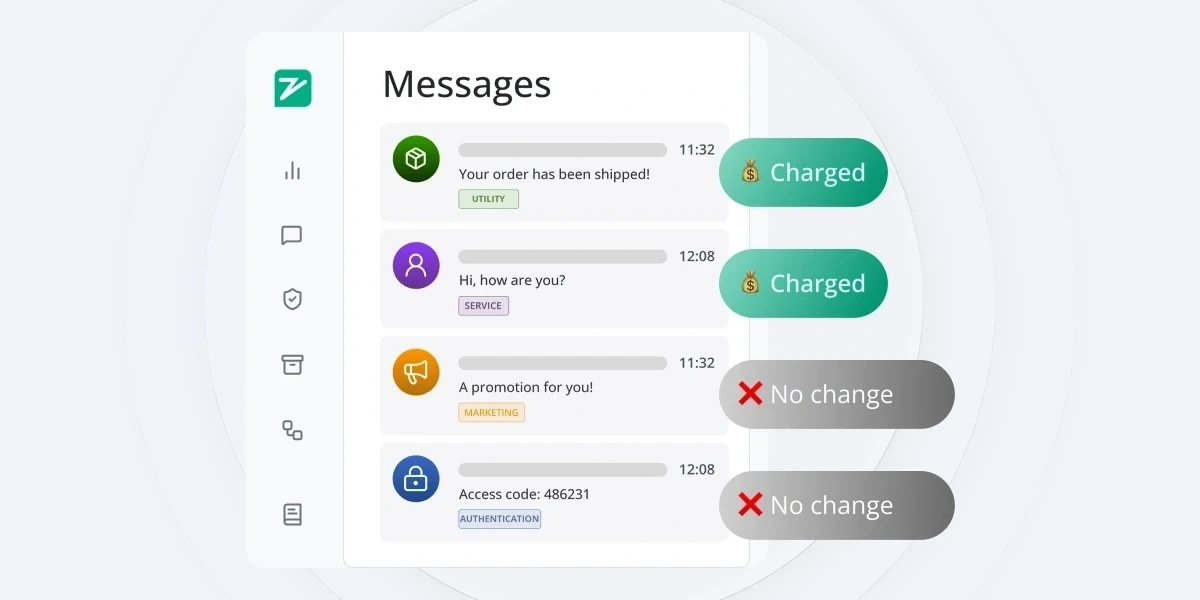
What changes is that each reply your company sends within that window starts being charged, one by one, under the same per-message pricing model Meta already applies to utility and authentication templates. That is the WhatsApp service message charge that takes effect on the 1st.
Three details weigh more than they seem.
It doesn't matter who wrote it. A reply typed by a human agent and a reply generated by a third-party automation go into the same bill. The charge looks at the delivery channel, not the origin of the text. Anyone who thought of removing automation and putting people in its place to save money will find that this isn't the way.
There's no price drop for buying in volume. Utility and authentication templates have price tiers that fall as volume rises. Service messages don't. The unit price is the same at message number 10 and at number 50,000.
Utility templates inside the window change too. That appointment reminder or delivery notice you used to send at no cost because the customer had just talked to you goes into the charge as well.
See also: Guide: Sending Bulk Messages on Business WhatsApp
The four message categories and what changes in each
From October, everything your company sends fits into one of these categories. It's worth knowing all four, because that is how the invoice will arrive.
Category | What it is | Situation today | From 10/01/2026 |
Marketing template | Campaign, promotion, reactivation | Charged, with a volume-based price scale | No change |
Utility and authentication template | Confirmation, code, delivery notice | Charged outside the window, free inside | Also charged inside the window |
Service message | Free-form reply, outside a template, inside the window | Free | Charged per message, with no price drop for buying in volume |
Meta artificial intelligence message | Reply generated by Meta's own solution | Its own rule since August 2026 | Charged per token |
A message falls into only one category. You don't pay twice for the same send.
The table looks bureaucratic, but it is your November cost spreadsheet. The entire difference between an operation that prepares and one that panics lies in knowing which slice of the volume sits on each line.
Also read: WhatsApp API: is it for my company or do I need another solution?
Who feels the impact most
A customer service operation with a lot of conversation and few templates is the most exposed. That's the case for support, after-sales, collections, scheduling and sales teams or salespeople who negotiate by message. In these cases, most of the traffic is exactly what used to be free.
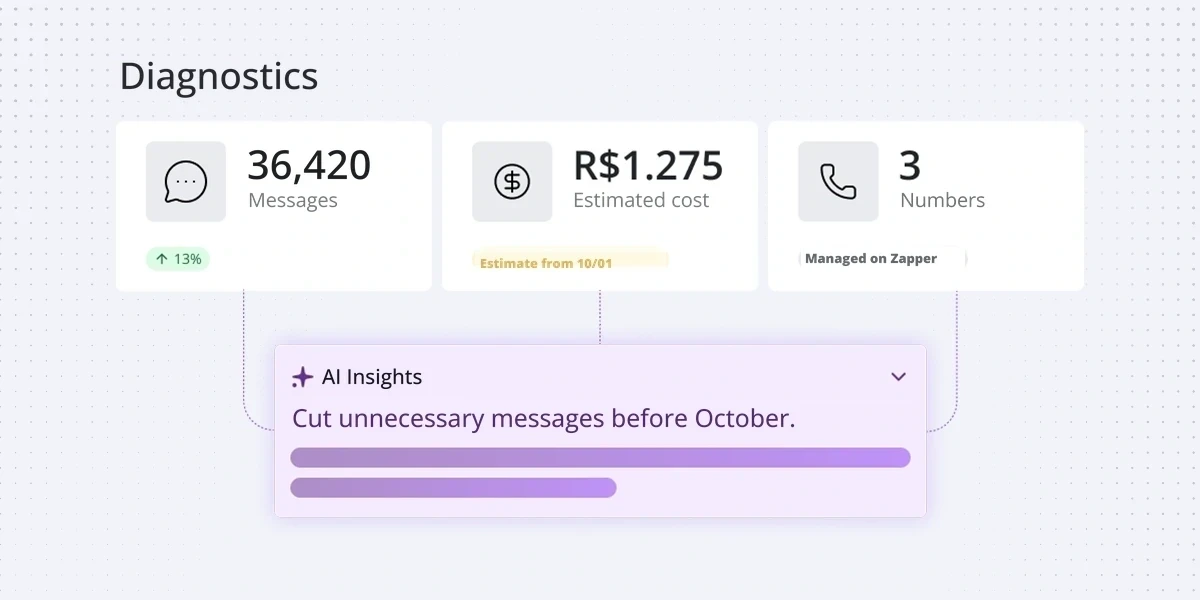
A concrete example helps. A support operation with 10 agents, each resolving 30 conversations a day, with an average of 6 messages per conversation, sends something close to 36 thousand service messages a month. Today that costs zero. In October, it becomes a line in the budget that no one approved.
Those who send few free-form messages and work mostly with templates were already paying for almost everything. For them, little changes, and it's worth knowing that so you don't spend energy on a problem that isn't yours.
If you don't know which group your company is in, that is the first problem to solve. And it isn't a vendor problem, it's a problem of visibility into your own operation.
On this point: Business WhatsApp management: scale without losing control
WhatsApp Business API price 2026: how much does it cost per message
This is the part that takes the topic out of the realm of opinion and puts it in the realm of budget. If you're searching for the WhatsApp Business API price 2026, note that Meta's official name for the platform is "WhatsApp Business Platform", but the market still searches for "API", so we use both terms throughout the text.
Market estimates point to about US$ 0.0068 per service message in Brazil, something close to R$ 0.035 at the current exchange rate, since Meta hasn't yet confirmed the final amount per country. An analysis published by the E-Commerce Brasil portal arrives at a similar reference by another route, estimating something around R$ 4 thousand per 100 thousand messages sent.
It seems small per unit. It isn't small per operation.
The table below shows the WhatsApp cost for a business by monthly volume of service messages:
Monthly volume of service messages | Approximate cost per month |
10 thousand | about R$ 350 |
50 thousand | about R$ 1,750 |
100 thousand | about R$ 3,500 to R$ 4,000 |
500 thousand | about R$ 17,500 to R$ 20,000 |
And that is just the platform fee. Those who use third-party AI automations in replies add the processing cost on top. Market estimates indicate that 10 thousand replies can cost something close to US$ 268 for simple service and reach almost US$ 968 when the interaction is complex.
To understand how to calculate these amounts and simulate the exact impact on your invoice, see our detailed article on cost calculation and volumetrics: How to calculate the real cost of the WhatsApp API at your company.
A word on method: the dollar exchange rate moves these values, and Meta may still adjust its price table by market. Treat the numbers above as an order of magnitude to decide whether the topic is big or small at your company, and confirm in the official documentation before finalizing a budget.
Meta's AI came into the bill first
One detail of the timeline went unnoticed in almost all the coverage. Charging for Meta's own artificial intelligence solutions began on August 1, 2026, two months before the change to service messages.
There the logic is different: you pay per token consumed, not per message. The package of 1 million tokens costs about US$ 2, and the average published cost is between US$ 0.04 and US$ 0.05 per interaction, varying with the complexity of the conversation.
This isn't a technical detail. Meta started selling AI solutions and, at the same time, started charging for the replies of third-party automations. Those who were evaluating which AI to use in customer service now have a financial decision on the table, not just a technical one.
What stays free
Two things remain free of charge, and one of them becomes a planning tool.
The 72-hour free entry window. When the customer arrives through a click-to-WhatsApp ad or through the message button on a Facebook or Instagram page, a 72-hour window opens at no charge. That free tier remains valid after October.
This has a consequence few are commenting on: the change improves the relative cost of the click-to-WhatsApp ad. That is why this exemption works as an essential planning tool for restructuring the acquisition funnel. Those who already invest in media should be looking at this math now, not in November. The larger the share of traffic that comes in through this path, the lower the exposure to the new charge.
The regular WhatsApp Business app. The one installed on the phone isn't the same thing as the API platform. The charge that takes effect in October applies to the API.
This second point tends to cause confusion at companies that operate both ways at once, with some numbers on the API and others on the app. It's worth mapping which number is under which regime before doing any math.
Understand it better here: Professional WhatsApp without the API's restrictions
What to do before October 1
Measure the current volume of service messages. Broken down by number, by team and by type of service. Use 90 days of history, not 30, because sales operations have seasonality and sizing off a weak month produces a surprise in November.
Find out how much of that volume is waste. In most operations, a relevant share of messages isn't customer service. It's an automatic greeting followed by another greeting, a receipt confirmation, a question the customer had already answered, a message split into four bubbles when it fit in one. Every extra bubble becomes an extra charge.
Look at the source of your traffic. If a good part of your leads already arrives through click-to-WhatsApp ads, you have less exposure than you think. If almost nothing arrives that way, there's an idle cost lever there.
Review what really needs to go through the official API. Templates, broadcasts and active communication at scale, yes, no debate. One-to-one conversation with a customer who has already replied is a different nature, and this is where the choice of connection mode stops being a technical matter and becomes money. There is even a way to split this within the same campaign, without operating two separate systems. We explain how further below.
Check where your history is stored. This doesn't change October's bill, but it changes the size of the damage when a number goes down. A conversation that lives only on the employee's device leaves with them.
Learn how to use our monitoring solutions to optimize your results: Zapper Management and Monitoring Solutions
There is a hybrid way to broadcast
Almost all the tools on the market picked a side. They either send everything through the official API, with an approved template and per-message cost, or send everything through the employee's direct account, without a template and with a different kind of exposure.
Zapper pioneered a third path: hybrid broadcasting, in which the same campaign can go out through both modes within the same flow.
In short, without going into detail: you build the campaign once and define what must have an approved template and what is conversation that can go out from the direct account. The platform handles the cadence and the sender for each part, and the history of both paths lands in the same place, without an operation split across two systems.
That design is precisely what changes October's bill, because part of the volume that would have gone entirely into the charge no longer does.
The right setup depends on your volume, your type of message and the state of your numbers. In a 20-minute conversation we open the screen and show how this would look in your scenario.
Get to know Zapper's broadcast solutions: Zapper Broadcasts
Frequently asked questions
Does the charge apply to WhatsApp Business on the phone?
No. The change is to the WhatsApp Business Platform, the API platform. The regular app follows a different logic.
Will my customer pay anything?
No. A message sent by the customer remains free of cost. The company always pays, and only for what it sends.
Are automation replies charged too?
Yes. Automatic replies from third-party systems count as service messages. Meta's own AI has a separate rule, charged per token, and shouldn't be added into the same spreadsheet.
If a human replies instead of the automation, is it cheaper?
No. The charge looks at the delivery channel, not who wrote it. A human reply delivered through the API is a service message.
How much will it cost per message in Brazil?
Market estimates point to about US$ 0.0068 per service message, something close to R$ 0.035, since Meta hasn't confirmed the final amount per country. Analyses estimate something around R$ 4 thousand per 100 thousand messages. Confirm in Meta's official documentation before finalizing a budget.
And Meta's AI solution, how is it charged?
Per token, not per message, with the charge in effect since August 1, 2026. The package of 1 million tokens costs about US$ 2 and the average published cost per interaction is between US$ 0.04 and US$ 0.05.
Do service messages get a price drop for buying in volume?
No. Unlike utility and authentication templates, the unit price doesn't fall as volume rises.
Can you avoid the charge?
Avoid it, no. Reduce it, yes: by sending fewer unnecessary messages, increasing entry through click-to-WhatsApp ads and choosing with judgment what needs to go through the official API.
Do I need to switch vendors because of this?
Not necessarily. You need to understand your volume and your connection design. Switching vendors without that diagnosis is solving it in the dark.
Conclusion
The WhatsApp change in October 2026 isn't the end of WhatsApp as a sales channel. It's the end of a period in which a relevant part of the cost of operating on this channel was invisible.
The point isn't the price of the message. It's that many companies don't know how many messages they send, or through which path, or how much of it is necessary. Those who have this visibility will treat October as a budget adjustment. Those who don't will treat it as a crisis.
Until October 1 there is time to measure, cut what's surplus and design what goes where, without rushing and without a hasty vendor decision.
Want to know the size of your bill before October?
Our team builds a diagnostic of your WhatsApp operation with real volume by number, by team and by message category, showing where the cost that appears in October is and what share of it is avoidable.
Schedule a Zapper demo and see the number before it reaches the invoice.

Related reading
WhatsApp API: is it for my company or do I need another solution?
How to calculate the real cost of the WhatsApp API at your company
Sources
Cost and timeline data compiled from Meta's documentation and from reports published in August 2026 by the Acontecendo Aqui portal and by E-Commerce Brasil.
WhatsApp is going to charge for messages that until now were free. Starting October 1, 2026, replies sent within the customer service window go straight into the cost spreadsheet of sales operations.
This isn't speculation. It's what is written in Meta's own documentation, with a defined deadline.
This guide walks through the WhatsApp change in October 2026 end to end. What applied until now, what changes at the turn of the date, who feels it most, what stays free and what you can do before the deadline.
The rule that applied until now
When a customer sends a message to your company, the 24-hour WhatsApp window opens. Inside it, your team replies freely without paying anything per message. The window restarts with each new message the customer sends.
In practice, this means an agent could exchange 40 messages with a customer over the day and the cost stayed at zero. It only left zero when the company needed to start the conversation itself, and that's where an approved template with category-based pricing came in.
It has been this way since July 2025. Many sales operations built their customer service routine on top of that free tier, without measuring how much they depended on it.
Find out more in this article: Business WhatsApp management: what you are missing
How the WhatsApp service message charge works from October 1
The 24-hour window still exists. The customer still pays nothing to talk to you.
What changes is that each reply your company sends within that window starts being charged, one by one, under the same per-message pricing model Meta already applies to utility and authentication templates. That is the WhatsApp service message charge that takes effect on the 1st.
Three details weigh more than they seem.
It doesn't matter who wrote it. A reply typed by a human agent and a reply generated by a third-party automation go into the same bill. The charge looks at the delivery channel, not the origin of the text. Anyone who thought of removing automation and putting people in its place to save money will find that this isn't the way.
There's no price drop for buying in volume. Utility and authentication templates have price tiers that fall as volume rises. Service messages don't. The unit price is the same at message number 10 and at number 50,000.
Utility templates inside the window change too. That appointment reminder or delivery notice you used to send at no cost because the customer had just talked to you goes into the charge as well.
See also: Guide: Sending Bulk Messages on Business WhatsApp
The four message categories and what changes in each
From October, everything your company sends fits into one of these categories. It's worth knowing all four, because that is how the invoice will arrive.
Category | What it is | Situation today | From 10/01/2026 |
Marketing template | Campaign, promotion, reactivation | Charged, with a volume-based price scale | No change |
Utility and authentication template | Confirmation, code, delivery notice | Charged outside the window, free inside | Also charged inside the window |
Service message | Free-form reply, outside a template, inside the window | Free | Charged per message, with no price drop for buying in volume |
Meta artificial intelligence message | Reply generated by Meta's own solution | Its own rule since August 2026 | Charged per token |
A message falls into only one category. You don't pay twice for the same send.
The table looks bureaucratic, but it is your November cost spreadsheet. The entire difference between an operation that prepares and one that panics lies in knowing which slice of the volume sits on each line.
Also read: WhatsApp API: is it for my company or do I need another solution?
Who feels the impact most
A customer service operation with a lot of conversation and few templates is the most exposed. That's the case for support, after-sales, collections, scheduling and sales teams or salespeople who negotiate by message. In these cases, most of the traffic is exactly what used to be free.
A concrete example helps. A support operation with 10 agents, each resolving 30 conversations a day, with an average of 6 messages per conversation, sends something close to 36 thousand service messages a month. Today that costs zero. In October, it becomes a line in the budget that no one approved.
Those who send few free-form messages and work mostly with templates were already paying for almost everything. For them, little changes, and it's worth knowing that so you don't spend energy on a problem that isn't yours.
If you don't know which group your company is in, that is the first problem to solve. And it isn't a vendor problem, it's a problem of visibility into your own operation.
On this point: Business WhatsApp management: scale without losing control
WhatsApp Business API price 2026: how much does it cost per message
This is the part that takes the topic out of the realm of opinion and puts it in the realm of budget. If you're searching for the WhatsApp Business API price 2026, note that Meta's official name for the platform is "WhatsApp Business Platform", but the market still searches for "API", so we use both terms throughout the text.
Market estimates point to about US$ 0.0068 per service message in Brazil, something close to R$ 0.035 at the current exchange rate, since Meta hasn't yet confirmed the final amount per country. An analysis published by the E-Commerce Brasil portal arrives at a similar reference by another route, estimating something around R$ 4 thousand per 100 thousand messages sent.
It seems small per unit. It isn't small per operation.
The table below shows the WhatsApp cost for a business by monthly volume of service messages:
Monthly volume of service messages | Approximate cost per month |
10 thousand | about R$ 350 |
50 thousand | about R$ 1,750 |
100 thousand | about R$ 3,500 to R$ 4,000 |
500 thousand | about R$ 17,500 to R$ 20,000 |
And that is just the platform fee. Those who use third-party AI automations in replies add the processing cost on top. Market estimates indicate that 10 thousand replies can cost something close to US$ 268 for simple service and reach almost US$ 968 when the interaction is complex.
To understand how to calculate these amounts and simulate the exact impact on your invoice, see our detailed article on cost calculation and volumetrics: How to calculate the real cost of the WhatsApp API at your company.
A word on method: the dollar exchange rate moves these values, and Meta may still adjust its price table by market. Treat the numbers above as an order of magnitude to decide whether the topic is big or small at your company, and confirm in the official documentation before finalizing a budget.
Meta's AI came into the bill first
One detail of the timeline went unnoticed in almost all the coverage. Charging for Meta's own artificial intelligence solutions began on August 1, 2026, two months before the change to service messages.
There the logic is different: you pay per token consumed, not per message. The package of 1 million tokens costs about US$ 2, and the average published cost is between US$ 0.04 and US$ 0.05 per interaction, varying with the complexity of the conversation.
This isn't a technical detail. Meta started selling AI solutions and, at the same time, started charging for the replies of third-party automations. Those who were evaluating which AI to use in customer service now have a financial decision on the table, not just a technical one.
What stays free
Two things remain free of charge, and one of them becomes a planning tool.
The 72-hour free entry window. When the customer arrives through a click-to-WhatsApp ad or through the message button on a Facebook or Instagram page, a 72-hour window opens at no charge. That free tier remains valid after October.
This has a consequence few are commenting on: the change improves the relative cost of the click-to-WhatsApp ad. That is why this exemption works as an essential planning tool for restructuring the acquisition funnel. Those who already invest in media should be looking at this math now, not in November. The larger the share of traffic that comes in through this path, the lower the exposure to the new charge.
The regular WhatsApp Business app. The one installed on the phone isn't the same thing as the API platform. The charge that takes effect in October applies to the API.
This second point tends to cause confusion at companies that operate both ways at once, with some numbers on the API and others on the app. It's worth mapping which number is under which regime before doing any math.
Understand it better here: Professional WhatsApp without the API's restrictions
What to do before October 1
Measure the current volume of service messages. Broken down by number, by team and by type of service. Use 90 days of history, not 30, because sales operations have seasonality and sizing off a weak month produces a surprise in November.
Find out how much of that volume is waste. In most operations, a relevant share of messages isn't customer service. It's an automatic greeting followed by another greeting, a receipt confirmation, a question the customer had already answered, a message split into four bubbles when it fit in one. Every extra bubble becomes an extra charge.
Look at the source of your traffic. If a good part of your leads already arrives through click-to-WhatsApp ads, you have less exposure than you think. If almost nothing arrives that way, there's an idle cost lever there.
Review what really needs to go through the official API. Templates, broadcasts and active communication at scale, yes, no debate. One-to-one conversation with a customer who has already replied is a different nature, and this is where the choice of connection mode stops being a technical matter and becomes money. There is even a way to split this within the same campaign, without operating two separate systems. We explain how further below.
Check where your history is stored. This doesn't change October's bill, but it changes the size of the damage when a number goes down. A conversation that lives only on the employee's device leaves with them.
Learn how to use our monitoring solutions to optimize your results: Zapper Management and Monitoring Solutions
There is a hybrid way to broadcast
Almost all the tools on the market picked a side. They either send everything through the official API, with an approved template and per-message cost, or send everything through the employee's direct account, without a template and with a different kind of exposure.
Zapper pioneered a third path: hybrid broadcasting, in which the same campaign can go out through both modes within the same flow.
In short, without going into detail: you build the campaign once and define what must have an approved template and what is conversation that can go out from the direct account. The platform handles the cadence and the sender for each part, and the history of both paths lands in the same place, without an operation split across two systems.
That design is precisely what changes October's bill, because part of the volume that would have gone entirely into the charge no longer does.
The right setup depends on your volume, your type of message and the state of your numbers. In a 20-minute conversation we open the screen and show how this would look in your scenario.
Get to know Zapper's broadcast solutions: Zapper Broadcasts
Frequently asked questions
Does the charge apply to WhatsApp Business on the phone?
No. The change is to the WhatsApp Business Platform, the API platform. The regular app follows a different logic.
Will my customer pay anything?
No. A message sent by the customer remains free of cost. The company always pays, and only for what it sends.
Are automation replies charged too?
Yes. Automatic replies from third-party systems count as service messages. Meta's own AI has a separate rule, charged per token, and shouldn't be added into the same spreadsheet.
If a human replies instead of the automation, is it cheaper?
No. The charge looks at the delivery channel, not who wrote it. A human reply delivered through the API is a service message.
How much will it cost per message in Brazil?
Market estimates point to about US$ 0.0068 per service message, something close to R$ 0.035, since Meta hasn't confirmed the final amount per country. Analyses estimate something around R$ 4 thousand per 100 thousand messages. Confirm in Meta's official documentation before finalizing a budget.
And Meta's AI solution, how is it charged?
Per token, not per message, with the charge in effect since August 1, 2026. The package of 1 million tokens costs about US$ 2 and the average published cost per interaction is between US$ 0.04 and US$ 0.05.
Do service messages get a price drop for buying in volume?
No. Unlike utility and authentication templates, the unit price doesn't fall as volume rises.
Can you avoid the charge?
Avoid it, no. Reduce it, yes: by sending fewer unnecessary messages, increasing entry through click-to-WhatsApp ads and choosing with judgment what needs to go through the official API.
Do I need to switch vendors because of this?
Not necessarily. You need to understand your volume and your connection design. Switching vendors without that diagnosis is solving it in the dark.
Conclusion
The WhatsApp change in October 2026 isn't the end of WhatsApp as a sales channel. It's the end of a period in which a relevant part of the cost of operating on this channel was invisible.
The point isn't the price of the message. It's that many companies don't know how many messages they send, or through which path, or how much of it is necessary. Those who have this visibility will treat October as a budget adjustment. Those who don't will treat it as a crisis.
Until October 1 there is time to measure, cut what's surplus and design what goes where, without rushing and without a hasty vendor decision.
Want to know the size of your bill before October?
Our team builds a diagnostic of your WhatsApp operation with real volume by number, by team and by message category, showing where the cost that appears in October is and what share of it is avoidable.
Schedule a Zapper demo and see the number before it reaches the invoice.
Related reading
WhatsApp API: is it for my company or do I need another solution?
How to calculate the real cost of the WhatsApp API at your company
Sources
Cost and timeline data compiled from Meta's documentation and from reports published in August 2026 by the Acontecendo Aqui portal and by E-Commerce Brasil.